


America’s ‘First War’
The American Flag and National Anthem are symbols that we all know today. What few people know is that these symbols did not always exist. These things did not come into use until the War of 1812, and (in the case of the National Anthem) their appearance seemed accidental. I wrote about the birth of the National Anthem here.
Why did it take so long? After the Revolutionary War, much remained to be worked out. It was a new concept, this infant country; many did not know if the American experiment would be a success or fall on its face. This led to unrest and, in many, unwillingness to express enthusiasm for the freedoms that had been won.
During the presidency of James Madison, the War of 1812 tested resolve in these newly freed states. Though later opinion on the war was divided, it was responsible for stirrings of patriotism in the hearts of men and women alike. This was important—until that point, the liberated states had done bickering, rather than bonding to form a strong nation.
I’ve already written about James Madison, the fourth President of the United States. He made valuable contributions and became known as the Father of the Constitution. What we do not expect of such a man, is that he was very timid and soft-spoken. His lifelong struggle with epilepsy made socialization difficult. Seldom did he go out with others, preferring to study in the privacy of his library.
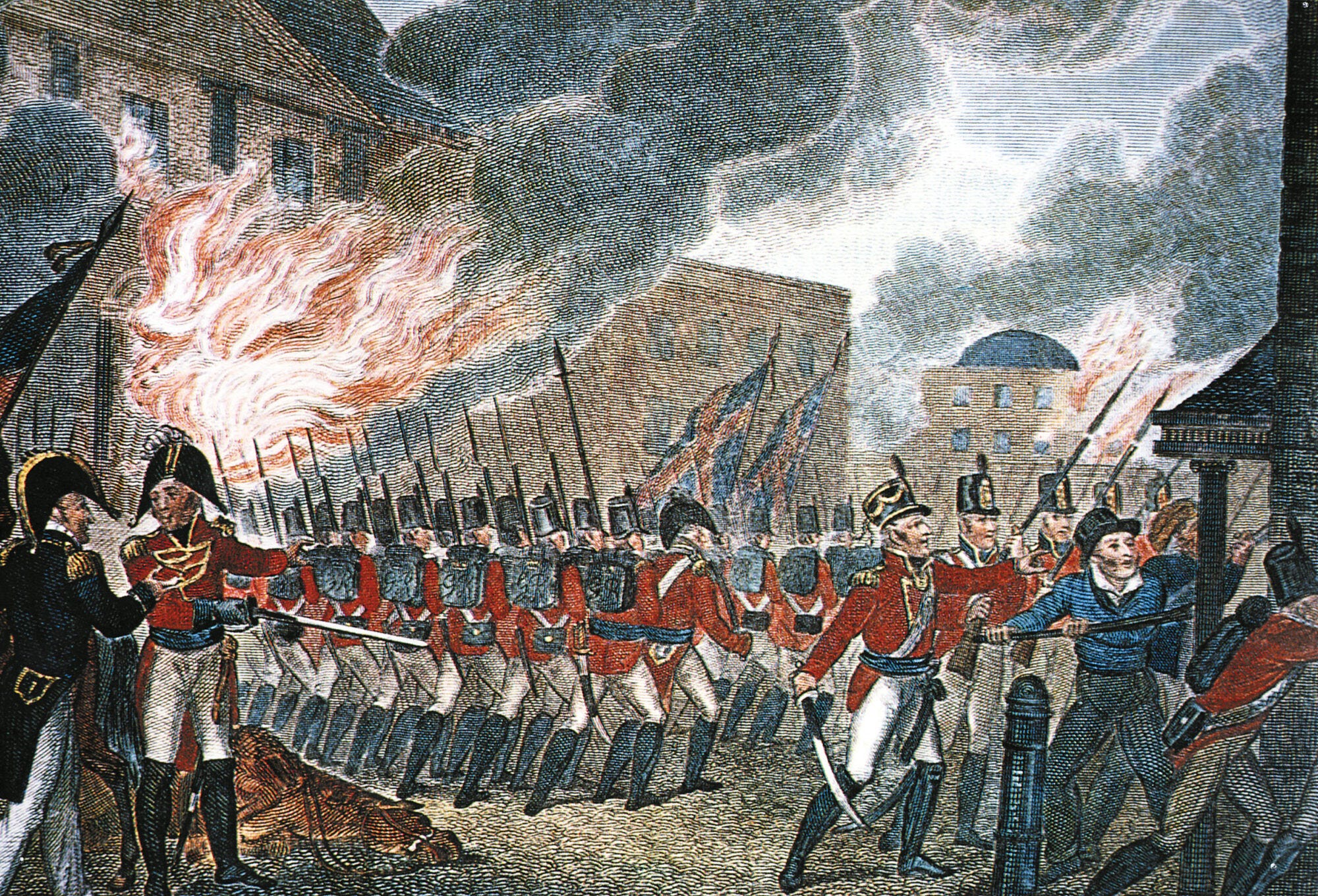
That Madison’s personal attributes were soft is no bad thing. Madison did not have Washington’s godlike status, or Jefferson’s flamboyance. One thing remains true today: there is room in our world for people of all personalities. We can all make unique contributions.
James Madison was a mystery in life and remains so in death. If we’re honest, we’ve probably heard more about his charismatic wife, Dolley. When the Madisons were in the White House, all of society was forced to admit it: Dolley was the life of the party. When it came to forming a strong nation, she had more to contribute than a pretty face.
A Tale of Two First Ladies
Like Martha Washington, Dolley Madison had been both married and widowed. These two women grieved their first husbands appropriately, then married again, as was the custom of the time.
It is unlikely that they suspected how influential their second husbands would be. It is also likely that these men had traces of that greatness in their personal bearing. Washington certainly would have, but we will never know, as Martha burned all of his letters from their time of courtship. Martha’s own story is a mystery; she often seemed to vanish in the shadow of her husband.
The truth is that the Washingtons loved and needed each other—and so did the Madisons.
Dolley Madison was born in North Carolina on May 20, 1768. She was born to Quaker parents. Though she would renounce her Quaker beliefs, they would shape many of her decisions with regards to politics and morality. Dolley’s first husband, John Todd, was a Philadelphia lawyer. The wedding took place on January 7, 1790, at a Quaker meeting house.
Unfortunately, their marriage did not last long. They were separated by fate, which took the form of the yellow fever epidemic. It was devastating, and it ravaged Philadelphia. The epidemic made Dolley into a young widow. Tragically, John Todd was not the only member of her family to fall to this scourge; this epidemic took one of Dolley’s two sons, as well as her mother-in-law and father-in-law.
In many ways, Dolley Madison and Martha Washington were similar: they both became widows at young ages, and both knew the grief of losing children. Martha Custis would go on to marry George Washington, who adopted her two surviving children. He would be a good stepfather to them, until their early deaths.
In a similar way, Dolley met James Madison in May of 1794. Forty-three year old Madison was a longstanding bachelor. Perhaps to improve his image as a sensible politician, he’d at last begun to think of taking a wife. Their courtship was brisk, and they were married on September 15, 1794.
Due to her choice to marry Madison, a nonmember, Dolley was cast from her Quaker community. Expelled from the Society of Friends, she began attending an Episcopal church, weathering this change with grace and cheer. Many such challenges would punctuate her life, but Dolley would surprise everybody by remaining kind and hopeful throughout. She would become the balance necessary for James during his political career.
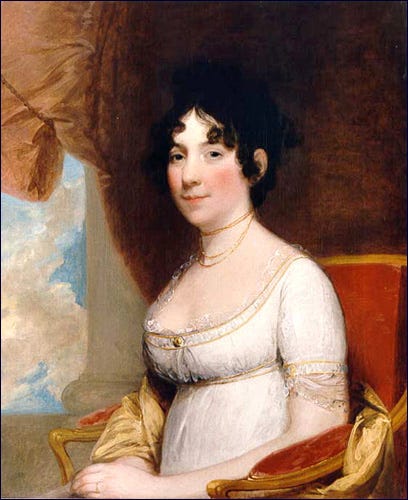
Dolley Madison might have lost her Quaker friends. She more than made up for them during her years in the White House. She was a skilled socialite, able to unite people who held differing political and world views.
A Matter of Portraits
During her White House years, Dolley Madison became a source of inspiration. Many artists wished to capture her likeness on canvas. In 1803, one of the painters to work with her was American artist Gilbert Stuart.
Stuart had previously built a name for himself. He was famous for having made portraits of revolutionary subjects such as George Washington, Thomas Jefferson, and John Adams.
In A Perfect Union by Catherine Allgor, the biographer describes Dolley’s reaction to Stuart’s renditions of herself and James:
In May 1804, Dolley reported to Anna that “Steward has taken an admirable picture of Mr. Madison-his & mine are finished.” Mischievously, she offered her review: “Quite pritty he has made us.”
Allgor describes the painting of the First Lady, offering details about the woman on the canvas:
Artistic convention determined several prominent elements of Stuart’s portrait of Dolley, from the classic three-quarter pose to the sweeping drapery and glimpse of sky in the background. Dolley adhered to another set of conventions as well. According to contemporary courtesy books, a firmly closed mouth differentiated the truly refined from the slack-jawed uncouth. Like Stuart’s most famous subject, George Washington, Dolley faces the viewer with a beautifully composed, compressed mouth.
Dolley faces the viewer—this assessment is accurate, because as the ‘Queen of Washington,’ she never failed to pay guests the attention that they craved. A niece of hers put it this way: We like ourselves better when we are near her.
Visiting the Queen of Washington
Dolley understood that politics could not be limited to war plans or grand speeches. In order to win the trust of the people, one must understand them—and make them feel important. For this reason, her regular parties at the White House became the place to be.
While a few people complained that Dolley’s events were costly and frivolous, objections were few. Even back then, it was natural for people to be curious about what life was like in the President’s house.
Dolley’s portrait captured her likeness, but it wasn’t her image that made her famous. As children, we are told about the portrait of George Washington that was on display at the White House. We’re told that Mrs. Madison rescued it from the attacking British during the War of 1812.
We have become fixated on this story—but why?
Perhaps it fascinates us because it’s the tale of a woman displaying courage. After all, the early wars are often taught as times when grandiose acts seemed dominated by men. I believe, also, that it enthralls us by telling us about Dolley herself. Her patriotism caused her to care for ‘smaller things.’ This attention to detail makes her act relatable to us.
On a human level, we can understand her attachment to things—like the portrait, or the silverware that she also rescued. Of course, we wish we weren’t material creatures—yet we love the tangible. Is it not likely that, if given prior notice of such an attack, we would try to save our valuables?
When asked about the portrait, Dolley offered an explanation:
“I acted thus because of my respect for General Washington—not that I felt a desire to gain laurels; but, should there be a merit in remaining an hour in danger of life and liberty to save the likeness of anything, the merit in this case belongs to me.”
In a situation of peril, would we not also hope to save special things—those that remind us of people we love?
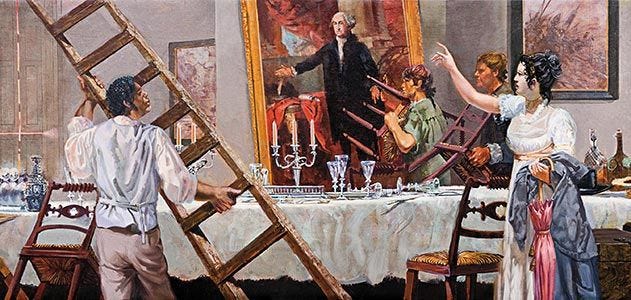
Allgor insists that Dolley’s legacy consists of more than the items she preserved. In her later years, Dolley was remembered for the warmth she displayed during her ‘drawing room’ meetings—events in which she made everyone feel better about themselves.
Remembering Dolley Today
There is a reason why Dolley Madison was called the “Queen of Washington.” As our nation formed its identity, she borrowed important characteristics from the government America had renounced:
Dolley adapted a form of the European royal levée. By calling [these events] drawing rooms, Dolley made them seem less continental, while still evoking a touch of the British gentry. … Initially, Dolley put a general note of invitation in the newspapers. The only qualification for attendance was the usual: that one have been “introduced” to the Madisons, either personally or through letters of introduction.
After finishing Catherine Allgor’s biography, I was glad to know we had a Dolley Madison. I understood that she had done more for our country than rescuing a painting.
Dolley could attract people who had no reason to be in the same room. She was a source of strength to her husband, whose life was made difficult by a taboo malady. When James died, Dolley faithfully sorted and published his writings, aware of the treasures they were.
Dolley Madison helped give the office of First Lady the form it has now. Many later Presidents’ wives would learn from her example. They also offered places for people to gather and discuss ideas. Though not often called queens, they knew the importance of making one’s guest feel special.
When James and, later, Dolley Madison died, the nation they had helped form had begun to change. Political parties started to crop up, new states were on the horizon, and growing pains rendered the union precarious. But the Madisons continued to defend what they worked for and believed in. They did not often debate about new ideas; however, they were happy to speak about what they achieved.
Their strength and dignity should serve as examples for us now. We should work for a stable world, making our choices with great care so that conflict won’t bowl us over. Whether we’re introverted like James or energetic Dolley, it does not matter! This world has need of both types of people.
Let us be what we are, and do our part well, so that society might continue to thrive.
Martha Washington, the First Founding Mother

We observe history from valuable angles by focusing on ladies who lived through it. Where did they stand during crucial events? How did changes affect them?
When I was in first grade (more than 3 decades ago), I remember coloring a picture of James and Dolly Madison running from a burning house holding several items, including pearls if I remember correctly. Not entirely historically accurate, but does get the point across for first graders lol.
I am loving these posts!