


Women who Painted Truth
Longtime followers of this blog know that Beatrix Potter is one of my literary and artistic heroines. She defied the expectations placed upon Victorian women, pursuing ambitious goals during a time when marriage and domesticity were treated as a woman’s highest calling. A precocious child fascinated by wildlife and biology, she started young: when her pets died, the child Beatrix dissected them to study their skeletons.
Later, she wrote the famous The Tale of Peter Rabbit books, becoming so involved in the publishing process that she even decided how large her chapbooks should be. She created what we would today call a brand, complete with toys related to her characters and special editions.
She did far more than that. She is best known for her cartoon rabbit in the blue jumper, yet her most impressive drawings were realistic: she collected unidentified fungi and illustrated them in marvelous detail.

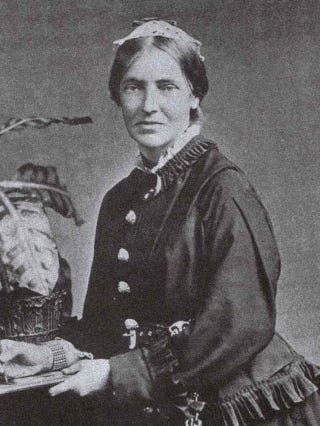
Beatrix Potter was not the only Victorian woman who chose to live a life that differed from what was expected of her. Marianne North’s passion for art led her to venture beyond boundaries set for women of her time—farther than Beatrix herself.
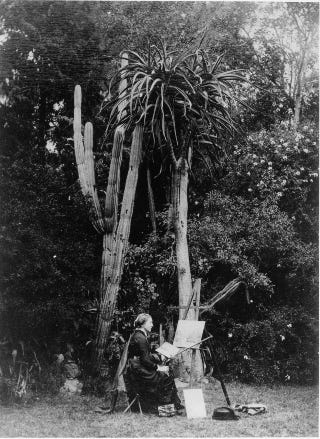
Marianne’s artistic pursuits carried her across five continents. She embarked on adventures that most ladies—and even gentlemen!—at the time would never attempt.
Abundant—Invisible—Beauty
I believe that more should be known about Marianne North.
Previously, I had known only her name and the fact that she was a talented artist. It felt like fate when I went to the thrift store a few months ago and found a book containing memoirs she had written about her travels: Abundant Beauty: The Adventurous Travels of Marianne North, Botanical Artist.
Abundant Beauty is a rather slim and battered volume, the sort of book that might sit unnoticed on a shelf for years had I not found it. I already possessed the faintest inkling of who Marianne North was, but did not know the lengths to which she had gone to create art. It bears markings indicating that it once belonged to the local library, though it had either been replaced or quietly discarded.
It is remarkable that both of these women put pen to paper, yet are not remembered for the full depth of their passions. Beatrix Potter was intelligent for reasons beyond Peter Rabbit, yet her name calls to mind the children’s section of the bookstore. Marianne North’s memoirs, unfortunately, are even less known. I might easily have overlooked that little volume. I might never have had a chance to read the observations she recorded during her adventures.
Travels with Father
The eldest of three children, Marianne North was born to Janet and Frederick North. They were a family of wealth and social standing, descended from a baron. Her father served as a Norfolk Deputy Lieutenant and Justice of the Peace, as well as the Liberal M.P. for Hastings. This privilege makes it even more remarkable that Marianne devoted her life to visiting countries where unfamiliar languages filled the air and the world felt entirely new.
Marianne did not begin her solo travels until her thirties because of a promise she made to her mother. On her deathbed in 1855, Janet North asked Marianne not to abandon her father. It was a promise she kept lovingly, for she and Frederick shared many interests. Together, they traveled the world, visiting places such as Egypt.
No doubt these excursions planted in Marianne’s heart a spirit of adventure that would guide the course of her life after Frederick’s death in 1869. The first journey she undertook alone was to India. Abundant Beauty: The Adventurous Travels of Marianne North, Botanical Artist begins with her memoirs of this excursion.
Marianne North, Travel Blogger
Not only was Marianne North an excellent artist, but she was also a talented writer.
As I read her memoirs during her tour of India, I felt as though I were sitting at the feet of a skilled and energetic storyteller. I often encountered passages so engaging that I could picture her seated across from me. I could imagine that we were sharing tea.
Marianne North did not write like a distant academic. She wrote like a woman in motion—curious, observant, amused, occasionally exasperated, and utterly alive to the world around her.

As I read her memoirs, I often forgot that more than a century separated us. Her descriptions are filled with color, climate, noise, exhaustion, delight, and danger. There is an immediacy to her writing that feels modern—as though she understood that travel was not merely about recording places, but about translating experience itself.
What Marianne Left Us
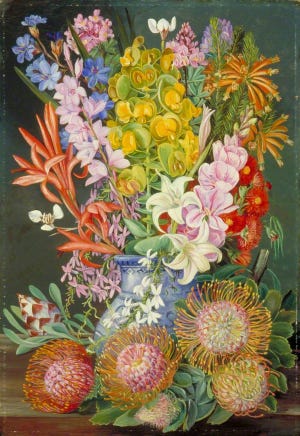
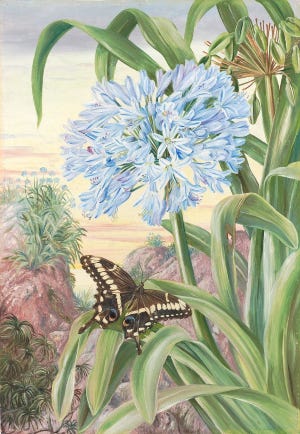
What makes Marianne North’s work remarkable is not merely that she traveled so widely, but that she painted what she saw with extraordinary precision.
Her paintings were neither decorative fantasies nor romanticized impressions. They were acts of attention. Each canvas represented hours of observation, patience, and study. In a sense, she was preserving not only plants, but moments of encounter between herself and the natural world.
When we examine the lives of men and women who lived long ago, it is tempting to conclude that they were very different from us.
Times have changed, we think. I could never take the risks she did; it is a different world.
It’s true that the world has changed since Victorian times. Today, photography offers us more detailed images of the tropical plants Marianne North captured with her paintbrush. At first glance, the photograph might seem superior to the painting.
But is it? Can we not value the digital image alongside the work created painstakingly by a human hand—the fruit of a studious mind devoted to learning such techniques?
We might also think there is no need to travel in order to learn. Television and the internet provide photographs, maps, and documentaries to keep us informed. Yet Marianne North experienced something through her travels that we can never encounter through a screen. She immersed herself in the sights, smells, altitude, cuisine, and even the dangers of the lands she visited.
What, then, can we learn from Marianne North? Travel may not be possible for everyone, but there is still joy in leaving one’s comfort zone. There is fulfillment in learning something new, plunging into it, taking the risks required by paying genuine attention.
To draw the same picture again and again until one has captured its soul—this, perhaps, is the true value of the journey.
The process itself matters most.
Conclusion
It is true that memories today are more quickly captured with the click of a camera. It is true that YouTube can offer us tours of lands far away—lands we might never have the chance to see in person.
We live in an era that brings everything closer, in a sense. However, we must not allow ourselves to lose the craving for adventure that propelled these women forward.
It may not be safe to cross jungles or mountains as Marianne North did. That does not mean we have lost the opportunity to take risks. We can choose curiosity over comfort. We can learn slowly, observe carefully, and allow ourselves to be changed by what we love.

YouTube and photography will never replace the sense of accomplishment that comes when, after weeks of practice, we finally play a song correctly, draw a picture, or complete a project.
Through our imaginations and the things we create, we can still explore.

I have never come across her before so thanks for the introduction - her paintings are beautiful!
Thank you so much for sharing about Marianne North. Women artists tend to be overshadowed by their male contemporaries, so it’s wonderful to bring attention to their work!