


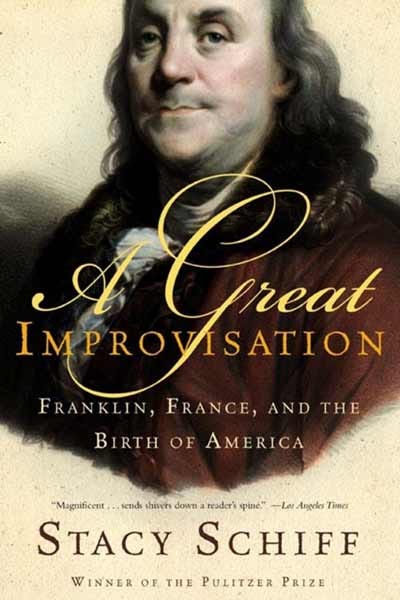
“In December 1776, a small boat delivered an old man to France.”
These are the opening words to a book called The Great Improvisation by Stacy Schiff. It tells the story of how an alliance with France, handled by an unlikely man, helped the American colonies win the war against Britain.
I had already known that France helped us during the War for Independence. Recently, I decided to read about how they did so and for how long. The alliance Schiff described always seemed rather flimsy, because everybody involved had their motives. By the time I finished reading, I was disconcerted by the twists and turns.
Schiff continues: “America was six months old, Franklin seventy years her senior. And the fate of that infant republic was, to a significant extent, in his hands.”
From our privileged place in the future, this seems like a time long long ago—but in a general sense, it was recent. Negotiating with France—what a great responsibility for a man of that age.
It did not help that so many people surrounding Franklin, even his compatriots, were anything but straightforward:
All births are messy, but America’s was a particularly untidy and improvisational affair. Even among its most eminent minds, there were diverging objectives where foreign affairs were concerned. Washington’s was to win the war without French troops. Adams’s was to win the war without a political attachment to France. Franklin’s was to win the war. … He was nowhere more dogged, or more stubbornly idealistic. As has been said of him, “politically he was an American before it was really possible to be one.”
Franklin himself was not predictable. He appears to have been one of those quiet people of whom we must be wary:
He [Franklin] could be negligent, manipulative, inconsistent, unmethodical, uncommunicative, vindictive, breathtakingly imprecise. Renowned for his overarching curiosity, he sought refuge in professions of ignorance. He set his colleagues’ teeth on edge.
Benjamin Franklin was not the first American sent to win French support. Before him, thirty-eight year old Silas Deane struggled to carve a place among aristocrats. Among other tasks, Deane had been dispatched on a shopping expedition. He was charged to obtain ‘clothing and munitions for an army of 25,000 men.’
Clothing and munitions were vital. Deane was advised that a ship of war would also be useful. He seems to have been given these tasks without a title to boast of. Instead, Deane was advised to pass discreetly, as an Indian trader.
It’s no wonder that Deane struggled. He did not yet know about the signing of the Declaration of Independence. It was a matter of timing; Deane arrived in Paris on July 7, 1776. Had the dates been shifted a bit, he might’ve had more confidence. Instead, he was groping about in the dark, with no clue as to what was happening at home. Even the post was being confiscated; it was nearly impossible to get a straight message from Congress.
After the signing of the Declaration, Franklin embarked for Paris. This eccentric man would have a title: He was named minister plenipotentiary, which is a ranking below ambassador but possessing power and authority to act on behalf of the country.
Franklin would be surrounded by all the right people. It might’ve helped that he was already famous for his scientific experiments. He had long dabbled in science, and was still fascinated by it when he arrived in Paris. The reputation preceded him, so he had admirers eager to show him around and show off.
There were several differences between Deane and Franklin. I think the most notable was that Franklin seemed at ease in a country different from his own.
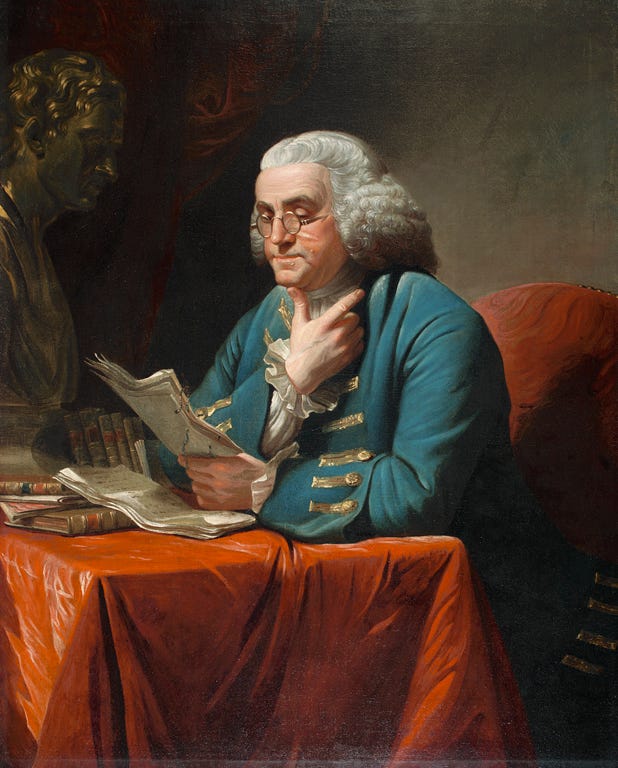
Franklin did not travel to France alone. With him were his son’s son, sixteen-year-old Temple Franklin, and his daughter’s seven-year-old, Benny. Their family relationship was rather complicated; I’ll write about it in a separate post. A Great Improvisation does go into detail about these young men. Reaching maturity in Europe, they grew to feel more European than American.
If you’ve been following this blog for a while, you know I’ve embarked on a quest to learn American history through the stories of the Presidents. It struck me that I could also learn through the story of Benjamin Franklin, though he was not a President. He played a pivotal role in the cause for independence.
Like Deane, he had been sent to negotiate with the French. He had a great responsibility, to persuade the French to send supplies and troops. If left to fight Britain alone until the end, the outcome might have been very different. Tired and ill, American soldiers were poorly prepared for continued conflict.
France’s assistance was not completely selfless—there was more than a small sense of competition against Britain—but it helped lead to victory. Learning of Franklin’s years in France would help understand the narrative.
Franklin had a peculiar way of making friends. Those surrounding him said he barely spoke French, but often acted like he did. He was able to exchange ideas with individuals such as the French aristocracy and even the King, who grew very fond of him. The French were so amused with Franklin, I got the impression that they treated him a bit like an awkward puppy—bemused by his way of being.
Rather than feeling insulted by this, he used it to his advantage.
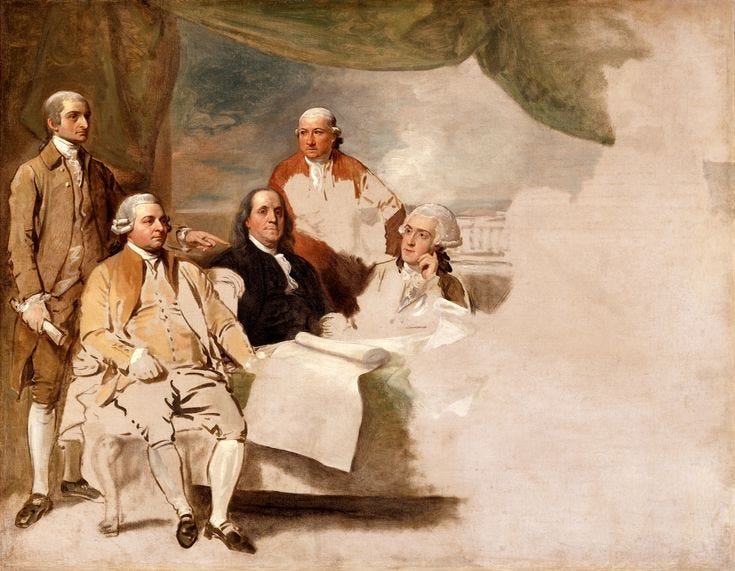
When John Adams went to join Franklin in France, he would not be so amused by this behavior. The compatriots would discover that they were not always well suited to carry out this crucial job together. Adams seemed envious of the French adulation of Franklin. For years afterward, he would complain that Franklin was unprofessional— among other, more heated things.
Regardless of Adams’ unhappy words, Franklin was a celebrity when he left France in 1785.
Some of Franklin’s popularity must have stemmed from his willingness to think differently. The world was beginning to explore new philosophies and sciences, topics in which Franklin excelled.
For example, on the matter of religion, he opined:
Every faith had in common five principles. A God had created and governed the world; he was to be worshipped; the best way of serving God was to do good among men; the soul was immortal; in the future if not in the present, vice would be punished and virtue rewarded.
Comparing sect and ritual to the wrapping of a standard French pastry-the pâtissier was just as likely to wrap his confection in red as in yellow paper, with a wool as with a flax string, none of which had any bearing on his goods—Franklin concluded that religious fundamentals were identical.
Stacy Schiff’s book, A Great Improvisation, spans from the start of the Revolutionary War to the Treaty of Paris. It is a well-researched book; however, I found it to be heavy reading.
I started in March and, being a fast reader, expected to have it finished within two weeks. This did not happen; I always hesitated even to reach for the book. I began to worry that I was the problem. Was this not an interesting, crucial topic in relation to my project? Why was I not wanting to read it?
After finishing the book, I still couldn’t say that I loved it. I went to Goodreads and checked reviews, where I discovered that I wasn’t the only person who struggled to get through Schiff’s writing. Other readers encountered similar trouble; they just managed to word it better than I.
The writing was too dense. I also had trouble with some of the language. Perhaps if I’d been reading on my kindle, I would have been able to look up words on the spot. Alas, I am lazy; it was frustrating to have to type up the tricky words. But it wasn’t just the words.
I remember reading certain paragraphs four times before I could grasp what Schiff was trying to say. She was using old words and trying to pack too much into three or four sentences.
I don’t consider myself to be a better writer. Still, I could think of ways in which to write those sentences so that they flowed better.
The dense writing was not so bad as to make me give up on the book. If a reader is patient, it tells a great story, including a great many details. I would like a book that discusses Franklin’s early years; A Great Improvisation is scant on information about the years that shaped this man. There are other books I can turn to for those things.
When Franklin returned to America as an elderly man, he might not have known that a revolution would soon break out in France. He might not have imagined that many of his friends would be killed. We can hope that he pictured those people alive and healthy, the way he had known them.
However, Franklin was clever. He might have sensed an emerging, revolutionary spirit in France. After all, in most other situations, he seemed two steps ahead of everyone else.
By the end of Franklin’s life, men who had mistrusted him also began to respect him. This was not exactly the case for John Adams, who continued to speak grudgingly of the manner in which Franklin represented their nascent nation. In the end, Adams seemed unable to forget his apparent hurt pride that, somehow, Franklin was more popular among the French.
In spite of Adams’ grousing, Franklin’s personality and mysterious strength exceeded all forms of slander. Centuries later, he is honored with the other Founding Fathers; without his interactions in France, we might not have won.
Benjamin Franklin, in his own way, played a part in changing history.
Have you read about Benjamin Franklin? What do you think about his ventures in Paris? I would love to hear your thoughts!
For Womanhood and Humanity: The Later Life of Julia Ward Howe

How long it seems since I last stopped in at Mariella’s! When I last spoke on Julia Ward Howe, we were up to our ears in snow and ice here in the Maine woods; now the lilacs bloom and the foxes carry dinner across the fields to their babes. How life changes in a moment!
https://open.substack.com/pub/thegrumpydoc/p/benjamin-franklin-from-reconciliation?r=55exjm&utm_medium=ios
I really enjoyed this! Great writing and very interesting.