


Exploring the Inner Landscape
May is here, and as the flowers begin dotting our landscapes with their calming colors, we begin to perceive changes taking place within ourselves. It is not only the flower beds that are beginning to show their abundance. I, too, am different.
It has long been my philosophy that, for a thing to be alive, it must be willing to change. A human must try new things, knock at different doors, in order to discover the full scope of what they are capable of. This year, I decided that I was not betraying the door of storytelling by trying another—I simply went and knocked at the door of the watercolor artist.
It was not a difficult decision to make. The desire has long existed in my heart to express myself with pencil and paint. As I have written before, 2026 has been my favorite year. At the age of thirty-two, I have at last begun to understand who I want to be—and the steps I must take to become her.
May and New Morning Routines
April was a month of learning. Having resolved that this would be the year I took initiative and learned to draw and paint, I began gathering art supplies. Like a little bird constructing her nest, I collected pencils, watercolors, three sketchbooks, and other small tools, placing them carefully into a basket.
Each morning, as I enjoy my first coffee of the day, I no longer lose time scrolling on my phone. Instead, I take out a sketchbook and begin to practice. I sketch simple boxes, interesting shapes—letting my mind express itself in a way both different from and deeply connected to the storytelling I have long dedicated myself to.
This year, I am not relying solely on YouTube tutorials to find my footing. April saw me attending my first pencil sketching class. The class itself was small—I was one of only two students that day—but I discovered something unexpected: the atmosphere of an art school is absolutely magical.
It is a place where people go to realize their potential. I can smell the paint and other mediums of creation in the air—indeed, I can almost believe I am smelling something like magic. It is a place where ideas gather, interact, and become.
I will return, this time joining a watercolor class. This is a kind of happiness I had not imagined before. If there is something you have always wanted to try but have not yet found the courage to pursue, I urge you to do so. It is worth the leap.
Novels that Sat with Me in April
In the month of April, I read several novels that gave me a great deal to think about.
For the sake of brevity, I will share three of them here—books that have earned a place on my Favorites shelf, and that I know I will return to.
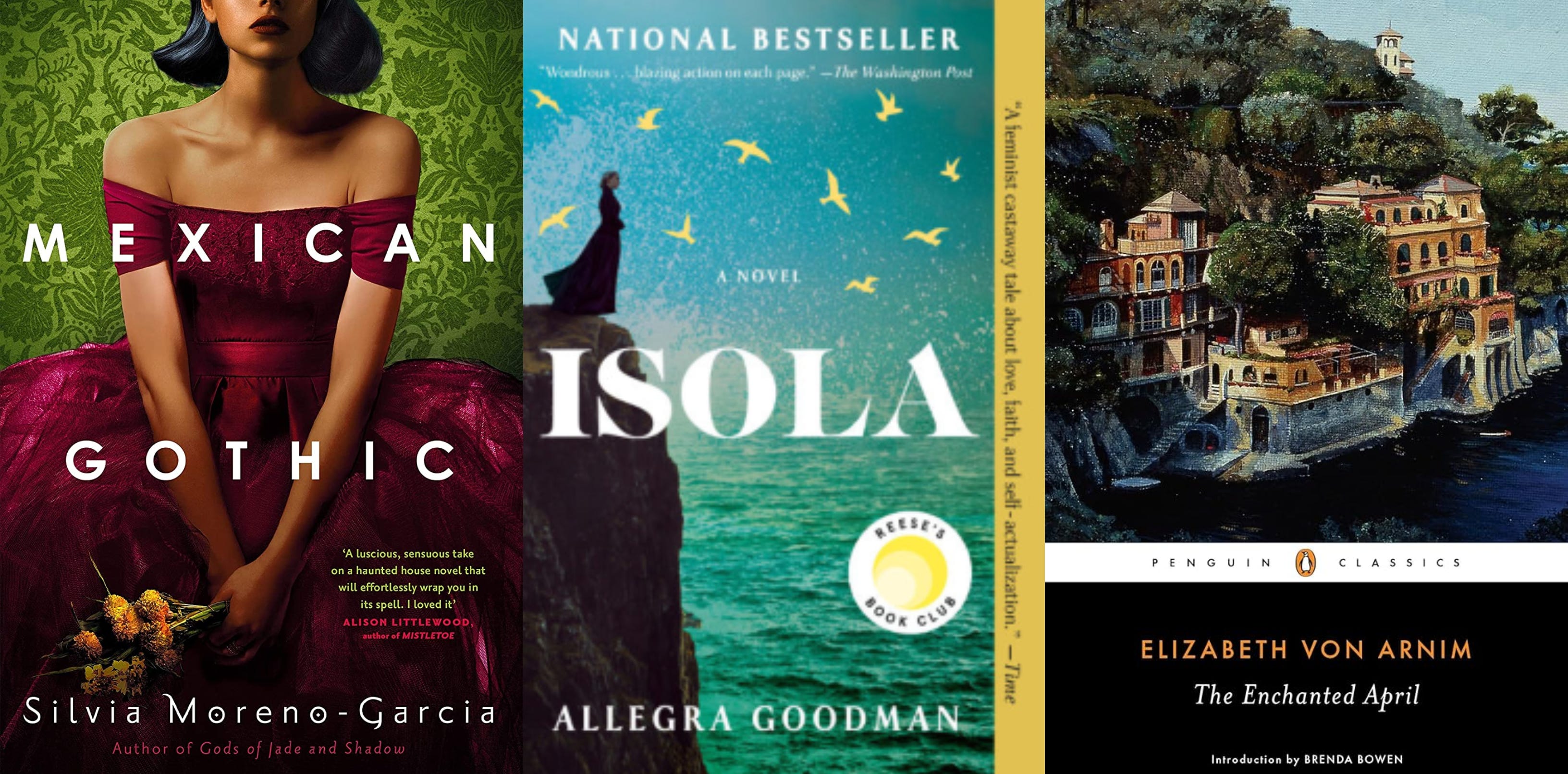
Isola by Allegra Goodman — I have written a full post about this powerful novel for the Tearoom Library. It is one of those rare books that so overwhelmed me with emotion that, at times, I had to pause to catch my breath.
Marguerite is a formidable protagonist who, born into comfort and then quickly cast into poverty, is forced by her guardian—a distant cousin—into a nightmarish situation no one should have to endure.
What struck me most was her transformation. You can feel the spoiled heiress gradually falling away as survival demands something stronger of her. She comes to understand that there is little satisfaction in idleness, and begins, piece by piece, to learn the skills required to sustain herself.
Most importantly, she comes to recognize her own value—and that it was never rooted in the family into which she was born, nor in any inheritance she might have received. Her worth lies instead in that inner reserve of strength which, even in the most frightening circumstances, does not abandon her.
Perhaps that is why the novel lingers: it reminds us that such strength exists, quietly, within us as well.
Mexican Gothic by Silvia Moreno-Garcia — If asked what I admired most about this novel, I would answer without hesitation: its atmosphere. The setting is not merely a backdrop, but something dense and immersive, pressing in on both the characters and the reader.
When Noemí is sent by her father to check on her cousin Catalina—newly married, and the author of a deeply unsettling letter—it is not immediately clear that she is suited to the task. She is bright, stylish, and accustomed to the ease of youth. Noemí has not yet been tested by real danger.
And yet, beneath that surface, there is intelligence and resolve. Her father persuades her to go by promising that he will allow her to pursue a university education upon her return. I found this detail moving—it is not duty alone, but the desire for learning, for purpose, that draws her into the unknown.
When Noemí arrives at her cousin’s new home, she senses almost at once that something is wrong. The house, marked by the long shadow of the surrounding mines, seems to hold more than history within its walls. There is a presence there—something ancient, patient, and deeply unsettling—woven into the structure of the place.
It is this slow, creeping realization that gives the novel its power: the sense that the house is not simply inhabited, but alive in a way that should not be possible.
The Enchanted April by Elizabeth von Arnim — I had long seen this title drifting through conversations as a favorite April read. This year, I finally decided to pick it up for myself, and I was pleasantly surprised by its gentle charm.
It tells the story of four women who, weary of their colorless lives in London, decide to rent an Italian château for the month of April. Each of them is seeking something that feels just out of reach—something that they believe can only be found elsewhere. Each longs to step away, if only briefly, from the pressures and disappointments of her life: husbands, expectations, or the quiet weight of having lived too carefully.
It is a pleasure to witness their interactions. The four women are markedly different, and yet the beauty of the château, along with the soft enchantment of the Italian landscape, gradually draws them toward one another. In that setting, they begin to soften, to open, to risk a kind of honesty that their ordinary lives have not allowed.
They come from different stations, shaped by different circumstances, and yet they are united in what they seek: a sense of fulfillment, a measure of peace, and a life that feels, at last, like their own.
Of course, April cannot last forever. They must each return home—to the very people and situations they had hoped to escape. And yet, it seems unlikely that they return unchanged. Something in them has shifted. Perhaps they carry back with them not answers, but a quiet courage—a willingness to shape their lives with greater intention.
We all pass through seasons in which our lives feel stalled, as though our time and talents are slipping past us. We may not be able to retreat to an Italian château for a month, but there are other ways enchantment finds us: in books, in small acts of attention, in the quiet turning inward that reminds us who we are.
And sometimes, that is enough to begin.
Conclusion
Taken together, these novels seem to speak to one another in quiet ways.
Each tells of a woman stepping beyond the life she thought she understood—whether into hardship, danger, or simply the unfamiliar—and discovering, in that crossing, something essential about herself.
Marguerite endures and becomes; Noemí perceives and resists; the women of April soften and begin again. Though their paths are very different, they share a common thread: the realization that a life does not remain fixed—it asks to be shaped, and sometimes reshaped, by courage, attention, and a willingness to step beyond what is known.
I find myself in a period of transition as I learn the crafts of drawing and painting. Perhaps that is why these stories stayed with me: I am not trapped in a sinister house, nor am I staying in an Italian château, yet I am still exploring a different landscape within myself.
Perhaps this is the greatest lesson I will take from the month of April: when there are no châteaux available to rent, and no means by which to do so, we still have art.
The small classroom, with its scent of paint in the air—so like the familiar comfort of a bookstore—suggests both escape and possibility. Books and art remain available to all of us, in one form or another. We are always being offered chances to see differently, to make something, to begin again.
And so the Tearoom continues, as all things do, through noticing, returning, and beginning again.
I loved Isola. It's almost a hard to believe story, but it was based on true events, which made it all the more compelling.