


Valued patrons of the Literary Ladies’ Tearoom, we have reached the end of October—and with it, we must offer the seat of authorly honor to a different guest, Louisa May Alcott, for November.
During that month, our book club will be reading Little Women. Elves are sweeping the tiled floor; faeries are hanging up all forms of garlands, storing away the decor of Halloween until next year. Because, yes, of course they’re real! They’re hard at work preparing to welcome the author of the March sisters.
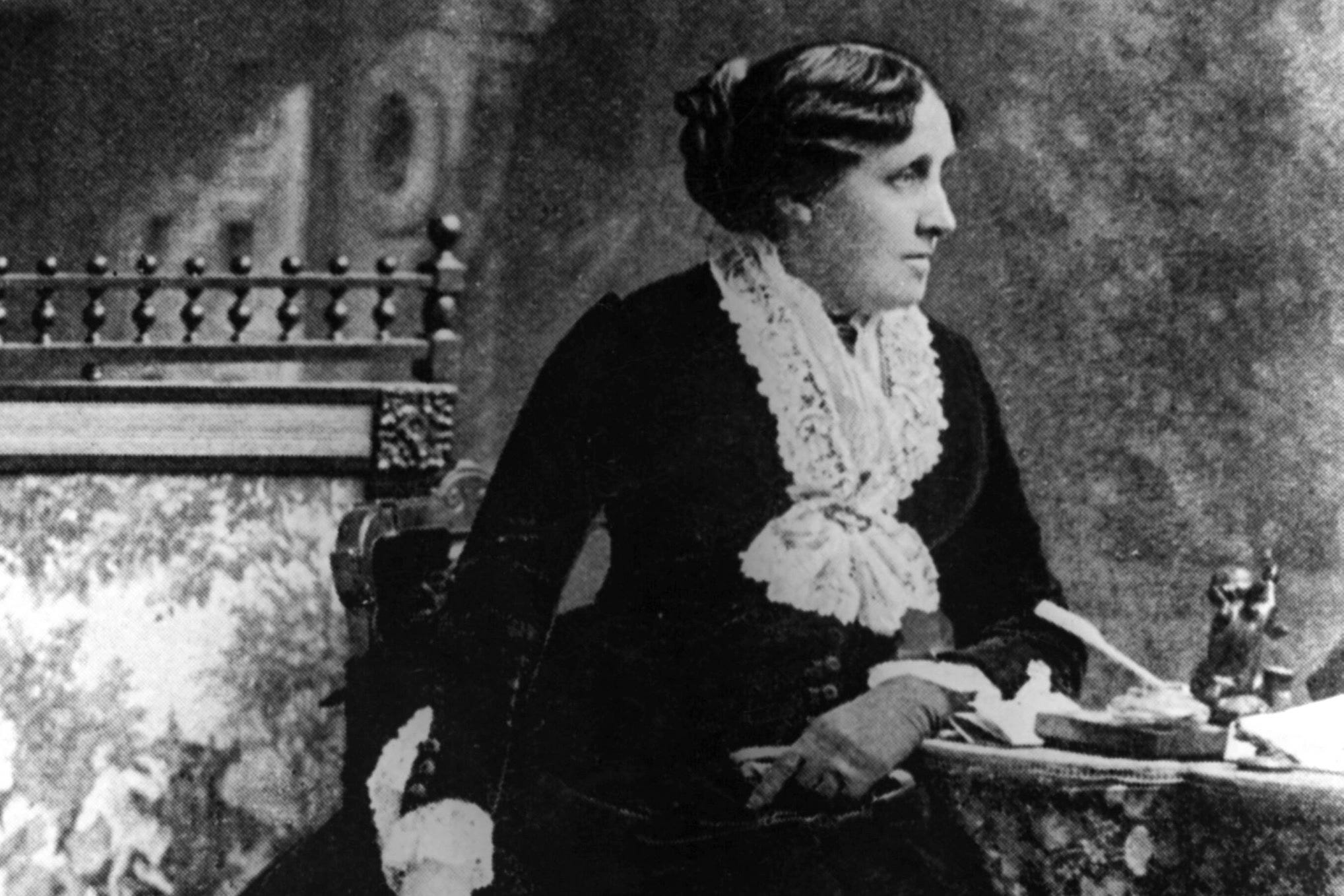
It’s been an emotional journey as I came to know Mary Shelley. There is much yet for me to discover about her; I have a copy of Romantic Outlaws by Charlotte Gordon, which I plan to read as a source for a proper essay later, much like my plans for an essay on Beatrix Potter.
As I am constantly saying, an author’s personal story is often more interesting than their novel (though Frankenstein, in its somber glory, well deserves the title of classic. That is a matter for a different blog post, which I will release later as a book review).
If this was an interview on television, I would be the gracious hostess, offering Mary Shelley my heartfelt thanks. For what, you ask?
I would thank her, firstly, for being fearless in writing Frankenstein and her other novels; for being bold and daring as she was in her lifetime; and I would concede that, while many of her choices were unconventional (and sometimes had dire consequences), she is a woman worthy of being called a hero.
To many, including myself, she is.
My previous Shelley post focused on the tragedy of the Shelley children. I cannot conclude Mary’s story without moving on to what might have been the greatest loss of her life: that of her husband, Percy, when he was only twenty-nine years old.
I think we have established, throughout the course of my month-long ‘interview,’ that Percy was prone to knee-jerk decisions. He would become fixated on an idea, following it until it bored him—or, in this case, killed him. He had decided that he longed for some excitement and took up sailing. During this time, he and Mary were living in Italy with their son, Percy Florence.
Perhaps Mary thought his fixation on sailing was another whim—or maybe she had a dark presentiment, the last time she spoke with him. We will never truly know, but her life was so full of tragedy and odd coincidences.
The last time Mary told Percy farewell, did she perceive that it would be the final time she’d see his face, in life…or in death?
Percy Shelley purchased a sailboat called the Don Juan and proceeded to immerse himself in his new hobby. He left on July 1, 1822 with a friend, Edward Williams, to Livorno. He had made plans to meet there with Lord Byron and Leigh Hunt (these two were not on the boat during the tragedy).
On July 8, 1822, Shelley sailed out of Livorno with two other passengers—just as a storm was coming in. If you would like a more complete account of the story, see this article.
That great storm caused the waters of the Gulf of Spezia to rise like one of the monsters he so often wrote of in poetry, and the Don Juan disappeared. Nothing was known of Percy or his friends for several days. Mary and the wives of the other missing men waited, their hearts pounding with fear.
To the horror of everybody involved, some days later, bodies began to wash up on shore.
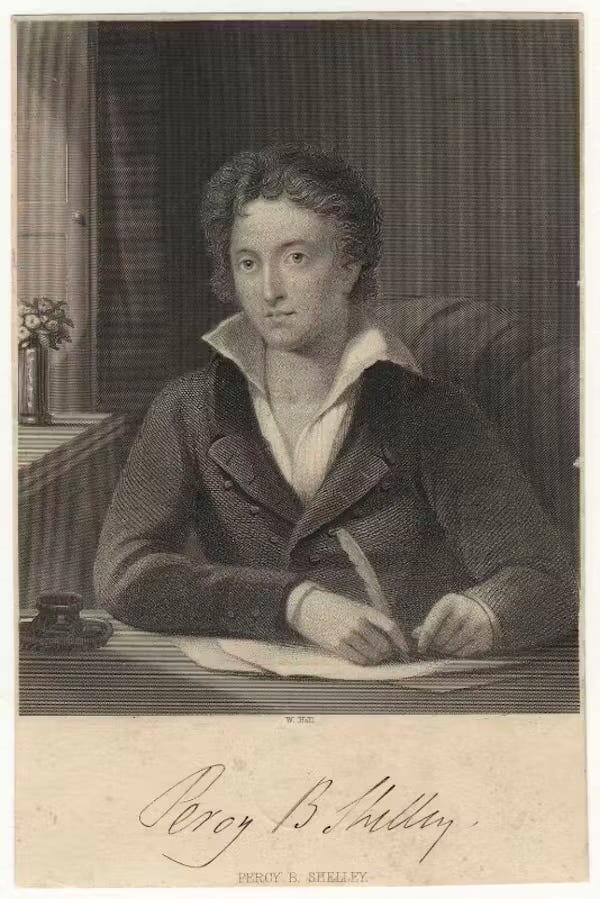
In a poetic twist, the bodies of his two friends were easily recognizable. Percy’s body, however, fared differently; when it washed up ashore at Viareggio days later, his features had been so destroyed that, according to reports, he was only identified because a copy of Keats’ Lamia was found in his jacket pocket.
The truth is, indeed, stranger than fiction: he had lived a life of verse, and it was verse that he took with him into the next life.
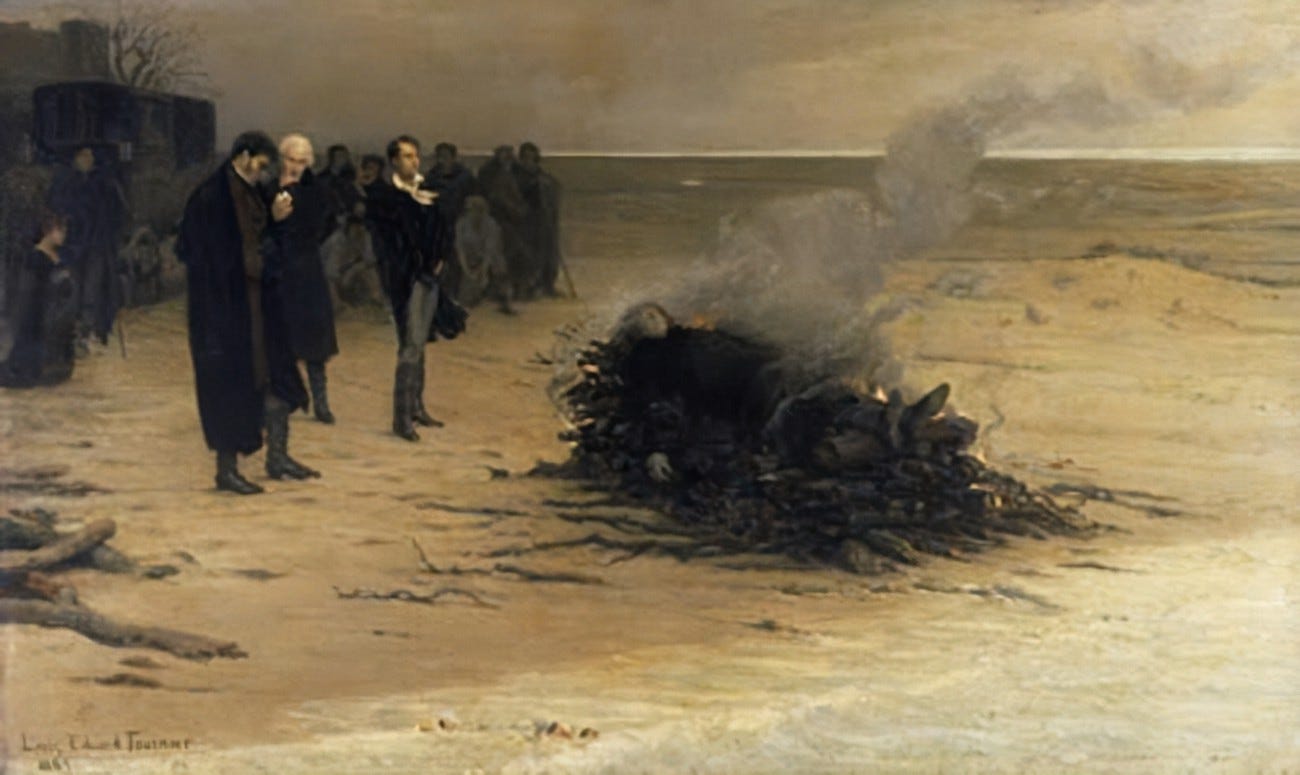
On August 16, Shelley’s body was cremated on the beach. Mary did not attend this ceremony, presumably crippled with grief. Her part in this tragedy wasn’t over, though; in yet another poetic twist, the fire did not destroy his heart.
His friend Williams tried to claim the late poet’s heart for his own, believing that Mary had become cold to her husband and did not deserve it. (Rumor had spread that they were no longer amorous as they had been at the start of their marriage—especially when Percy began seeing other women).
In spite of his infidelity, Mary continued to love her husband. It shouldn’t have been in dispute that this most sacred of organs should be hers for safekeeping. All the same, the quarrel continued until the sometimes-good Lord Byron interceded for her: Mary would keep her husband’s heart, and that was final.
Much could be said about him, but few dared argue with Lord Byron.
Mary took her husband’s charred heart, wrapped it in sheets of poetry, and kept it inside of a drawer until her own death in 1851.
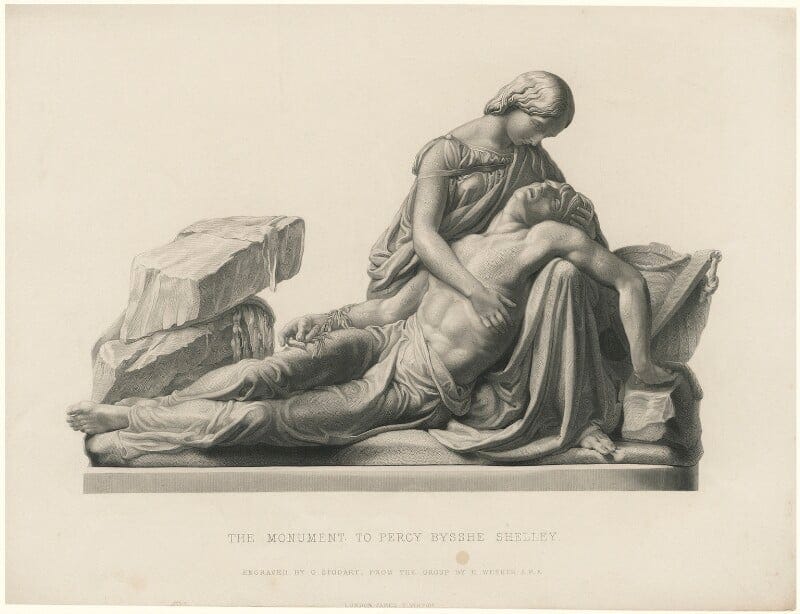
After this, it was buried with her at St. Pancras Old Church graveyard in London. There, Mary’s body and her husband’s heart rest together, though we all know that she is not gone. She lives on in her novels and in the hearts of each new generation to fall in love with her genius.
Mary lived a quiet life after Percy’s death. Never remarrying, she became preoccupied with the upbringing of her only surviving child. She endured humiliation from Percy’s father, baronet Sir Timothy Shelley. He sneered at her because of the way she and his son met. He blamed her for the way Percy’s marriage to Harriet had fallen apart.
In yet another bizarre twist of fate, Percy’s son with Harriet, Charles, died in 1826— struck by lightning during a rainstorm. (Coincidence?! THE TRUTH IS STRANGER THAN FICTION.) This made Mary’s son, Percy Florence, Sir Timothy’s heir. In this bitter manner, Sir Timothy was forced to interact with the two members of his family that he’d pretended, in the past, did not exist. While he continued to hold a grudge against Mary, he began to visit his grandson. We can assume that they bonded, eventually.
After the death of Sir Timothy, Percy Florence inherited the title and wealth. He married Jane Gibson in 1848, and she proved to be a loving, compassionate daughter-in-law. The three of them lived together comfortably; for the remainder of Mary’s life, Percy Florence gave her a place of importance and dignity. He, himself, lived an unexciting (compared to Mary’s, anyway) life, until he passed in 1889 at the age of seventy.
Mary’s legacy lives on, though Frankenstein overshadows her other works. Her other novels include Valperga (1823), The Last Man (1826), Perkin Warbeck (1830), Lodore (1835) and Faulkner (1837). All of her novels had to them an edge of impropriety for a woman; she was unafraid to address uncomfortable topics. One of her novels, Mathilda, hinted at incest; it was so taboo that it wasn’t published until 1959, years after her death. It is considered by many to contain ‘thinly-veiled character sketches’ of her father and Percy.
Her lighter works include travel novels and collections of Percy’s poetry, which she pieced together and edited. When she tired of writing novels and the stress that such projects required, she wrote biographies for periodicals. She especially delighted in writing articles about women. It shows that, though she was tired of the nomadic life, she remained a progressive at heart, believing that women ought to receive due credit for their achievements.
This is not the last time we will feature Mary Shelley in our seat of honor at the tea-table. While it is time to give Louisa May Alcott her chance to speak, much remains about Mary to be shared. She will be invited again, because I am interested in reading her other novels. I want to know about the stories that were overshadowed by Frankenstein’s monster.
For now, I imagine that Mary would be happy to curtsy and give another strong woman the chance to speak.
Once again, I invite you to join the Teacups and Tomes book club. This month, the read-through will be hosted by my lovely blogging buddy Hannah. We will begin reading Little Women and digging into Louisa’s story. Surely she has some tales to tell us about her own life, as well as the adventures of the March sisters!
If you wish to join us, click here. Our group is enthusiastic, cozy, and welcomes ladies and gentlemen. We begin on November 1. I, for one, am excited to learn about Louisa and how she came up with the tales of Meg, Jo, Beth and Amy. (I’ve recently seen the new film adaptation of Little Women; I know, I’m so late! If you’d like to read my thoughts on it, click here).
Perhaps you would like to read my Mary Shelley posts from the beginning, now that they are finished? Just in case, I will link below to the first one. Have a great week, and please comment with any critique/suggestions you might have regarding my posts. I love to hear feedback!
Mary Shelley: An Introduction & Her Dream

We have a new guest at Top of the Page this month! For, what else can I call it when a character knocks at the door, insisting to be let in? Insisting to be ‘interviewed’? Insisting that it is now her turn to be heard?
I've always wondered how I would react to my husband's death and after reading about Mary I cannot say what I would do. Maybe I would also take the heart?! Grief and pain created such intense feelings that can make one almost seem insane(or maybe actually becobecome mentally unwell). But part of me also also wants to ask, does it matter if authors were or were not mentally "stable" if their work was great? Edgar Allen Poe comes to mind! I sometimes wonder of some of the greatest works in history came about because of people on the edge, not in spite of it. And in a way I am happy that their suffering was redeemed and not wasted. And how much we should show gratitude and honor to those that went to the brink of existential crisis for us to be able to connect with our own hearts and feelings. 💔 Thanks Mariella!
Wow. What an incredible story.