


What makes a good leader? This question has been asked by deep thinkers for centuries.
The most memorable leaders, those we are fascinated by, tend to have traits in common, such as cunning, courage, and self-esteem.
Not all leaders are superhuman! A parent, a teacher, someone who is around when advice is needed—I consider all of these to be leaders. However, history has produced certain leaders that continue to come up in significant conversations. Their circumstances vary, their time periods as well; however, there was always something about them, an otherness.

When we read about them, we contemplate this otherness. Sometimes it is subtle, but in many cases, memorable people—those worth emulating—were faithful to belief systems.
We could be tempted to label this religion; however, not all of these people were religious in the traditional sense.
This was the case for George Washington, our first President. Though he was baptized an Anglican and raised in that denomination, it played a minor role in the career he was to take up. In fact, when war erupted against the British, he felt compelled to renounce the Anglican Church.
Whether or not he attended church in complete faith, Washington always made sure to behave in ways that ensured respectability. This began when he was a young man.
Truth in Every Place
As previously stated, Washington was not always devoted to the Anglican Church. After renouncing that branch of Christianity, he continued attending services in different denominations, such as Baptist and Methodist. He even crossed a line by worshiping with Catholics.
George Washington’s moral code might have had some root in religion, but that was not all of it. He was self-aware, sometimes to the point of paranoia.
Most people who met Washington considered him admirable. After all, his election as first President was nearly unanimous. That says a lot—after the Revolutionary War, it was difficult to get all of the states to agree on anything.
What was the moral code that guided Washington’s choices? There is a story from Washington’s youth that might shed light on it.
As a youth, Washington improved himself through books. He was determined to make something great of himself. He seems to have been influenced by rules listed in a guidebook of good behavior. It was called The Rules of Civility and Decent Behavior in Company and Conversation.
A compilation written in 1595 by Jesuit scholars, there is no doubt that this book contained Christian influence. However, I skimmed the text. It is not preachy. It is relatable today, helpful regardless of one’s belief system.
The Rules of Civility aims to help young men (and women!) establish personalities with honor and decorum.
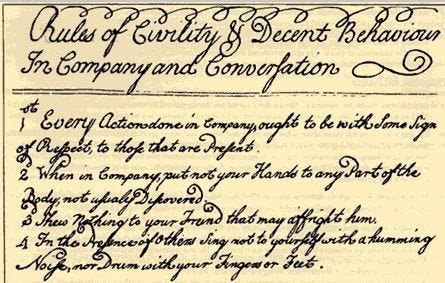
It is doubtful that George Washington took a sudden interest in Jesuit philosophy. Some historians suggest he used the words in this book to improve his penmanship. It makes sense—if you’re going to do a lot of handwriting, you might as well pick a text that’s worth the time.
Even so, the choice was fortuitous. Washington’s intention with those words might have been to improve his penmanship. Some of the guidelines will have rubbed off on him.
Shaping a General
It’s unlikely that George Washington transcribed so many guidelines without pondering them. Being a person of deep thought, he will have found several that resonated, while living a life full of challenges.
It’s almost certain that, when he was young, those words served as guides. Later, they were important tools to shape an ideal first President. The American Presidency was a brand-new role, laden with risks. One should not go into it without consulting other, wise people, for advice.
A description from David McCullough in his book 1776 reminded me of young Washington and his book of guidelines. McCullough wrote:
There was no hint of arrogance. “Amiable” and “modest” were words frequently used to describe him, and there was a softness in his eyes that people remembered. Yet he had a certain distance in manner that set him off from others.
“Be easy... but not too familiar,” he advised his officers, “lest subject yourself to a want of that respect, which is necessary to supp proper command.”
Be easy, but not too familiar. Several guidelines in the Jesuit book have a similar premises. They discourage imprudent trust and over-familiarity; they emphasize respect for one’s superiors and inferiors.
One guideline says:
Every action done when in company ought to be done with some sign of respect for those present.
Another offers caution:
When in the presence of others do not hum or sing to yourself or drum with your fingers or feet.
(Thomas Jefferson would have received poor marks for that one. He was always humming or singing to himself. He would burst into song when riding on horseback. Several accounts from family members and slaves evidence this).
Another guideline advises:
Show nothing to a friend that may frighten him.
(As a general in a terrifying war, Washington may have struggled with this one).
Washington the Studious Youth
Little is recorded about George Washington’s younger years. It is for that reason that I find this penmanship exercise so exciting.
If you add to those guidelines the philosophy and history books Washington read, a puzzle comes together. We understand that he created an image. The young man knew how he wished to be perceived by others.
Honor, after all, was the most important thing back then. It wasn’t unique to him; honor was a priority to every well-born man.
Washington was not given a classical education. He wasn’t taught foreign languages or law. These intellectual gaps brought him great insecurity, so that when he was elected President, he refused to leave the country. Since he did not know foreign languages, he refused the indignity of requiring a translator.
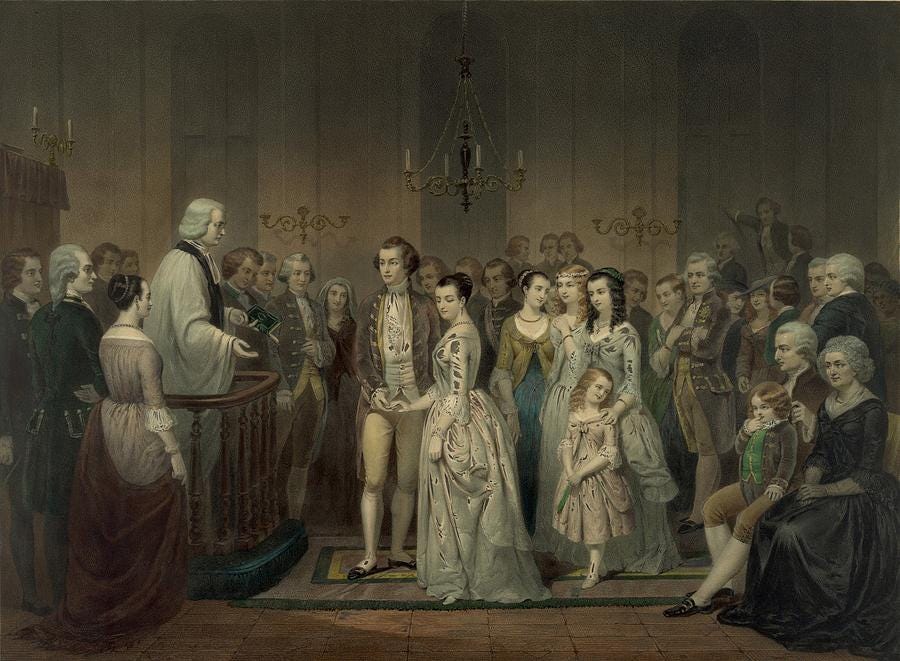
George Washington might not have had a classical education, but he was still impressive. Though he is said to have been somewhat awkward with ladies, he enjoyed dancing. His youth, furthermore, was not without flirtations.
Examples are recorded in His Excellency by Joseph J. Ellis:
There are pieces of adolescent doggerel about his “Poor Resistless Heart” pierced by “cupid’s feather’d Dart,” perhaps a reference to an unknown “Low land Beauty” that stirred his passions, perhaps a reference to his futile pursuit of Betsy Fauntleroy, a sixteen-year-old coquette who found him unacceptable. […] Later on women would swoon at his appearance, but at this early stage he struck them as awkward, even oafish, and paralyzingly shy.
Most people predicted that young George Washington would go places in life. It’s unlikely that they guessed the extent to which he would change the world.
Time would tell. To this day, we continue learning new things about him.
Everyone Breaks Down
Though known to be level-headed in crises, Washington was human. During the war, there were times in which he lost patience with his soldiers. They were ill-trained and in sore need of discipline.
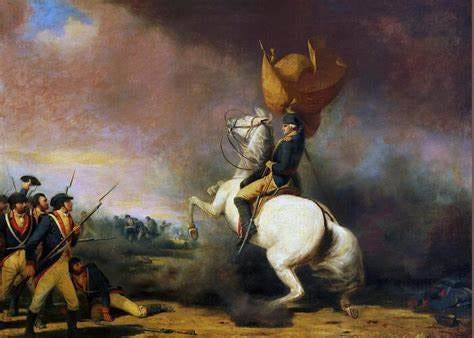
According to David McCullough, during the attack of the British at Kips Bay, he could not keep silent as he saw his men flee:
In a fury, he plunged his horse in among them, trying to stop them. Cursing violently, he lost control of himself. By some accounts, he brandished a cocked pistol. In other accounts, he drew his sword, threatening to run men through. “Take the walls!” he shouted. “Take the corn field!” When no one obeyed, he threw his hat on the ground, exclaiming in disgust, “Are these the men with which I am to defend America?”
He could also feel hurt. On one occasion, he accidentally discovered a letter written by General Lee to his comrade, Joseph Reed. Lee’s letter was in thanks to a missive Reed had sent, which appears to have been peppered with compliments for Lee. General Lee also agreed with criticism from Reed about Washington’s leadership during an ill-fated battle.
It would seem that Washington was not hurt by Reed’s criticism. He would later tell Reed that he was hurt “because the same sentiments were not communicated directly to myself.”
Washington was not afraid of criticism. He was a man who appreciated honesty.
Washington’s Secret
While extraordinary, Washington was human. Not all of his military decisions were successful.
I believe that his ability to learn and reemerge from ruin caused him to stand out. It’s the reason why we continue speaking about him to this day.
There were many times when the Revolutionary War seemed hopeless. Tired soldiers deserted or refused to reenlist. Fearing repercussions if America lost the war, townspeople began to renew their allegiance with Britain. The spirit of 1776 seemed to be slipping away.
Washington might have felt dispirited—but he did not quit. He would not quit. McCullough puts it best, at the end of 1776:
He was not a brilliant strategist or tactician, not a gifted orator, not an intellectual. At several crucial moments he had shown marked indecisiveness. He had made serious mistakes in judgment. But experience had been his great teacher from boyhood, and in this his greatest test, he learned steadily from experience. Above all, Washington never forgot what was at stake and he never gave up.
One does not need to be perfect, or religious, or have an exterior of steel, to be a great leader. It might be that, in order to establish a place in history, what’s needed is a willingness to improve.
Let us never tire of learning and improving. We are unlikely to become like George Washington, but we will live our lives well. We will rise to our feet each time we topple.
This is unique to the human spirit; this is greatness.
How the Post Office Created America

I have long been a fan of ‘snail mail,’ the practice of writing letters on paper. Using envelopes and stamps, we send tangible evidence of affection to family and friends. However, our mailboxes do not provide the same sort of thrill as in olden days; many approach it every day with a chagrin.
I love Rules of Civility--I have a copy on my desk as I'm writing this! Great read.
Thank you for showing his complexity! These are just a few of his little known facets, well done.