


I have been making delightful progress on my presidential reading challenge. In the beginning of July, it was time to do research on our fourth president, James Madison.
There are so many books about Washington, Jefferson, and Adams that I found myself caught in a rabbit hole. I delighted in learning as much about them as possible. In the process, I did notice that there are fewer books about James Madison. When the fourth president was mentioned, it was normally in the context of the making of the Constitution, or the War of 1812.
Madison tends to melt into the background when compared to the other Founders. This doesn’t mean that he was less significant: he helped to shape our country into what she is now. Well-read and studious, the Virginia-born lawyer helped construct a new political system, one he believed would serve as backbone for the new republic.
His ideas were so new that many of the other delegates at the Convention mistrusted them. This failed to sway him: he fought to achieve his vision, and while unable to pass all of the changes he had in mind, I still consider his contribution as having been a success.
There’s good reason why he is known today as the Father of the Constitution.
Madison the Introvert
The book I chose to read about him was James Madison by Lynne Cheney. She depicts a man very different from the other Founders, and this kept me turning pages.
Though introverted in ordinary settings, Madison was a gifted political orator. He did not often entertain guests in his Virginia home, Montpelier, and was happiest when immersed in books. Like many other men of his generation, he was self-educated.
However, James Madison did go to university at the start. At the age of sixteen, he began attending Princeton, where he studied beginning in 1769. During these years, he was one of the most devoted students, setting high standards for himself.
Cheney explains:
After receiving a promise from the faculty that if he did all the work of two years in one, he could graduate early, he began, as he described it, “an indiscreet experiment of the minimum of sleep and the maximum of application which the constitution would bear.” He managed to earn his degree, but with devastating effect on his health. A letter carried to Virginia by Dr. Witherspoon that told James senior of the health crisis is missing, but it is reasonable to suppose that it described the first of Madison’s “sudden attacks, somewhat resembling epilepsy.”
James Madison’s ‘Sudden Attacks’
Epilepsy—the word could destroy a person’s life in the 1700s.
Indeed, Madison began suffering attacks similar to epilepsy in childhood. They became worse when he went to school. This epilepsy would be a challenge to Madison throughout his life. He would reveal the truth about it only to people he trusted.
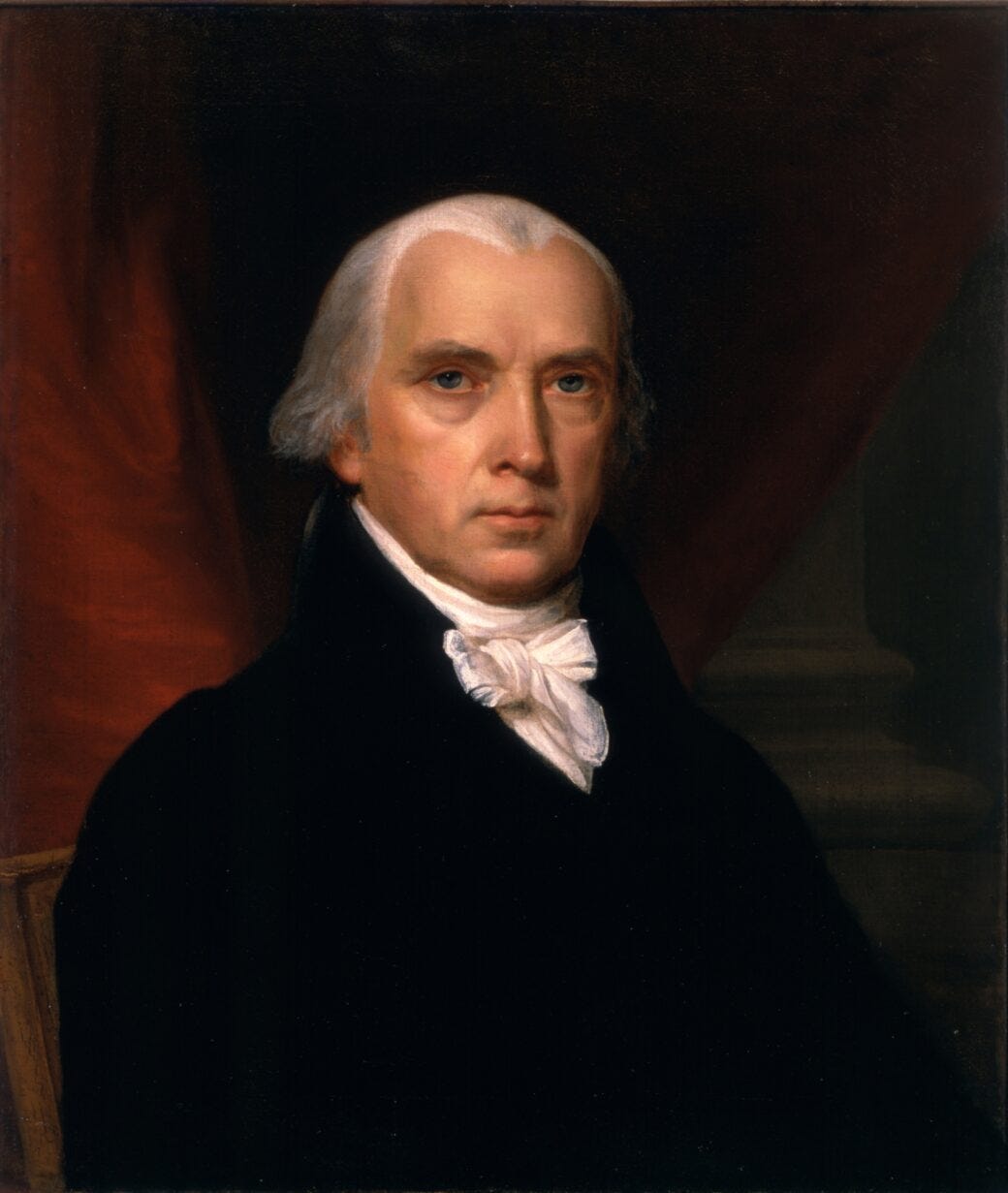
After Madison’s ‘sudden attacks’ at school became hard to conceal, his studying habits were questioned. A physician suggested that he was exasperating his condition by being an overachiever.
As a student, Madison deprived himself of sleep, poring over books of law and philosophy. Such exhaustion would make anyone stressed; today, it would be considered poor practice for mental health. Madison, with his epileptic episodes, would suffer a different sort of exhaustion.
In Madison’s lifetime, those who suffered from it were often cut off from society. Theories surfaced attempting to explain the ailment. While those theories seem ludicrous to us now, hundreds of years ago, they were taken seriously.
Lynne Cheney explained how significant names in Christianity influenced this negative view:
In the Christian era the idea of a supernatural origin arose again, almost entirely because of the story of the epileptic boy. An early church father, Origen, after analyzing the passage in Matthew, concluded that epilepsy “is obviously brought about by an unclean dumb and deaf spirit.”
Such ideas survived long after the time of Origen, so that they could be found in various religious and medical texts. These were books Madison could have been able to find during his years of study.
In a book published in 1729, the respected physician Jonathan Harle wrote, “That there were some actually possessed by the devil is a truth as plain as words can make it: ‘Tis true in one place a person is said to have a devil and be mad, and another to be a demoniac, and yet is called a lunatic, or one troubled with the falling sickness. If we take in both texts, we have the full meaning, which is, that the madness and epilepsy these people labored under were caused by the devil.”
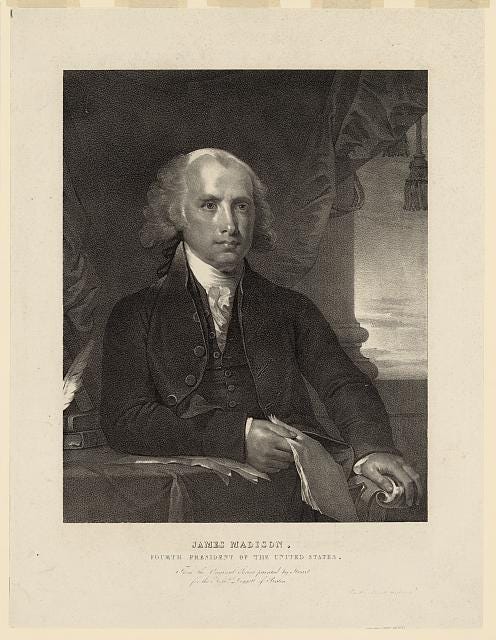
Dreams Stolen by Epilepsy
Superstition surrounded the condition. An old wives’ tale claimed that if a woman, when pregnant, witnessed an epileptic fit, the child would be born with the malady. A diagnosis of epilepsy, if discovered, could result in ostracization.
It’s no wonder that, when James Madison reached the age of reason, he made a choice. His conscience would not let him adhere to a belief system which said that God created him to be condemned. He would become a passionate advocate for separation of church and state, believing that ‘mental slavery’ should be done away with.
Some people with epilepsy did not suffer in quite the same manner. An example is George Washington’s stepdaughter, Patsy Custis, who experienced seizures since she was a child. Washington, who took good care of his stepchildren, spent great amounts of time and money searching for a cure. In spite of the high status of her stepfather, Patsy was never locked away. She enjoyed a social life and had many friends. Even her fortune would run out; epilepsy cause her death when she was sixteen years old.
In the case of James Madison, epilepsy reflected differently on his life—largely because he sought a public, political career. His condition made it difficult to form connections. Epilepsy would be the reason why he dropped out of Princeton. During the Revolution, he attempted to enlist in the Army during the Revolution, but was soon forced to abandon that dream, as well.
Some believe that Madison’s first marriage engagement suffered because of it. He had fallen for Catherine ‘Kitty’ Floyd, the daughter of another signer of the Declaration of Independence. Excitement shone through in their letters, but just before they were to begin planning a wedding, their ‘agreement’ came to a sudden end.
A probable theory is that Madison decided to reveal his condition to Kitty. Her rejection would wound him deeply. Sadly, the taboo subject of epilepsy could sever the strongest of ties.
One tie, however, was not threatened by Madison’s epilepsy.
Madison and Jefferson
James Madison and Thomas Jefferson would meet during the time of the Continental Congress. The two men became fast friends.
Jefferson, too, was an introvert with a passion for politics and philosophy. He, also, had a tragic life—his wife, whom he adored, had died and left him with three daughters. After Martha Jefferson’s death, Thomas became so despondent that his friends worried he’d given up on life.
Jefferson’s health was also troubled. He’d suffered from severe migraines that often kept him at home for days. In addition, he would have frequent stomach problems—some believe it was dysentery that he attempted to treat himself.
Jefferson and Madison spoke openly to one another about their health struggles. Some of their existing letters read like missives exchanged by brothers.
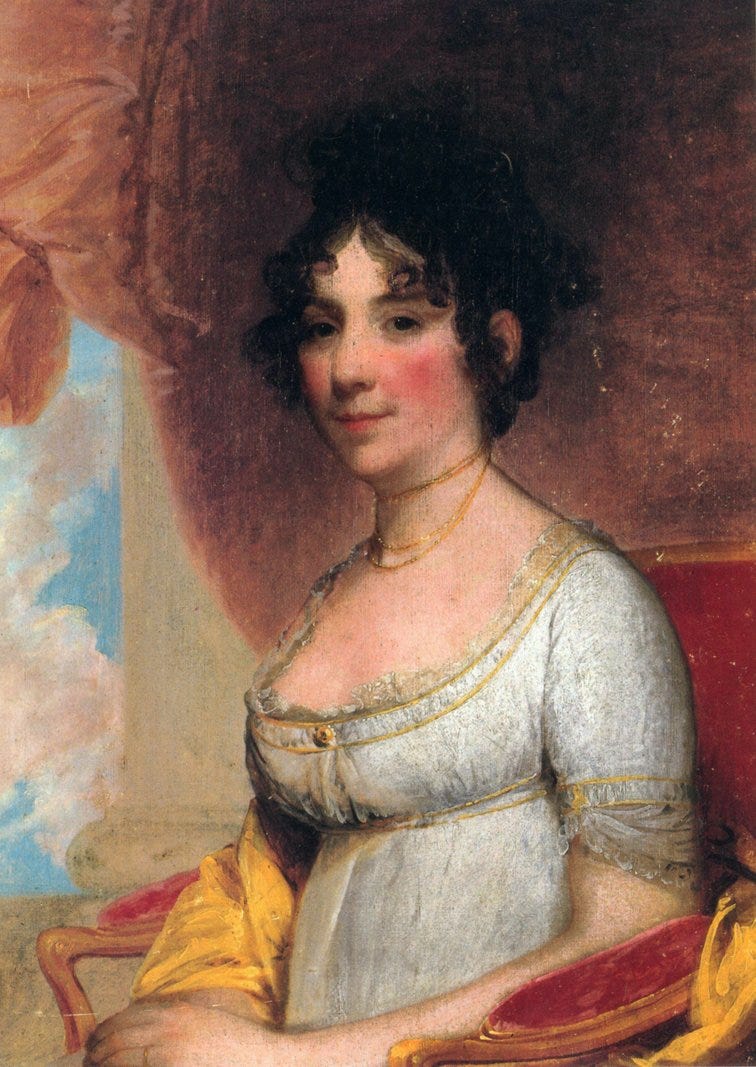
After Thomas Jefferson’s death, this bond would survive.
Jefferson asked Madison to ‘take care of me after death,’ meaning to preserve his reputation when he could no longer speak for himself. An opportunity would arise when secessionists attempted to twist Jefferson’s words in their favor. Madison rebutted them promptly. No one knew his late best friend better than him, and Jefferson would have been horrified to see how his writing was being used.
Read more about the Madison-Jefferson friendship here:
Friendships of the Founding Fathers

Many of the most striking events in human history are stories of relationships.
Madison’s Legacy
During the War of 1812, James Madison proved he was not only a talented philosopher, but he could also guide the nation through her first post-Revolution struggle. It was under Madison that the army began to fight in unison, defending one cause. They became more confident with every victory.
The British managed to burn down the White House. In spite of this devastating blow, American victory was achieved. The people of the new republic finally understood that they were a force worth reckoning with.
Directly after the Revolution, America seemed to be an experiment likely to fail. This war caused a surge of patriotism. It was during this war that Francis Scott Key famously penned the verses which would later become our National Anthem, the Star-Spangled Banner.
Madison’s wife, Dolley, displayed her own courage during this war. The famous incident with the George Washington portrait has made her one of the most popular women in early American history. I will be reading a book about her soon, and I’ll enjoy writing posts about yet another First Lady.
I am excited to learn more about the War of 1812 and the figures who played important roles in it.
Truly, this historical reading challenge has been one of the most fulfilling things I’ve ever decided to do. If you’re on the fence, I suggest that you give it a try!
The Scholar-Soldiers: Academic Life During the Revolutionary War

The cobblestone paths of Harvard Yard witnessed scenes that would have seemed unimaginable just decades earlier: students drilling with muskets between Latin recitations, professors debating not merely Aristotelian politics but the urgent practicalities of rebellion, and young scholars departing their studies to join Continental forces with volumes of P…
It sounds like you enjoyed this biography. I like this mix of personal reflection, quotes and images. It must take a lot of work but it makes for a much better piece. But I think you may want to double check the dates he attended College.
I’ll bet most people read Substack on their phones. And you have a great eye for how long each element should be and when to vary them for those readers.
What a wonderful post—thank you for this thoughtful take on Madison. I went in a different direction this morning, looking at how first-person interpretation brings him to life through performance and place.
Take a look at my latest post:
➡️ From Saratoga to Philadelphia: Kyle Jenks and the First-Person Revolution
https://open.substack.com/pub/seanpatrickkelleher/p/from-saratoga-to-philadelphia-kyle?r=4s7x39&utm_campaign=post&utm_medium=web&showWelcomeOnShare=true
It’s part performance, part public history, and 100% heritage tourism—Madison as you’ve never experienced him before.
Apparently, the fourth president is having a moment—and I’m here for it!