


To those of us alive in in this century, with the privileges of advanced technology and study of the past, ancient tragedies can slide off of us like fairy tales. Most don’t frighten us, since we better understand how things work. Events that shaped society into what it is now can feel distant from reality. We can forget that they did strike fear into our ancestors.
History books tend to gloss over what it was like to be afraid. This includes natural disasters. We might read about how the weather affected famous battles, or how a ship sank during a storm. Seldom does unusual weather affect everyone; the Little Ice Age was a fascinating period in which people feared what they didn’t understand. This unusual climate was felt by almost everyone on the planet.
The Little Ice Age began in the fourteenth century, stretching on until the mid-nineteenth. I’ve read snatches about it in articles, and was intrigued by the idea. It was, therefore, exciting when I discovered that author Philipp Blom wrote a book about it.
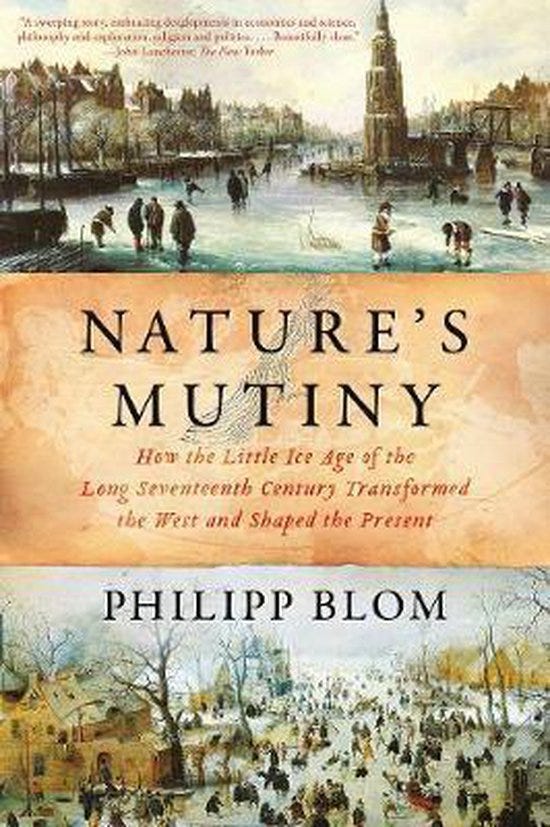
Blom’s book is called Nature’s Mutiny: How the Little Ice Age of the Long Seventeenth Century Transformed the West and Shaped the Present. It does not talk only about the weather, though Blom spends time explaining theories offered by modern science to explain those cold days. It’s unlikely that we will ever know for sure. However, research continues; the theories offer satisfying insight.
A Storm of Divine Wrath
Blom’s book describes the lives of people who experienced the worst of these odd years. Rich or poor, it was not possible to escape the Little Ice Age, because the chill made farming a gamble, causing food prices to skyrocket.
He also writes about how society changed: At the start of this crisis, most people interpreted it as a sign of divine anger. Different religions used unique traditions to fast, perform sacrifices, and do penance. Some even attempted to perform exorcisms, hoping their divine being would be pleased and restore sunlight.
Those who could write often filled diaries with fears and concerns. An excerpt from the diary of a Protestant pastor offers poignant perspective. During the 1590s, he wrote:
The lights and windows in the vault of the heavens often grow dark and will no longer shine and shed light on the world’s larceny / and they are longing with us for our salvation. And as the windows in an old house grow dark / and the face on a body that has lived too much / so the old and cold world also / declines visibly / the sun / the moon / and other stars / shine / less brightly than before / there is no true and lasting sunshine / no steady winter and summer / fruits and things growing from the earth no longer ripen as well / or are as healthy as they most likely used to be. Nature itself seemed to be turning against humanity: Nowadays, at the end of the world, one expensive year follows another without cease / and there is not only a great scarcity of bread, and very dear prices for our beloved corn and grain / but everything / from the smallest to the largest / which is needed for keeping house and for sustaining life / has come to the dearest penny / and has risen in the extreme.
Gradually, humans adapted to these changes. They learned new farming methods in hopes of ensuring that something would grow. They began trading with other countries. In midst of this progress began an Age of Enlightenment. There also came a change among people of the lower class: A new pursuit of literacy and education.
All of this began to take place, to the dismay of the clergy and titled. Until that point, clergy and the wealthy were the only groups expected to read. With this development, a new middle class began to surface.
Literacy helped common people to shake one of the greatest barriers separating them from the privileged.
As ordinary citizens began to write books of their own, the elite went into a panic. English printers published some two thousand pamphlets in 1641 alone. A concerned observer wrote in 1657:
The English since the Reformation are so much given to Literature, that all sorts are generally the most knowing people in the World. They have been so much addicted to Writing, and especially in their own Language, and with so much licence or connivance, that according to the observation of a Learned Man, there have been during our late Troubles and Confusions, more good and more bad Books printed and published in the English Tongue, than in all the vulgar Languages of Europe.
They condemned and banned books they did not like. Most horrifying was the dangerous idea, put forth by philosophers, that perhaps there was no God. Such ideas could end in the authors’ execution, so they were typically written in pages of politically correct “fluff” that could throw people off. In this way, many fended off persecution.
Such “fluff” did not always help; many of these bold thinkers were imprisoned, exiled, and tortured to death.
Art of an Endless Winter
The Little Ice Age inspired poignant pieces of art. These works depicted landscapes that we could not imagine today. Using skillful brushstrokes, artists captured a world that had become unbearably cold.
This world struggled to sustain life. In this world, the instinct for survival forced communities to become creative. They sought alternatives to their former lifestyles. As just one example, vineyards had to be relocated by hundreds of miles, to places sunny enough that fruit would be produced.
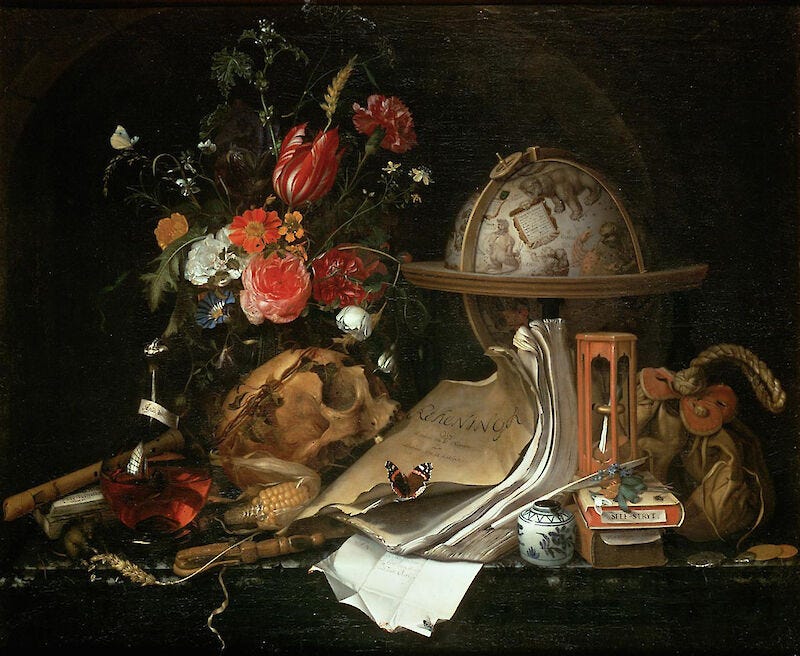
Among artists who used their skill to capture this challenging time was Maria van Oosterwijck (1630–1693), one of the few successful female painters of her time. I shared one of her still-life paintings earler in this article. Her still-lifes placed heavy emphasis on the theme of earthly transience.
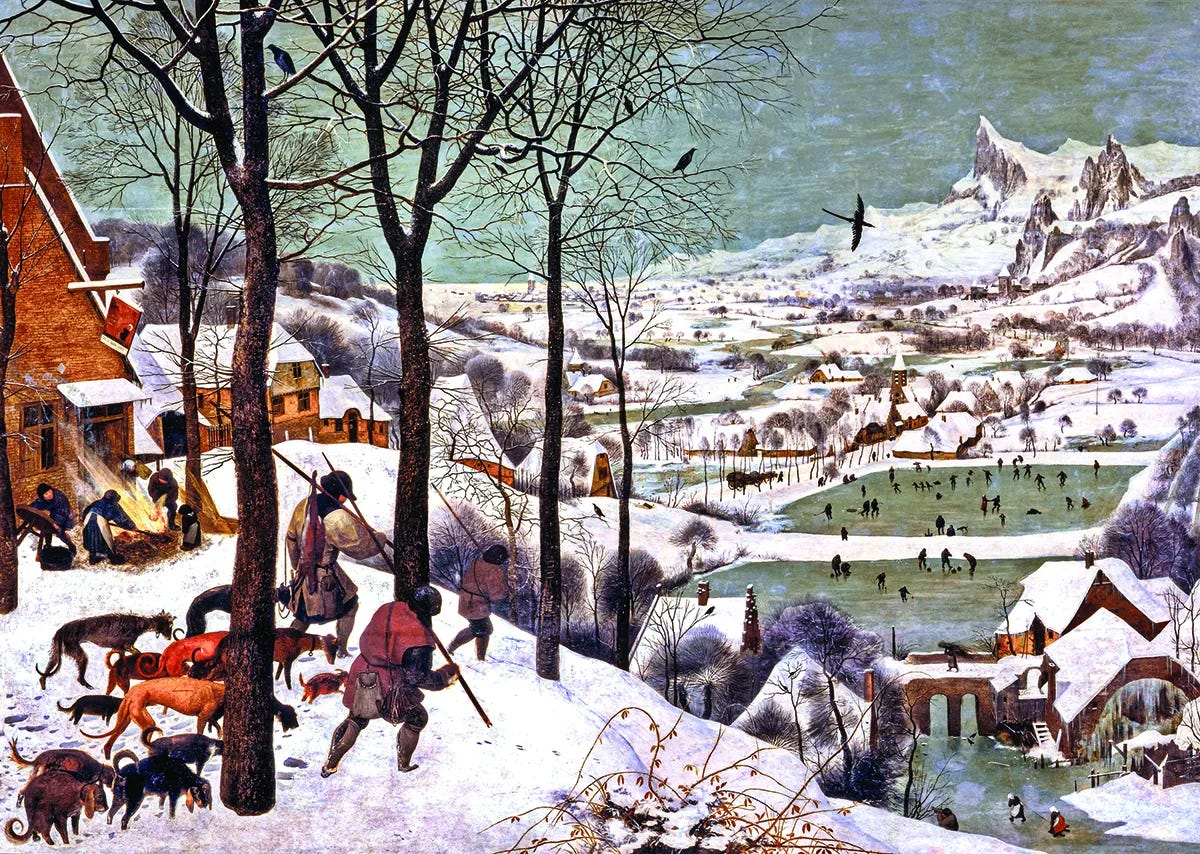
Another artist, Pieter Brugel, produced a piece called Hunters in the Snow. According to Nature’s Mutiny, Bruegel’s work evokes the inhospitable harshness of the season:
The Hunters was painted as part of a cycle of the seasons, an artistic convention that reached back into the Middle Ages. There are little winter landscapes in the famous Très riches heures du duc de Berry (1412–1416), but always as part of a seasonal cycle, indicating that spring would always arrive after the bitter cold of the dark winter. Now, however, winter landscapes established themselves as a genre in their own right, and this even invaded other themes.
Humans find ways to survive. The Little Ice Age is an example of how mankind responds to nature’s mercurial changes, even finding creative ways to make the best of it.
Between 1608 and 1814, the sudden drop in temperature caused the Thames River in England to freeze up. This led to popular festivals on the ice called Frost Fairs. At these fairs, visitors could enjoy games, feasting, even pop-up pubs.
Blazes and Dark Omens
The unpredictable nature of the Little Ice Age also gave way to fearsome tragedies. One of the most famous is the Great Fire of London, which took place in September of 1666. The blaze spread over the streets of Medieval London, and by the time it was put out, nearly 100,000 people were homeless. Paintings exist depicting this blaze; one cannot contemplate them without imagining the great fear that the victims must have felt.
Then, to make matters worse, in 1680 a comet came flashing in the sky above Europe. It is not surprising that those watching it began to fear that the world would soon end. One witness wrote about the comet:
I tremble when I recall the terrible appearance it had on Saturday evening in the sky, when it was observed by everybody with inexpressible astonishment. It seemed as though the heavens were burning or as if the very air were on fire.
In spite of the new interest growing around science and astronomy, life had become difficult. Even the most intelligent people could not help but wonder if this streak of fire might be a sign of God’s disfavor. Today, we know this comet as Kirch’s Comet or Newton’s Comet.
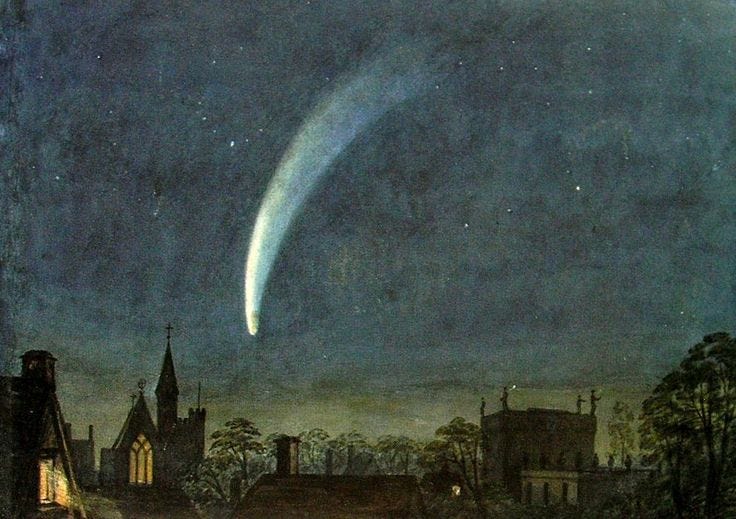
If it were to appear in the heavens today, we would watch the spectacle with awe and wonder. Today, we understand what comets and why they make their rounds. In 1680, it was another unusual sight to frighten people who were struggling to survive. It’s fascinating to think of how our perspectives have changed.
The truth is that there will always be a human instinct to believe in something else being the reason, be it a comet or simple bad luck. We might not perform sacrifices like they did then. Still, it seems to me that the temptation for superstition will always exist.
Conclusion
The Little Ice Age affected nearly every creature that lived. Today we face climate change, but it is different. We know more about it; we are knowledgeable enough to understand that it is not being caused by an angry deity.
Is it possible that we could make the necessary changes to save our planet before it is too late? While difficult, I choose to be optimistic. If we could all make the choices available to us, a change could take place.
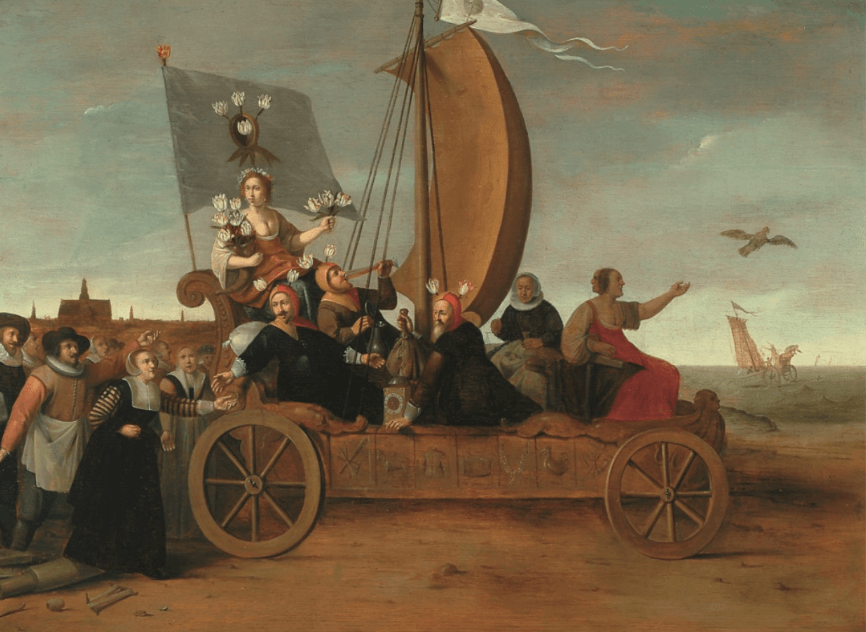
The Little Ice Age was a mysterious event that continues to fascinate scholars. It was the setting for many important events, from the Enlightenment to the tulip craze in the Netherlands. Nature’s Mutiny was a fascinating read; I only wish it had been longer, because that chapter in our society’s history contains so much.
Readers who enjoy world history will enjoy this book. I feel like we don’t discuss the events in this time frame enough; they were crucial in making humankind what it is now.
What have you been reading lately? I would love to know!
Am I a ‘Real Writer’?

Over the past three months, I’ve attempted to edit the third book in my series. Each time I begin to work, a sense of frustration washes over me. Recently, I managed to sort my emotions into words. I will share them here, hoping the process will become easier after I hit
This is a fascinating subject; thank you for sharing your review.