

Reflections on The Hobbit
My thoughts after returning to Middle-Earth in my thirties

In a hole in the ground there lived a hobbit. Not a nasty, dirty, wet hole, filled with the ends of worms and an oozy smell, nor yet a dry, bare, sandy hole with nothing in it to sit down on or to eat: it was a hobbit-hole, and that means comfort.
The opening paragraph of The Hobbit by J.R.R. Tolkien is well known and loved by most people who grew up enjoying classics—fantasy, in particular. As a paragraph, it is incredibly well written. The first sentence alone, with its snappy sound and vivid imagery, places in our minds an expectation for the adventure we embarking on.
It paints in our imaginations an image of Bilbo Baggins’ home. The phrase there lived a hobbit gives us images of a calm existence. This intro isn’t trying to tell us about a character who dreams of heroics. Rather, it describes a person who is merely living. As it turns out, the character in question does not at first take keenly to the idea of adventure—yet goes, all the same.
A Giant of a Story
J.R.R. Tolkien became famous with his Lord of the Rings series, a fantasy adventure that was so bold and ambitious on publication that it took the world by storm.
When trying to publish the Lord of the Rings, he wished for it to be released as one complete volume. He was not pleased that it needed dividing (because printing such a long book was a great risk, and would be today, as well).
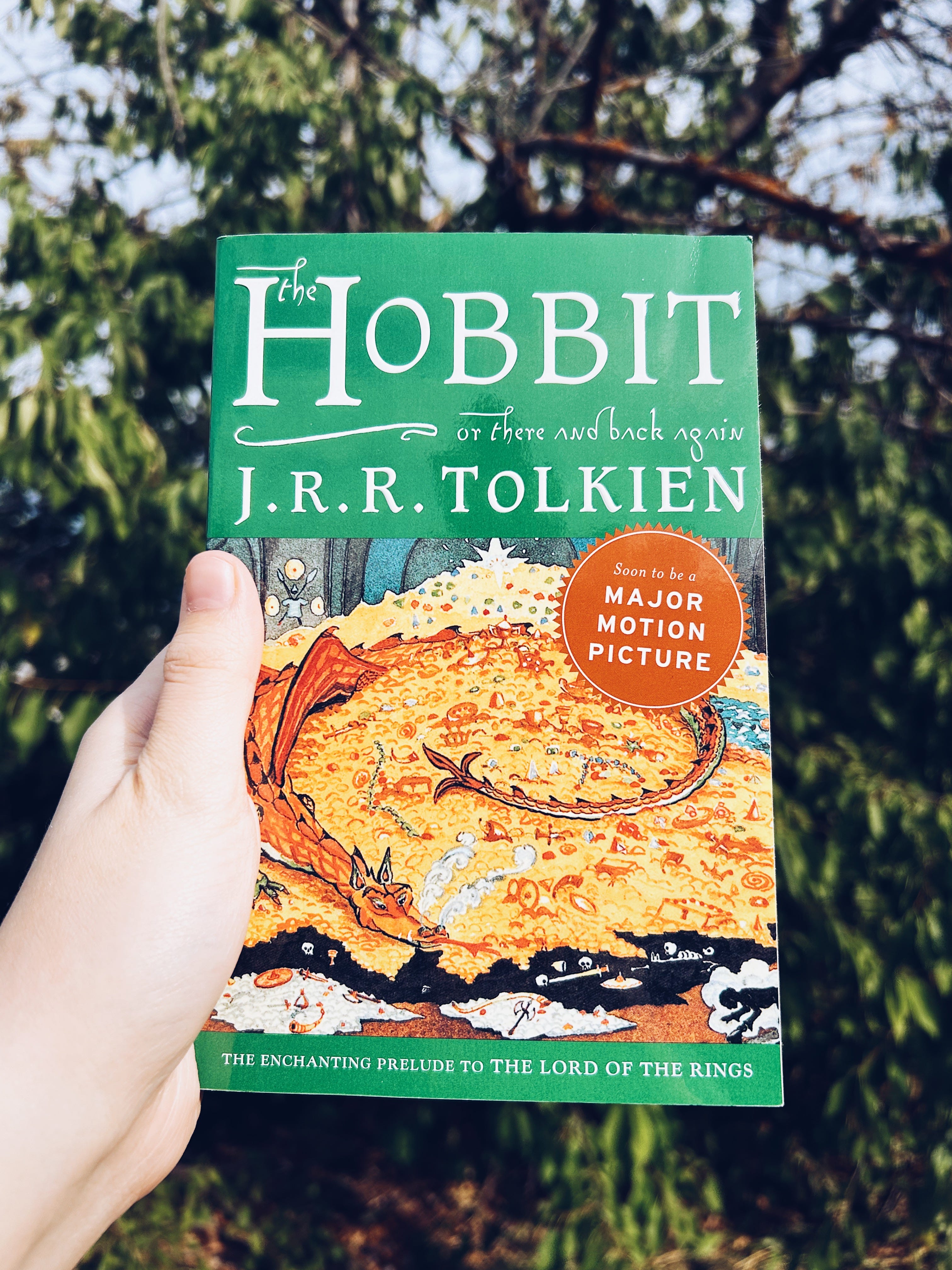
Tolkien’s masterpiece helped set an expectation for fantasy authors in the future. It created a genre where, in general, longer stories were preferred. However, as a reader, it is not the Lord of the Rings trilogy that truly earned a place in my memory.
The Hobbit, having been written for children, has a certain charm that the other books do not—or, at least, not so overtly. It is more of a book that you can reach for when you need a quick read, a hasty escape into a world of dragons and treasure.
The Hobbit is relatable to me. It touches on something all humans have but ignore: the longing to go on an adventure, even when we’re so numbed by comfort that we rarely take risks. But The Hobbit offers its own sort of comfort: Bilbo Baggins returns home after his adventure. After his decision to venture from his comfort zone, he heads back home to continue his calm life.
Tolkien often said that he was more like a hobbit than any of the other creatures that he wrote into his rich fantasy world. If we stop to think about it, most of us have something of the hobbit mindset in our hearts.
We don’t mind an occasional adventure, as long as we can go home when it’s done. Most of us enjoy a good meal (though perhaps not as much as hobbits do!) We are skeptical of anything that might challenge our comfort zones, though with enough thought we will on occasion step out into the world beyond.
How Characters Age
On the second reread, my perception of most of the characters changed. The dwarves in particular were less than impressive to me. They are set on finding their long-lost treasure in the mountain, yet are happy on multiple occasions to send Bilbo Baggins to do the hard work.
It isn’t that Baggins can’t do this work—indeed, as a hobbit, he possesses a skill set that makes him ideal for the role of burglar. It did bother me that none of the dwarves seemed interested in offering a hand, when the treasure was theirs, not his. Even if he declined their offer, it would have seemed the polite thing. But then, dwarves probably have a different sense than we do of what is polite.
I was pleasantly surprised by how I enjoyed the scenes that had Smaug in them. He, too, is obsessed with the treasure in the mountain. He considers the treasure to be his own, and protects it jealously, noticing when one cup disappears that Bilbo dares to take.
Thorin and Smaug both believe the jewels and gold to be theirs, but the difference, for me, was in how they went about protecting it. Until the very end of the book, the dwarves are hiding in the tunnels, happy to let Bilbo take care of everything resembling hard, dangerous work. Smaug has no help, and doesn’t need it, either. For years, his effort alone has been enough to keep his loot safe. Even if he had someone else to send in his stead, he wouldn’t; he would probably eat that person first.
It must be a more developed sense of grown-up logic. Reading The Hobbit this time around, I kept rolling my eyes at the dwarves. “If the treasure is yours, at least offer to help more.” “Why are you letting him take on a dragon alone? At least hang out in the corridor and listen for danger.” It just seemed to me that the word teamwork meant little in the minds of Thorin and his company.
“Perhaps,” I thought, “they don’t care for the treasure all that much, if they’re willing to do so little.” Or perhaps they deserve to lose it, and in an alternate version of the story, Smaug easily vanquishes his dwarven foes and is free to sleep on his pile of gold for another century.
When reading fantasy, grown-up logic must often be put away for the sake of enjoying a story. How can one be immersed in a plot and universe when our inner critic is pointing out things about the characters that, in our world, don’t make sense? Yes, in our world things are a certain way. In the book, it’s different. The stakes are higher, risks greater, and monsters larger.
A Satisfying Ending
I found the ending of The Hobbit to be perfect. After the battle and division of treasure, Bilbo realizes that he doesn’t care for shiny things as much as his dwarven friends do (regardless of who it was in their company that did more work towards finding it).
He takes only a couple of small chests with him to The Shire, where he is received by his friends and neighbors with confusion and alarm. He had been gone for so long that he was assumed dead. Annoyingly, his relatives tried to auction off his things and move into his house. He returned home just in time.
After Bilbo Baggins returned to his home, I imagine he became content with the peaceful life for a long time. He would have learned to enjoy the suspicion with which his friends and neighbors eyed him.
I do wish that Tolkien had written more books like this. His Lord of the Rings series is popular, but there is certainly something that The Hobbit possesses, a magic that exists because of its shorter length and snappier speed. It might also be the simplicity of the ideas: a dragon guarding a pile of treasure, greedy dwarves that are happy to let someone else do the hard work. It is Bilbo’s brief visit to the outside world, where he scratched an itch, finding excitement enough to keep him happy for most of his life.
We, too, tend to be lazy, but we can convince ourselves to take those risks in order to have memories. We will try a new place and return to the ones that we like more. We talk to strangers, always returning to the old people that we know and trust most. We leave home to come back at the end of the day and curl up with Netflix.
At the end of the day, deep down, we are truly hobbits at heart. We are more like Bilbo Baggins than we thought as children, and truly, I think that hobbits have the happiest lives of all the races.
"I do wish that Tolkien had written more books like this." I know what you mean — wonderful as LotR is, there really is something special about the whole style and atmosphere of The Hobbit.
...so true - there's a bit of Bilbo Baggins in us all.