


There is something ageless about books that recount adventures.
In 2025, it’s easy to feel as if the world has been explored, as if there’s nothing else new to find. This is not true; mysteries remain, even if they’re not as dramatic.
There might be few giant mountains left to name, but we still search for cures to illnesses. The bottom of the ocean remains largely undiscovered. And, of course, there’s space exploration.
Human nature is transfixed by tales of perilous journeys. Some of the best-known tales are of sailors. These men (and women!) braved wild oceans; some of their ships never returned.
They might have been discovered at the bottom of the sea. In many cases, they were only brought to life in lore as ghost ships.
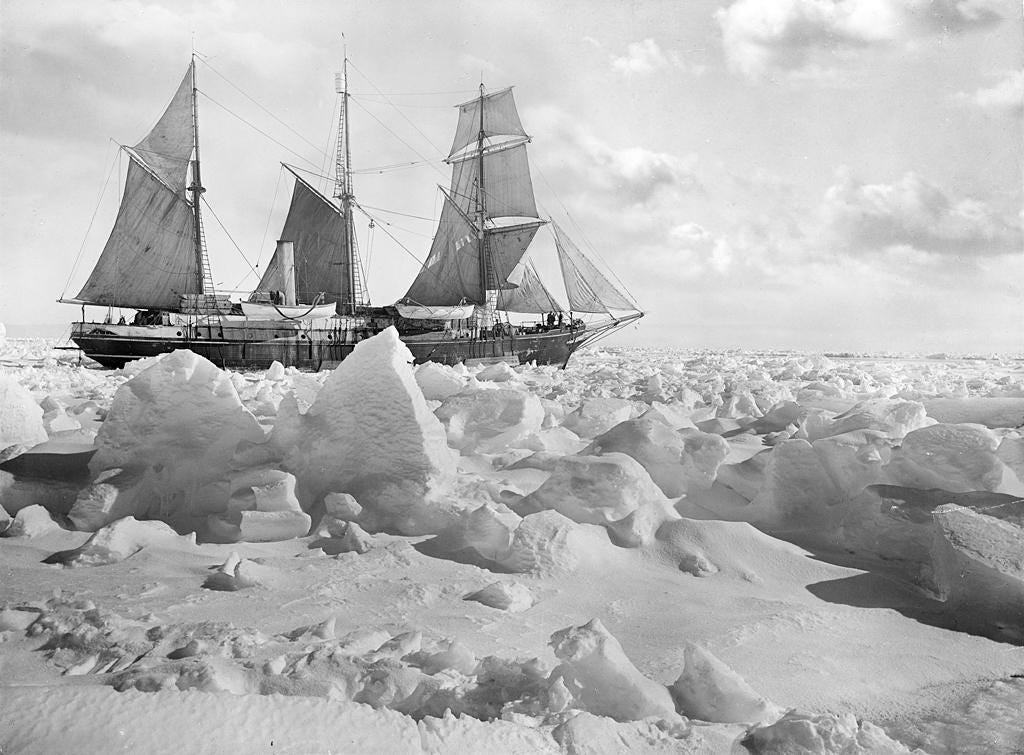
The crew of the Endurance became stranded in Antarctica in 1915. They avoided death because of the leadership skills of Sir Ernest Shackleton.
Endurance: An Epic of Polar Adventure was written by a member of this crew, F.A. Worsley. He was the captain of the Endurance, but even as captain, he trusted Shackleton’s instincts to get the men to safety.
The ship would not survive; it met a tragic end at the bottom of the Weddell Sea, where it was frozen in an icy tomb.
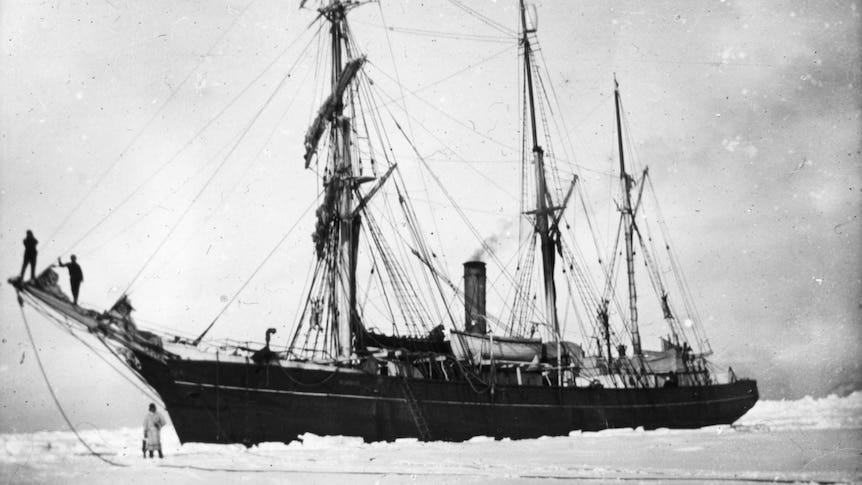
Recently, the Endurance was discovered, using advanced technology. While this is great, I think a more thrilling story is that which Worsley tells.
Not one man from the crew died. Shackleton was determined to get them home alive. He was willing to suffer all forms of discomfort in the process.
It is a matter of history, Worsley wrote, that Shackleton never did lose a man from his crew. But his caution was a product of an altogether exceptional brain:
...unlike some explorers he put the safety of his men far above any achievement that might be possible to him. I have never known anybody so careful. I think that somewhere else in this book I have said that he did the most dangerous things but did them in the safest way, and I repeat it because I think that it describes Shackleton more accurately than a volume of words.
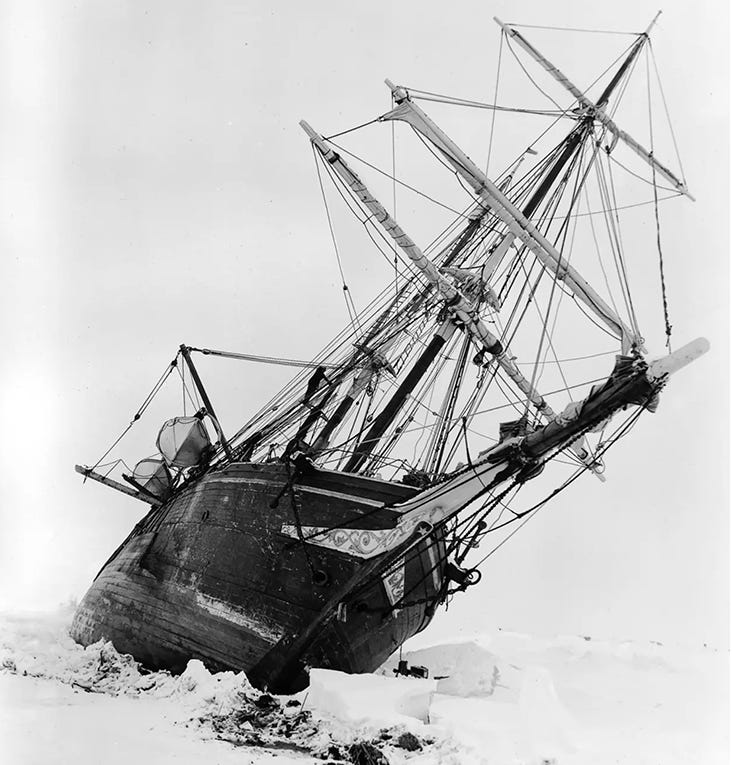
Worsley’s book is a testament to Shackleton’s leadership. It begins at the grim moment when Shackleton told the crew to abandon ship, sensing that the elements would overpower the Endurance.
It’s also an ode to the spirit of the time: The Great War was raging at home, and sailors were planning to enlist when they returned. None of them seemed to think of kicking up their heels before a hearth.
I sensed in these men a resolve that feels alien today.
Worsley and many other sailors would, indeed, enlist. A chapter is dedicated to recounting his adventures as a sailor during the war. It seems that these sailors were made of different stuff than we know; many posts could be dedicated to them.
However, this post is about the Endurance and Shackleton. It is about a form of adventure that few of us would imagine today.
Photos and videos exist of this dramatic event:
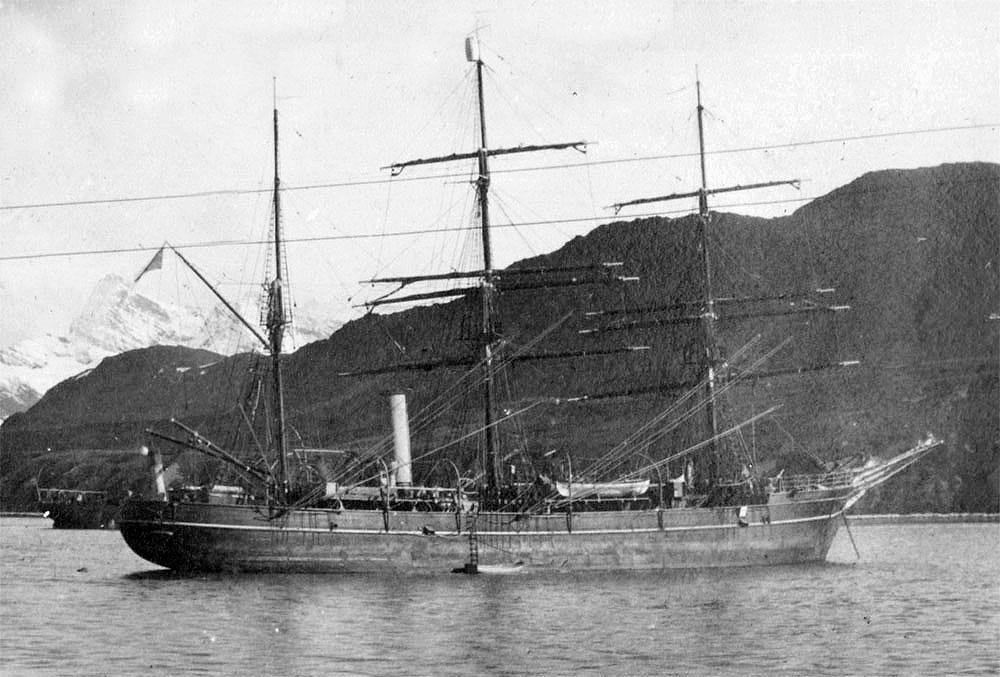
The last work done by our cinematographer, Frank Hurley, before his valuable camera was…thrown away, was to film the masts of the Endurance as these were slowly twisted from her by the overpowering ice-floes. It took extreme care and patience and wonderful judgment to enable him to film the masts as they came crashing down. So fine did he cut his distance that they swept within a few feet of where he was standing.
The story’s action reached its highest point when Shackleton decided that, to conserve food, most of the crew should be left on Elephant Island.
He took Worsley and four other men into a small lifeboat called the James Caird. His hope was to find help at one of the whaling stations on South Georgia Island. It would be a treacherous journey, but they forged ahead, since the other option was to languish in the cold and starve to death.
These men would remain on the James Caird for seventeen days. Not only would they endure polar temperatures, they would also be constantly wet. They would survive on inadequate food. They would endure days without any fresh water—or ice—to whet their thirst.
When at last they reached South Georgia Island, the quest was not finished: they had to cross the frozen land on foot, braving mountains and blizzards, until they arrived at the whaling station.
This frozen world was a terrifying place, but also beautiful, as Worsley wrote in the following description:
It might be thought that our surroundings were monotonous to the eye since all that we could see was snow and ice; but this was not so. There was a continual rainbow-like variety of colour. Outside the Arctic and Antarctic regions, of course, one is surrounded by coloured objects; and while there was nothing of this where we found ourselves beset, nevertheless we experienced colour in a way unknown outside the far North or South. It was as though our snowy surroundings were being painted upon continually by a master-hand, or the most superb lime-lights were being played upon us.
There was a certain dignity in the stillness. Many of the men involved would return to the ice for new journeys.
After a 36-hour trek across the island, they arrived at their destination. The crew of the James Caird wasted no time seeking help to rescue the others from Elephant Island.
One passage written by Worsley was intriguing in a different way. Shackleton had left two of his five-man crew in the shelter of a cave during the trek across South Georgia. However, once they had reached ‘civilization,’ where they were cleaned and fed and almost back to normal, it seemed that they shared a hallucination:
There was indeed one curious thing about our crossing of South Georgia, a thing that has given me much food for thought, and which I have never been able to explain. Whenever I reviewed the incidents of that march I had the subconscious feeling that there were four of us, instead of three. Moreover, this impression was shared by both Shackleton and Crean.
I did a bit of reading, and learned about Third Man Syndrome. It is a common phenomenon among hikers: when they become lost, it is common for them to feel as if there is a presence with them. If it’s a group of two people or more, they share a hallucination.
In most cases, the presence is benevolent, providing comfort or guidance. Whether or not this syndrome is real, Worsley’s account of a shared hallucination is memorable. I’m eager to read Shackleton’s book, to see if he also mentions this.
After the men on the James Caird left Elephant Island, they were pushed to the limit. Their rescue mission would not be easy, even after they found the whaling station. The water surrounding Elephant Island made for difficult sailing; it constantly froze over. When it was not frozen, large chunks of ice served as hazards.
At last, on board a Chilean ship called Yelcho, Shackleton rescued the other men. None of them had died, though they suffered. One of them needed to have his toes amputated, due to gangrene.
Worsley’s book is a record of human survival in places far from home. After the incident with the Endurance, Worsley would not return to safety.
In 1921, Shackleton invited him to join an expedition to Antarctica. This time, they sailed on a boat called the Quest.
To Worsley—and many other sailors—Shackleton had seemed endless. His sense of leadership was so positive that he could earn a crew’s loyalty in the least fortunate circumstances.
It was a great shock when, in January of 1922, Shackleton suffered a heart attack. He died on board the Quest, at the age of forty-seven.
Shackleton so loved to explore, that he would have wanted to end his life on a journey. His wife, Lady Emily Shackleton, had the same thought. At her request, the man was buried at South Georgia Island. His funeral took place at the small Whalers Church at Grytviken on March 5, 1922.
People like Shackleton possess courage, as well as astute leadership skills. They are able to guide groups through challenging situations, and (in ideal circumstances), everyone makes it out alive.
While this is not the only interesting tale of polar exploration, the fact that videos exist make it haunting.
The spirit exhibited by Shackleton and his men has not vanished. It lives in all of us. We could uncover it, if we would only be brave enough to take risks.
Humans will never lose the adventurous spirit! That spirit enabled us to discover new lands and venture into the unknown.
Let us search for that spirit as we journey through ordinary life. Things remain to be uncovered, even if this might take a different form.
It is just as rewarding, in the end.
Mary Shelley: An Introduction & Her Dream

We have a new guest at Top of the Page this month! For, what else can I call it when a character knocks at the door, insisting to be let in? Insisting to be ‘interviewed’? Insisting that it is now her turn to be heard?
Fantastic post about a fantastic leader. Well done!
The recent discovery of the ship found a case of McKinlay Whisky (Scotch) still untouched. There was a close reproduction made and you can buy it as Shackleton's blended Highland malt whisky. I am told it is quite good.