



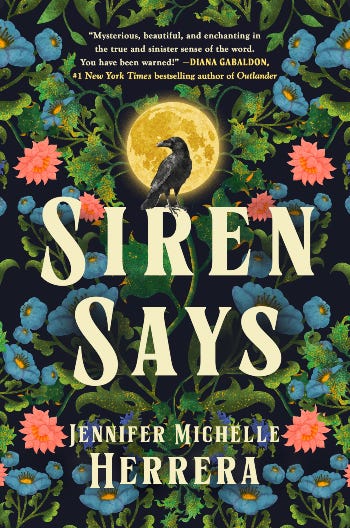
One of my favorite parts of running The Tearoom is the opportunity to sit down with authors whose work lingers in my thoughts long after I have finished reading. Jennifer Michelle Herrera’s forthcoming novel, Siren Says, is one such book.
You can find my review here.
Although the novel is wrapped in folklore, magic, and romance, what lingered with me was its exploration of grief, healing, and the courage required to remain vulnerable after loss.
I was delighted to speak with Jennifer about the myths that inspired the novel, the role grief played in its creation, the books she returns to again and again, and why fantasy can sometimes tell the truth more clearly than realism ever could.
Pour a cup of tea and join us at the table.

Q: Your first book introduced readers to your work, and now you have a fantasy novel arriving later this year. What drew you to this story, and how does it differ from what you’ve written before?
A: When I wrote my first book, THE HUNTER, it was during the middle of Covid. I felt compelled to make my book “say something,” both socially and politically, which it did. While I’m immensely proud of The Hunter for achieving what I set out do, now, 3 years later, the landscape has changed.
With SIREN SAYS, I wanted an escape. I wanted to create an immersive world--lush atmospheric details, flamboyant plants, glittering jewelry, and skies filled with crows. I wanted to make a place where people could just tuck in for a little while and forget life’s bigger problems. In this way, the goal of SIREN SAYS was less intellectual and more emotional.
The true seed for this story came about when I read a book called If Women Rose Rooted. That book tells the myth of a woman named Mis, who suffers an enormous tragedy, and in her grief, she becomes a bird that terrorizes a town for 300 years. Warriors try to kill her but no one can stop her. It’s only when this gorgeous harpist plays music for her (and sleeps with her) that she is reminded that she’s human.
I deeply connected to that idea. That it’s not anger or vengeance or hatred that’s going to get us out of this current moment. It’s something softer.
Q: Every writer has a different relationship with the creative process. What does an ordinary writing day look like for you, and what rituals help you return to the page?
A: I wake up pretty early. I get breakfast for my kids, I drink some coffee, and then I head over to a coffee shop. They know me there. They know my order. I sit in the same seat every day and I write for about one to two hours. Then I go on with the rest of my day. If I’m lucky I get to return to my story again later.
If I’m really struggling with my writing, then I pull up my “special” playlist. Any time I write a book, I listen to the same music over and over again—and I never listen to that music if I’m not writing. With my first book, I listened to the soundtracks for Normal People and Jane Eyre. With this one, I used a playlist I found on Spotify. Any time I’m having difficulty finding my creative rhythm, I put that music on and it transports me back to that world.
Q: Which authors or books have had the greatest influence on your writing, and are there any whose presence readers might recognize in your work?
A: I’m really obsessed with Rebecca Ross’s books. Wild Reverence, in particular, was so brilliantly done. It had such a blend of mythology and immersive setting details and affection. It also felt very fresh to me.
I was also really inspired by Alice Hoffman. Practical Magic will always be a touchstone for me in part because I was so young when I saw the movie. I’m still obsessed with Tiger’s Eye because Nicole Kidman said that it would keep her safe. I keep Tiger’s Eye everywhere.
I loved Other Birds by Sarah Addison Allen, and Debra Harkness’s A Discovery of Witches. I was blown away by the level of detail and care that went into those descriptions of the Bodleian. I also read this really great book by Diana Gabaldon about how to write sex scenes. It was delightful!
In general, I gravitate toward books that feel both mythical and true to life. I think there are people who can create whole fantasy worlds without needing to reference any earlier works. But I don’t know that that’s ever felt as real to me as finding myths already in existence and re-imagining them.
Q: Fantasy often allows writers to explore real-world questions through an imaginative lens. Were there particular themes or ideas you found yourself returning to while writing this novel?
A: One theme I kept returning to in the writing of SIREN SAYS was this idea of power. The main character Raven has come to associate having power with being destructive. In fact she has seen that these two things go hand in hand. This is, in part, because of her experiences with her stepfather, and in part because of her experiences with her own magic. I wanted her to interrogate that relationship to see if there was a way to have power without hurting other people.
There is also a theme of grief that runs through this story. I was experiencing my own grief when I wrote this, and I didn’t know what to do with all that latent energy. When you’re grieving, you feel like this shaken bottle. At least I did. There’s this pressure under your skin has nowhere to go. I didn’t know how to make sense of that feeling or how to find a place for its release that didn’t feel monstrous. I found myself exploring that a lot when I wrote.
Q: If we were sharing tea together in The Tearoom, what book would you place on the table and insist everyone read—and why?
A: Easy. That’s The Last Unicorn by Peter Beattie. Most people know of the animated movie from the 1980s with the same title, but that was based on a book.
The story is all about a unicorn who goes on a quest to find out where all the other unicorns have gone. But then she is attacked by the Red Bull, which is a metaphor for fear and anxiety and anger, and as a result, she becomes human. She sobs. This is the worst thing that could possibly happen—to know deep in her soul that she’s immortal and to be forced to live as a human.
As the story progresses and she becomes comfortable with her humanness, she loses her sense of herself. For instance, in the beginning of the book, men cannot see themselves in her eyes’ reflection, but soon, they can. Soon she forgets her purpose. She falls in love and becomes an object for this very lovely prince. The problem isn’t that he’s not wonderful. The problem is that she is forgetting that she’s immortal.
The story is about remembering who you are and how hard it is to fight to be your true self and how we’re all born with a deep knowing. I cannot read it without weeping.
