


How We Are Kept Alive by Books
Life is fleeting. We only have a limited time in which to leave our mark. But books have a way of continuing that mark after we are gone. Long after an artist or writer dies, their work remains, waiting to speak to new generations.
Sometimes these works do even more than that. They become a bond between people who love each other, carrying memories across years and even beyond death itself.
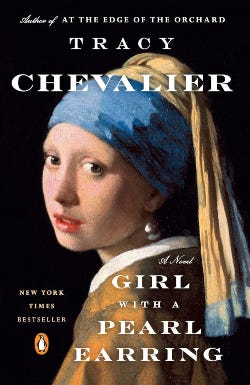
One book that always reminds me of this is Girl with a Pearl Earring by Tracy Chevalier. Longtime subscribers may remember my earlier review of the novel here.
For years, I saw a copy of the novel resting on a table beside my grandmother’s chair. It was one of her constant companions. When I was younger, I noticed it but never thought to read it myself. It was not until my late teens that I finally opened its pages and discovered one of the first works of literary fiction that revealed to me the depth and humanity the genre could contain.
Books & Immortality
My grandmother died in 2019. Afterward, I kept her copy of Girl with a Pearl Earring alongside my own. Today, the two books sit together on my shelf, matching volumes containing words she cherished and that I now cherish too.
I may no longer be able to sit beside her and discuss the novel, but I can still open its pages and visit the same scenes she visited. I can meet the same characters she met, Griet and Vermeer. The book is more than a favorite novel to me. It is a connection.
This year, I took a chance and sent an email to Tracy Chevalier, asking if she would be willing to answer a few questions for my literary newsletter. I explained why Girl with a Pearl Earring is so special to me—that it was one of my grandmother’s favorite novels—and then I hit Send.
I was not expecting a reply, so when Tracy Chevalier answered my email a few weeks ago, I nearly leaped out of my chair. She was gracious enough to agree to an interview about a novel that occupies such a special place in my heart.
If you have not yet read Girl with a Pearl Earring, I encourage you to do so. I thank Tracy Chevalier wholeheartedly for her thoughtful answers, and I am glad that I took that chance.
Authors should know when their books reach us as something deeper than entertainment. The written word—the power of story—can bridge the gap between life and death.
These questions were a way of honoring that novel, and the strange way it has threaded itself through my life.
The Interview
Q: Looking back, what surprises you most about the lasting life Girl with a Pearl Earring has had with readers around the world?
A: I am still amazed that so many people are interested in the back story of this painting. The look the girl gives us has always drawn me in and made me wonder about her, about the painter, about the moment he captured in paint. I didn’t realize that others were wondering this too. The magic of a masterpiece like this painting is that, even with a whole book about it (a fiction, of course, as we know nothing about the girl), we still don’t know why she’s looking that way at Vermeer – a poignant balance between joy and sadness, innocence and experience. That’s what draws us back to the painting again and again, and maybe what has drawn readers to the book.
Q: Readers often describe the novel as “quiet” in the best sense of the word. What do you think quiet stories are able to accomplish that louder stories sometimes cannot?
A: We live in such a noisy world now – literally and figuratively. (I notice this even more now as I’m having ear issues and often have to put earbuds in to block out the noisy streets, public transportation, restaurants.) Social media is full of shouty opinions, and books feel longer and more vociferous. Quiet books are a relief from all this. And we notice them, the way we notice when a silent person speaks – we actually listen because it’s so rare to hear from them. With Pearl Earring I was trying to replicate the quiet calm I saw in Vermeer’s paintings, because it’s so powerful. His paintings are deceptively simple – usually of a woman on her own, doing something domestic like pouring milk or reading a letter. It feels like a curtain has been drawn back and we’re getting to witness something private and intimate. Imitating that style suited my own style. And it gives the reader some space to respond to the story, to fill in some of the gaps. A book is a contract between writer and reader – I provide some of it, and the reader steps up and creates the rest. It’s much easier and more satisfying to do that without a lot of shouting.
Q: What do you hope modern women readers recognize in Griet’s inner life?
A: Maybe they recognise a bit of themselves – that stage in life when you’re so young but rapidly growing and maturing, learning sometimes painfully of the person you want to be. And seeing the world as a wider, more interesting place than the narrow vision you’ve grown up with.
Q: If you could invite one woman from history to sit with for an evening conversation, who would you choose?
A: I would like to meet Maria Barovier – a Venetian glass beadmaker in the 15th century, when it was rare for a woman to work in glass. She featured in my last book, The Glassmaker. I’d like to hear how she managed her career in such a male dominated domain and time, in the most beautiful city in the world.
Q: What kinds of books, paintings, or quiet rituals have continued to nourish your creative life over the years?
A: The lockdowns during the pandemic really showed up how important variety is to me. I found it very hard to write during those times, because I craved museums, art exhibitions, different restaurants, travel! All that stuff that goes into the well and stimulates me. I live mainly in London, so I get a lot of variety. However, we also have a small cottage in the English countryside and that is my quiet place where I’m outside a lot and there’s nothing but birdsong and sheep baaing. I need that balance for my creative life.
Conclusion
As I finished preparing this interview, I found myself thinking once again about the copy of Girl with a Pearl Earring that sat beside my grandmother’s chair for so many years. Books have a remarkable way of connecting people who may never meet. Through this novel, my grandmother encountered Tracy Chevalier’s imagination. Years later, I encountered both of them through the same story.
Perhaps that is one of literature’s greatest gifts. A good book does not simply entertain us for a few hours and then disappear. It becomes part of our lives. It accompanies us through seasons of change, sits patiently on our shelves, and waits for us to return. Sometimes it even becomes a bridge between generations.
My sincere thanks to Tracy Chevalier for her generosity, thoughtfulness, and willingness to share her insights with The Tearoom. And to those of you who have your own well-loved books—the ones that remind you of a particular person, place, or season of life—I hope you will revisit them soon.
You never know what old friend might be waiting within their pages.
The Tearoom Library, No. 028 — Girl with a Pearl Earring

The Tearoom Library, No. 028 — Girl with a Pearl Earring
I've read this one such a long time ago and I really liked it and I've read several of her books after this one. I'll definitely look back and read some of here newer books. Thank you for the reminder 😊