


For those of us who live in America, July has always felt like a fitting month to return to our nation’s history. This year carries an added significance as we approach the 250th anniversary of the Declaration of Independence—a reminder that our country’s story, though comparatively young, is already rich with triumphs, contradictions, and remarkable lives.
Last year I began a reading project that has quietly become one of my favorite long-term pursuits. My original goal was simple: to read about every American president in chronological order. Before long, that curiosity expanded to include the First Ladies as well. The deeper I ventured into these biographies, the more I discovered that history is rarely as tidy as the versions we encounter in school.
The most memorable moments are often the ones that never make it into textbooks. They survive in letters, diaries, forgotten friendships, private struggles, and the ordinary details that reveal historical figures as fully human. Reading history this way has made the past feel less like a collection of dates and more like an ongoing conversation.
July seems the perfect time to continue that conversation.
I am still only partway through my reading journey, but along the way I have found several books that deepened my understanding of America’s past and introduced me to people I am glad to have met. Today I’d love to share a few of my favorites. And if you have a recommendation of your own, I hope you’ll leave it in the comments—my reading list is always growing.
Jefferson’s Daughters by Catherine Kerrison
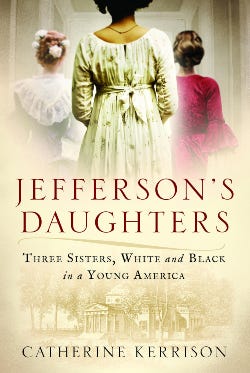
One of the books I most vividly remember from last year was Jefferson’s Daughters. It became an important source in many of the articles I wrote, and it opened a quieter window into early American life than political histories usually allow.
If the stories of First Ladies are often overlooked, then the lives of presidents’ children are even more so—figures who move through history at the edges of visibility, shaping events and being shaped by them without ever fully occupying the centre of the narrative.
Jefferson’s Daughters tells the story of Thomas Jefferson’s three daughters: Martha (known as Patsy), Mary (Polly), and Harriet. The book follows not only the well-documented lives of the two daughters he acknowledged publicly, but also Harriet, the child born to an enslaved woman in Jefferson’s household—a life recorded only in fragments and later interpretation.
Martha lived in the President’s House and assisted her father with public and social duties during his presidency. Polly died young, her life cut short by tragic illness. Harriet’s story, by contrast, remains elusive; the historical record is sparse, and the book suggests she may have later lived in Washington and married, though much remains uncertain.
What stays with me is not only the individual details of their lives, but the way they sit at the edges of a much larger historical figure. They were not secondary to history, even if they are often treated as such. They were part of its texture—quietly present, quietly necessary, and too often left unnamed.

Flag by Marc Leepson
We are all familiar with the American flag, but we are less familiar with its long and evolving history. Marc Leepson’s Flag traces that history as a kind of biography—one that spans centuries, conflicts, and quiet acts of design and revision.
The flag we know, with its fifty stars, is not a fixed origin but the result of gradual change. Over time, it shifted and expanded as the country itself changed, each addition marking a moment of political and historical transformation.
Leepson’s account is not only about symbols, but about people. He introduces the artists, seamstresses, soldiers, and citizens whose work—often uncredited—shaped the physical form of the flag. Through their hands, the banner becomes less an abstract emblem and more a record of labour, intention, and belief.
Alongside its official history, the book also explores the myths and uncertainties surrounding its origins, reminding the reader that even the most familiar symbols often have more complicated beginnings than we assume.
What emerges is a portrait of the flag not as something static, but as something assembled over time—stitched, revised, and carried through generations. It is a reminder that national symbols are never separate from the people who make and remake them.

A Perfect Union: Dolley Madison and the Creation of the American Nation by Catherine Allgor
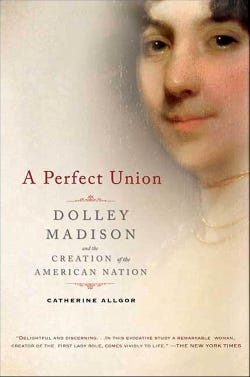
Dolley Madison is one of the most well-known Presidential wives, remembered largely for a single dramatic moment: the story of her rescuing the portrait of George Washington during the War of 1812, as the President’s House burned.
But as Catherine Allgor shows in A Perfect Union, Dolley Madison was far more than the legend that history has preserved.
She possessed a rare instinct for political life—not through formal power, but through presence. As a skilled social figure, she understood how influence often moves through conversation, hospitality, and the careful shaping of relationships. Her gatherings brought together people across political divides, creating spaces where public life could be quietly negotiated. In contrast to her reserved husband, President James Madison, Dolley became the social centre that helped sustain his political world.
What emerges in Allgor’s portrait is not simply a historical figure defined by a single heroic act, but a woman who understood the architecture of political life from its interior spaces—the rooms, conversations, and gatherings where reputation and influence are formed.
It feels fitting that she is remembered for saving a portrait of George Washington. Allgor offers us the same gift in reverse: a portrait of Dolley Madison herself—just as vivid, just as carefully preserved, and far more complete than the legend alone allows.

Mary Ball Washington: The Untold Story of George Washington’s Mother by Craig Shirley
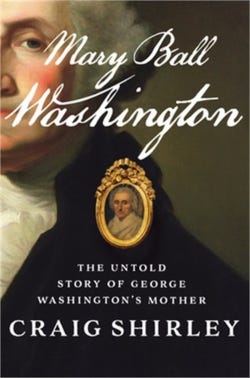
Many books tell the story of George Washington, the father of our country. They examine his life from different angles and perspectives, offering us a rich portrait of the man he was and what made him so unique among his peers.
When I discovered Craig Shirley’s book about George Washington’s mother, it was a pleasant surprise. Until then, I had not realized that she had been obscured by her son’s legacy and achievements. It was a delight to read the book, for I was eager to learn about the woman who had raised him.
Mary does not seem to have welcomed her son’s military career. She was the daughter of English immigrants and remained loyal to the British Empire throughout her life. Yet, as a mother, she was able to see beyond those convictions, never disowning her son despite disagreeing with him. George, meanwhile, renounced the Church of England, of which she had been a faithful member all her life.
Differences in political and religious views have always caused strain within families. Sometimes those divisions become so great that a family will fracture. This was not the case with George Washington and his mother. He cared for her and provided for her until she passed away in old age.
To know the Founding Father well, one should also know the mother who raised him. Craig Shirley has written a poignant tribute.

History is inexhaustible, and so is the pleasure of reading it. These four books reminded me that the American story is not only shaped by presidents and battles, but also by daughters, mothers, hostesses, artists, and ordinary people whose lives quietly altered the course of the nation.
If you have a favorite work of American history, I’d love to hear about it in the comments—my reading list is always growing.