


When letters and documents survive from past centuries, they become treasuries of truth to study. How many events and individuals have been lost or forgotten because no one wrote about them—or because the writings disappeared?
Parchment is fragile. Even if it can survive winters and summers in forgotten attics, the yellowing pages or faded ink evidence time. We cannot salvage all of the documents concerning people who lived before us.
We need not despair! Many historical figures can be preserved in detail, if their journals or letters survive. The documents create a fascinating paper trail.
This isn’t the case for Martha Washington. Famously, after George’s death, she burned all the letters they ever exchanged. She wished for their conversations to remain secret from prying eyes in the future, knowing their exchanges would one day be picked apart.
It was her prerogative, and I understand her motives. I’m not sure I want all of my journals available for study after I die (not that my journals are half as interesting as those letters must have been!)
Parson’s Daughter, President’s Wife
A paper trail does exist for Abigail Adams.
I have not yet finished reading the biography Abigail Adams by Woody Holton. I’m nearly halfway through, and already I’m impressed by our second First Lady. Not only was she the wife of a president, but one of her sons, John Quincy, also became one.
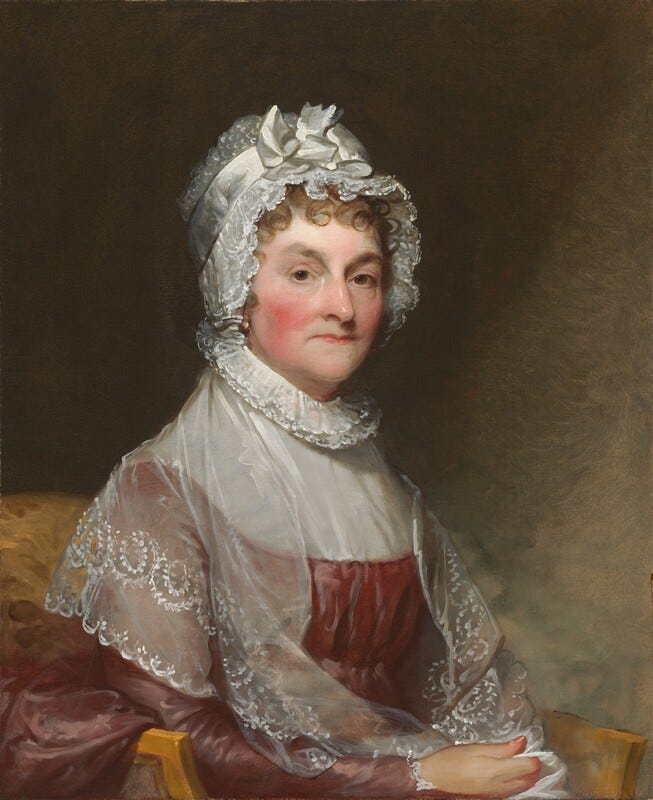
Enough of her letters survive to tell a delightful story, indeed. Her words sparkle. She was an intelligent woman, ‘bold’ for her time.
When she wrote to her husband, she called him her ‘Dearest Friend.’ She made clear her affection for him, but was unafraid to criticize when she believed that he erred.
They were not always fond of one another. It is amusing to read about how their acquaintance began. John Adams as a youth had a tendency to be judgmental. Abigail’s father, Parson Smith, did not escape John’s judgment.
Having heard the Parson speak disparaging words about people they knew mutually, John was quick to call out hypocrisy in his diary. Holton writes:
As it was, Adams considered Smith a “crafty designing Man,” and in his diary, he even leveled at the older man a charge that Puritans usually reserved for their archenemies, Catholic prelates. “Parson Smith,” he wrote, “has no small share of Priest Craft.”
In a delicious example of irony, John Adams’ dislike for Parson Smith would extend to the parson’s daughters—even the one for whom he would, one day, fall madly in love:
Calling seventeen-year-old Mary and fourteen-year-old Abigail by their childhood names, Adams declared that “Polly and Nabby are Wits.” … Later in the same diary entry, Adams asked himself whether the Smith girls were “either Frank or fond, or even candid.” He already knew the answer: the two were “Not fond, nor frank, not candid.”
A Woman of the Future
Abigail Adams is admired for the way she expressed herself. She was unafraid to speak her mind, at a time when women seldom did.
Her famous line to John, ‘Remember the Ladies,’ was one instance in which she hoped the law would become more favorable to women. In this case, she referred specifically to ending domestic violence.
To her frustration, John did not pay heed to this reminder, making excuses and eventually forgetting her request. No matter—the point is that she wrote the words. She voiced a sentiment that was long in her heart.
This matter must have been in the hearts of many women suffering from violence. How many of those ladies would have been brave enough to ask for change?
Abigail had the personality necessary for the tumultuous time in which she lived. Her writings reveal a woman who did not mince words, one with bold colors and deeply-held beliefs. She was not afraid to ‘step out of place’—but was subtle about doing it.
It’s no wonder that she has become popular among history lovers today. She is a character who shines well in our imaginations.
The Early Years
Abigail Smith was born in Weymouth, Massachusetts on November 22, 1744. As mentioned, her father was a parson. Parson Smith’s wife, Elizabeth, would bear him five children. Abigail was the second-born.
Abigail’s youth seems to have been spent under the protective eye of her mother. Holton writes:
Two distinct explanations for this deficit appeared in a letter she wrote one of her granddaughters a few years before her death.
One of these focused on a flaw in the larger society; the other was much more personal. “I never was sent to any school,” Adams recalled. “I was always sick. Female education in the best of families went no further than writing and arithmetic.”
It is not clear if Abigail was sick, or if Elizabeth simply wished to shelter her from the many illnesses that caused child mortality. Abigail was not sent to school; instead, she taught herself with books in her father’s library.
Many important figures took this route. One famous example was George Washington, who didn’t have a classical education. Though James Madison attended Princeton for a time, he would be forced to leave when his epilepsy made study impossible, and he also turned to heavy reading.
I would love to know all the books that Abigail Adams enjoyed. They helped create a wise woman, quick to answer any question. She enjoyed plays, such as those of Shakespeare. She often quoted from authors in letters, using others’ wit to voice her thoughts.
She even used them to tease her husband, her ‘Dearest Friend’ who continuously frustrated her.
Madame Diplomat
John Adams would be sent to France twice as a diplomat during the war, in the years of 1778 and 1779. The second time, he went with their eldest son, John Quincy, convinced that such experience would be good for the boy’s career.
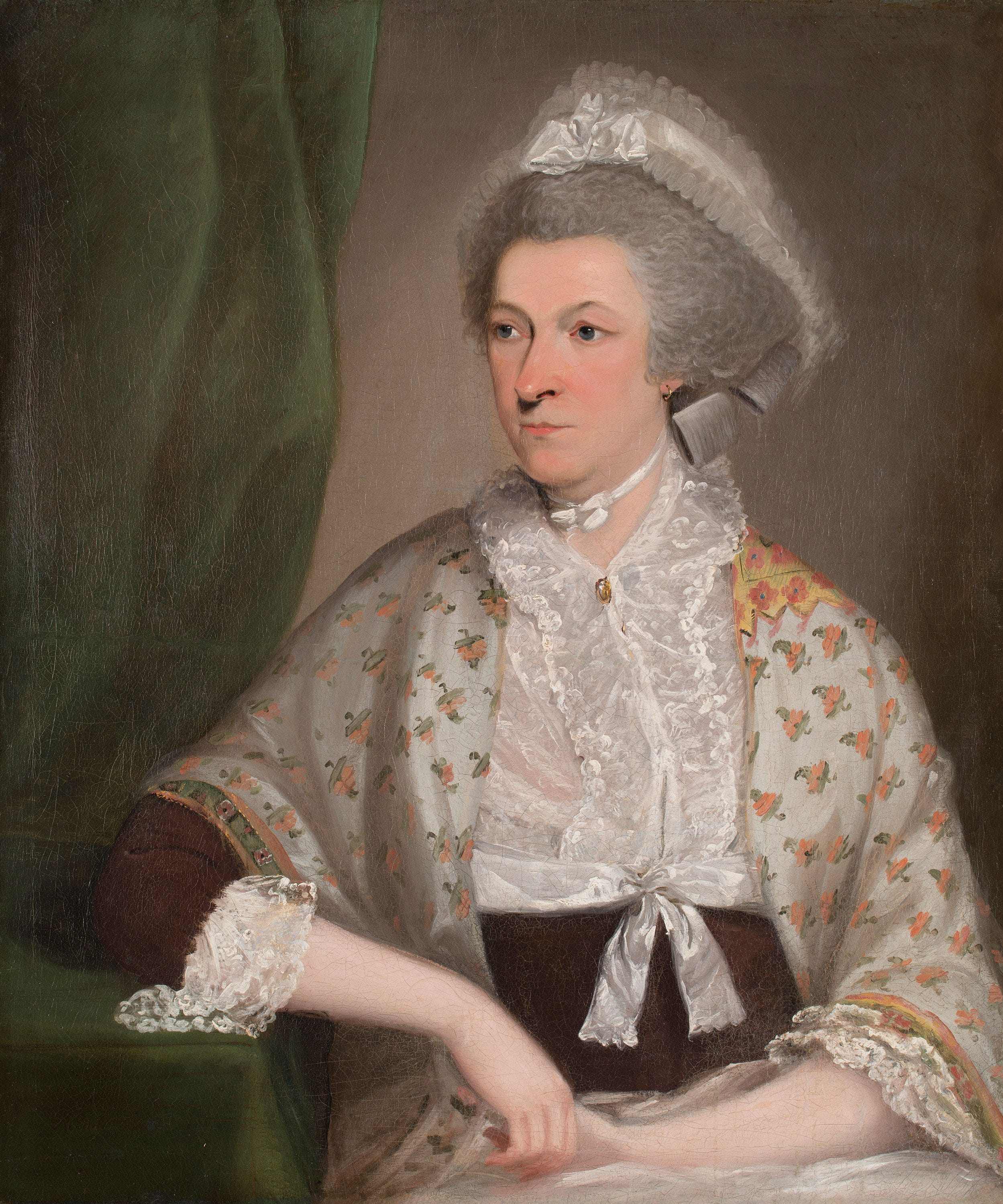
Both times, Abigail was left to manage their home on her own—as well as matters of the farm. Much of farming was exceeded her knowledge, so she wound up hiring assistants to aid in those matters.
When it came to a home, she could to manage perfectly well. Of course, it took time for her to adjust to life without her husband—and, later, to cope with the absence of John Quincy.
It didn’t help that her husband’s letters were not frequent enough to calm her anxiety. This seems to have been a matter of prudence, since letters overseas were being intercepted.
Reasons notwithstanding, the distance seemed eternal to her.
The Smallpox Epidemic
Abigail’s letters give voice to the unease felt by colonists during the war. Battles were often fought within earshot of the Adams home, and she wrote about them to her husband.
She appears to have remained calm throughout the actual battles; her true fear is recorded during the dark time of the smallpox epidemic.
Beginning in 1775, it was a blight to soldiers on the field. Indeed, it was a greater threat than the enemies they were fending off. Smallpox did not limit its attacks to the battlefield; soon, big cities such as Boston became chaotic, with one in three sufferers dying.
In 1777, things became so grim that action was taken. Realizing that smallpox could kill his men before the British reached them, George Washington called for nationwide inoculation. He, himself, was immune to the disease, having contracted it in his youth.
The same could not be said for most common people. Servants in the Adams household began to fall ill. Abigail’s elderly mother, Elizabeth, caught it and died. Seeing the danger this epidemic posed, Abigail agreed to be inoculated, along with her children.
Inoculation was a common practice in that time, though there was still a chance that a person might succumb in the process. I can imagine it was a frightening decision to expose her children to smallpox.
I have learned so much about Abigail Adams, and I’m not even halfway through Holton’s book.
Abigail Adams was an example of courage and determination in difficult times. She was clever, resourceful, and knew how to make herself heard without stepping too far out of place.
She was quick to befriend women of unconventional opinions, such as poet and playwright Mercy Otis Warren. We see in descriptions of such women the spirit of equality stirring. It would be years before women had the vote, but the desire for it was alive.
Next weekend, I’ll write more about Abigail Adams. She is one of the brightest characters of the Revolutionary War, and I do believe she had the perfect personality for a First Lady—back when the role was not yet even defined.
Like Abigail Adams, let us know our minds, take risks, and approach life with caution—but not with fear.
The Two Lives of Martha Washington

If you’ve been keeping up with my newsletter, you’ve seen me talking about my new project—The Tearoom: First Ladies. It’s going to be a series focusing on the wives of US Presidents.
A charming read, your fondness for her shines through!
This was wonderful!!! I can't wait to read your next post about her. I wish I could have met her!