


Lately, I’ve taken an interest in the people who cared for our country in her early years.
As I read about them, I imagine the overarching question, Now what? that must come over them—after the war against Britain was won. Since such a feat had never before been pulled off, I’m sure many of them were prepared for the possibility that the experiment would fail.
It is a good thing that the young nation had strong leaders, fit for the task. The most obvious examples would have been present during the Second Continental Congress. These were meetings by delegates from the thirteen colonies.
Their meetings proved to be fruitful. One of the most famous outcomes of these discussions was the Declaration of Independence. Ironically, the delegates did not know at the time that this Declaration would mean so much.
There was much for these men to discuss. How important was our alliance with France? Was there any chance of patching up some wounds in the relationship with the mother country?
These were important matters; if one was to get into those disputes, it would spiral into another article entirely.
In this post, I would like to talk about one of the most famous members of the Second Continental Congress, the man who is most often credited with writing the Declaration of Independence.
Thomas Jefferson has created a legacy, indeed. Today, he is discussed by historians and avid readers, many of whom see him as a living contradiction. This is especially true because he was a slave owner as well as a defender of freedom.
Books have been written about these perceived character issues. I plan to read more of them; this year, I have read two.
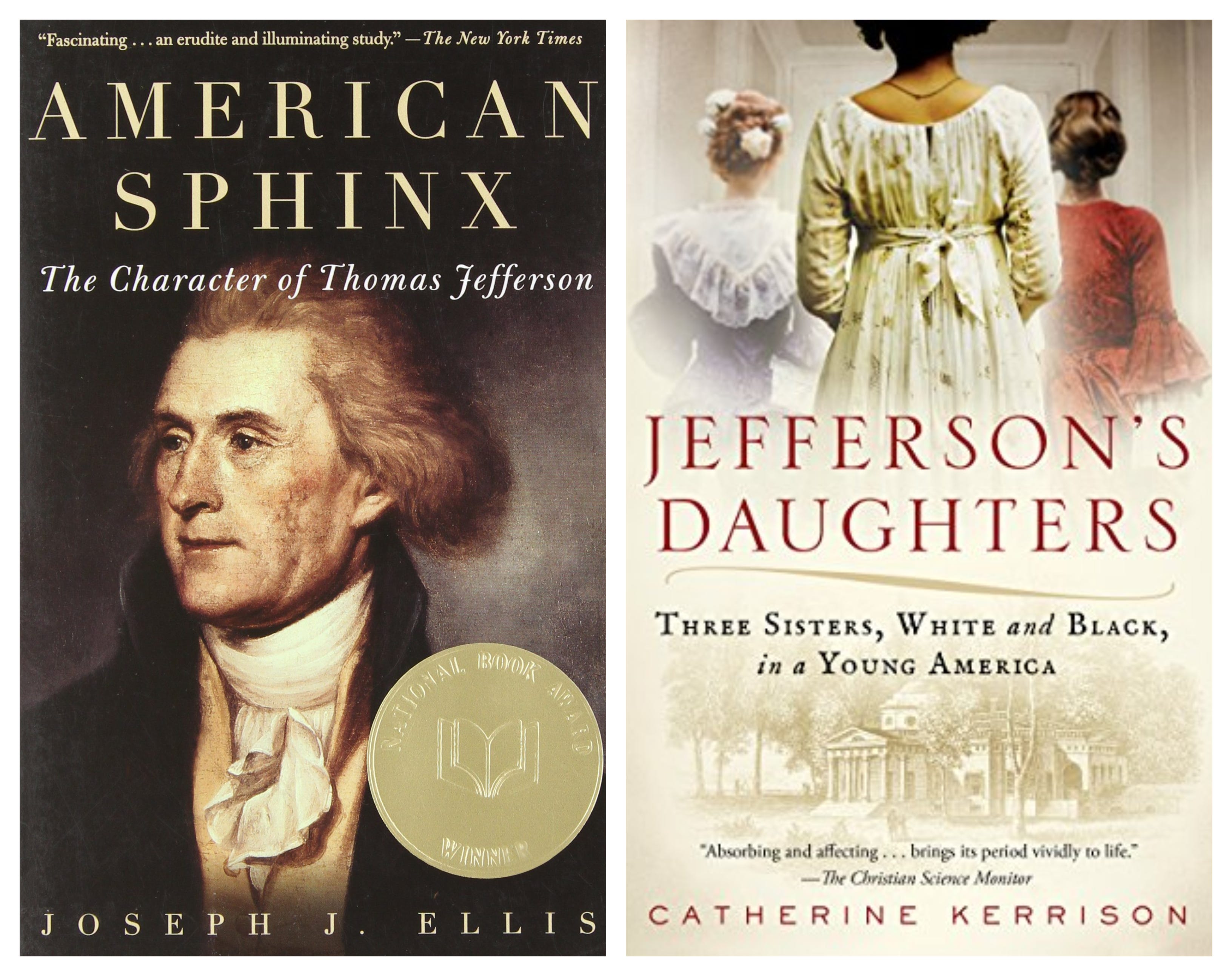
Last week, I finished American Sphinx by Joseph J. Ellis. That is the book I’ll be quoting in this post. I found many of his descriptions of Jefferson to be endearing and relatable.
Self-Evident Truths
Who was Thomas Jefferson, the man whose words grace our history books? I’ve read enough about him to have an idea, though—like with most other Revolutionary heroes—much remains that is only rumor and myth.
We can read his words, pick apart his choices, try to form an idea of his thoughts—but at the end, there remains so much guess-work. The Revolution it was not such a long time ago; it, too, is in mystery. The fact that England was defeated by untrained, malnourished soldiers is difficult to believe.
I have enjoyed the project I began this year, a goal of reading about the Presidents and Founding Fathers. One of the best books I’ve picked for this purpose was Ellis’s American Sphinx. This year, in March, I read and took heavy notes on a book called Jefferson’s Daughters. It tells of the lives of Jefferson’s two acknowledged daughters, Martha and Maria. There are also several chapters dedicated to the life of Harriet Hemings, one of his children with slave Sally Hemings.
Jefferson’s Daughters revealed much the life of our third President. It was not focused on him; as the title suggests, it spoke more about the personalities of his children. This book shows that, at least with regards to Martha and Maria, Jefferson was a devoted father. After the death of his wife, Martha, in 1762, he never remarried, not wishing to burden his daughters with a stepmother.
A man with deep emotions and a fear of weakness, his wife’s death nearly pushed him over the edge. Ellis writes:
Jefferson was inconsolable for six weeks, sobbing throughout the nights, breaking down whenever he tried to talk. Word of his extended grieving leaked out from Monticello and caused some friends to worry that he was losing his mind.
His daughter, Martha (called Patsy) became his companion after this. She accompanied him to Paris when, in 1784, he was sent there as Minister Plenipotentiary. Later, when he became President, Martha would join him for diplomatic dinners, taking on a role of First Lady.
I wrote a piece about Martha Jefferson and her impressive education here.
American Sphinx provided the context I sought: information about his Presidency. It offered what detail was available about his younger years (which isn’t much, since most early family documents were lost in a fire).
It revealed the Jefferson who wrote the Declaration of Independence. Later, in spite of his determination to retire from politics, this man would decide to run for President.
Most surprising to me about Ellis’s Jefferson was the man’s introversion. One would expect the author of the Declaration of Independence to be outspoken, bold, and somewhat enjoy the spotlight.
It was quite the opposite. Thomas Jefferson, as a young man, was an introvert; he was chosen to write the Declaration because his strength was in the written word. As President, he did most of his work at the writing-desk. As an old man, he kept to himself in his beloved Monticello.
Ellis writes:
By disposition and habit, Jefferson’s most comfortable arena was the study and his most natural podium was the writing desk. … He was a young man who very much liked to be in control… Solitary study allowed him to work out his private perspectives without interference and without the unpredictability of an improvisational debate.
Though extroverts tend to receive more spotlights, Jefferson proves that introverts can also make history. An introvert, when asked about a topic on which they are passionate, will put aside their apprehensions and take a stand.
As an introvert, I do not like the sensation of an audience, either. It doesn’t mean that my voice is unheard, soft as it might be. I have a voice, and I do use it.
The Face of the Declarer
Ellis revealed details about Jefferson’s character that I do not recall coming across in Jefferson’s Daughters. These are details which paint him as a human being, not simply the author of an important document. It does not brush aside the contradictions, but offers a portrayal that shows us his humanity.
One of my favorite passages describes his tendency to spend his day in song:
He sang whenever he was walking or riding, sometimes when he was reading. His former slave Isaac reported that one could “hardly see him anywhar outdoors, but that he was a-singin’?.” … Apparently this constant singing was a long-standing habit. So, if we are prepared to take a few leaps of faith, we can plausibly envision him riding into Philadelphia in 1775 in his phaeton, with his horses and his slaves, a tall and slim young Virginian, with reddish blond hair and a self-consciously diffident air, lounging nonchalantly in his seat, singing to himself.
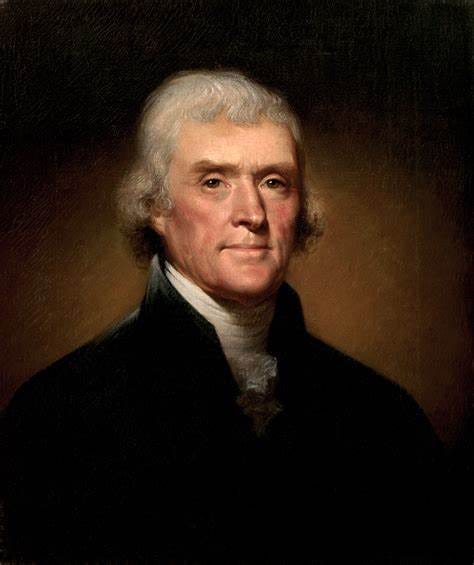
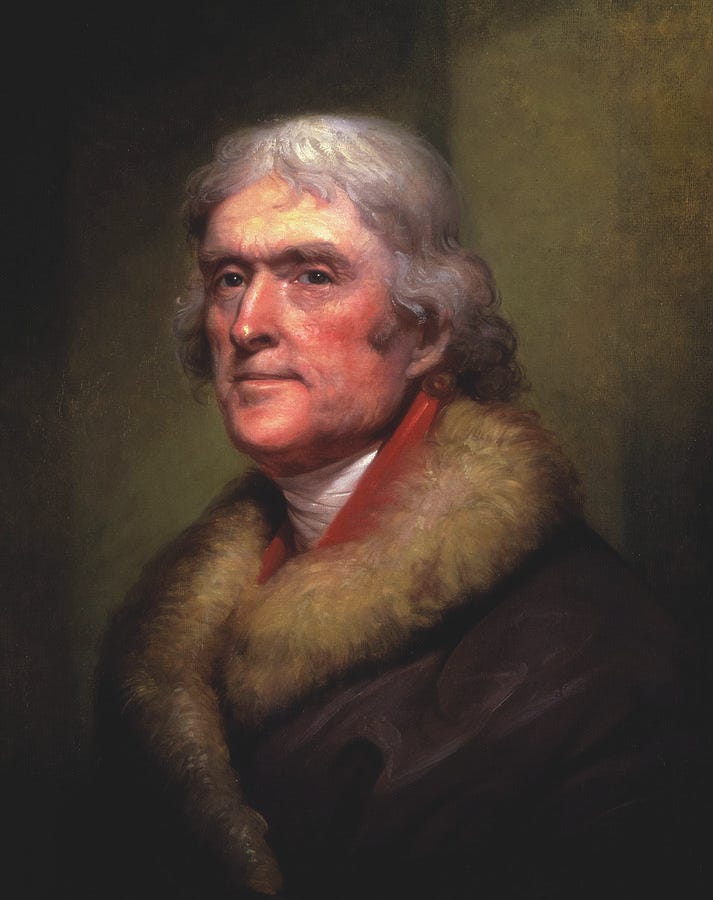
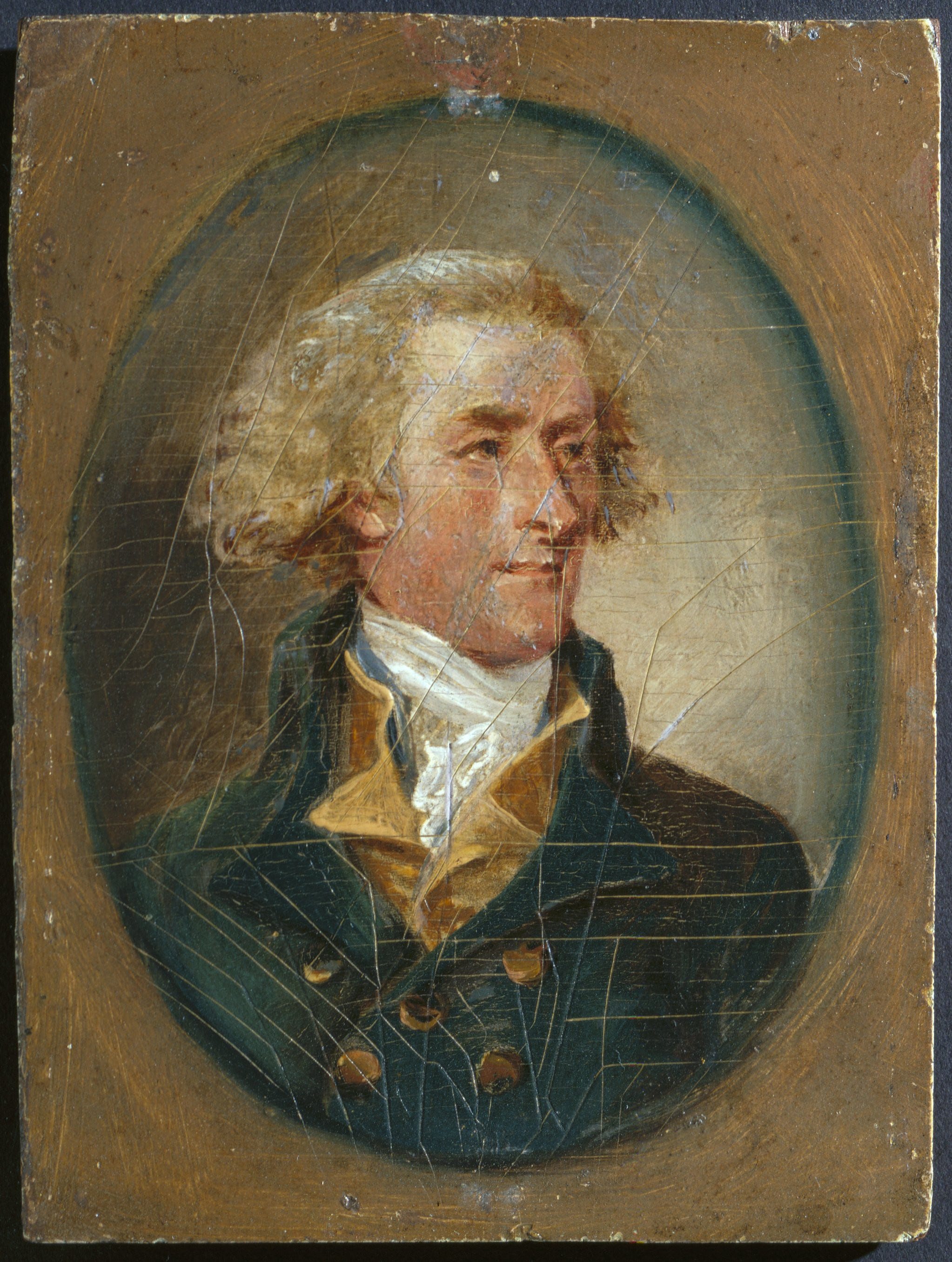
Though many portraits exist of Jefferson in his diplomatic years, the color of his hair is a matter of debate. Was it red, or blonde?
While this detail will forever be debated, other features were unanimously agreed upon by his colleagues. One such detail was his lean, tall frame. The other was his complexion, often red due to his much-loved rides on horseback.
Most of the later portraits describe him as red-faced and heavily freckled, with a complexion that was either scorched or radiant. … Most descriptions of the older Jefferson emphasize his “scranny” or thin face.
A similar debate exists about the color of his eyes:
The color of his eyes is also controversial. Virtually all the later reports indicate they were clear blue; the earlier descriptions, and most of the portraits, have them hazel or green. Perhaps they changed color in different light.
Even Jefferson’s body language, as described by those who knew him, indicated introversion and a great tendency to protect his own personal space:
On his feet he was square-shouldered and formal. He bowed to everyone he met and tended to stand with his arms folded across his chest, defining his own private space and warding off intruders. When seated, however, he seemed to melt into the upholstery with a kind of contorted grace, one hip high, the other low, shoulders slouched and uneven, his torso folded in several places, part jackknife and part accordion.
A Face is Just the Beginning
These descriptions give us a hazy idea of what Jefferson’s acquaintances recalled of his appearance. There was more to Jefferson than that, the matters that continue to make him such a controversial figure today. I will write more about Jefferson in the near future; there is much to say, and I’ve discovered that I enjoy writing about the Founding Fathers. This is no longer just a hobby; this is passion.
Until my next article, enjoy some paintings of Thomas Jefferson. He is unique among the Founding Fathers in that several portraits exist of him, especially in his later years. Some of the most famous include two by the renowned artist Rembrandt Peale:
Another by John Trumbull can be found on the Monticello website:
Finally, one of the most famous portraits of Thomas Jefferson—completed during a visit to London in 1788—by Mather Brown:
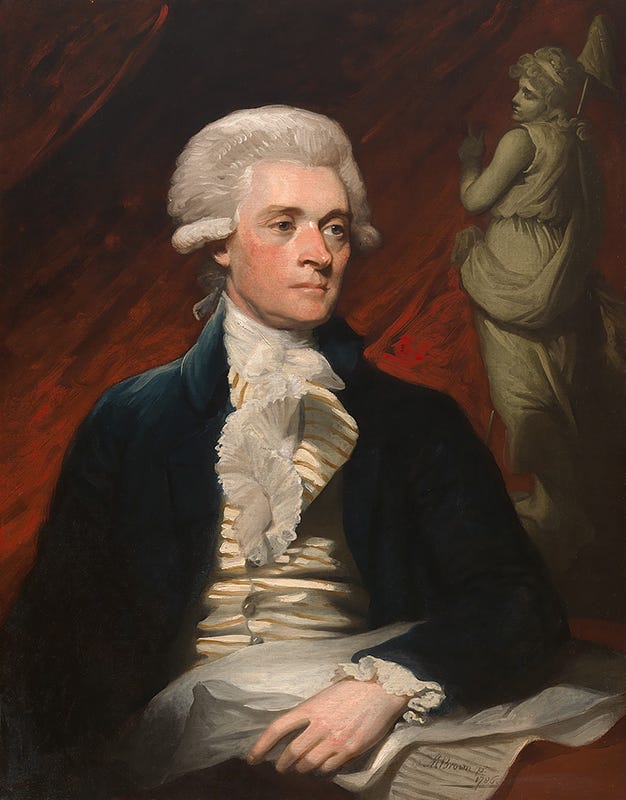
Learn more about the Mather Brown painting here.
Game of Queens: The Women Who Built Early Europe

Read more of my work—check the Table of Contents here!