


The Value of Self-Education
History has seen countless important figures who did not have classical educations, improving themselves through self-education by means of books. George Washington and Abraham Lincoln are two who immediately come to mind when I ponder this. Certainly, there are women who, in spite of the societal pressures of the times in which they lived, managed—by means of their brothers’ or husbands’ books—to achieve a deeper understanding of the world.
Self-education has become an easier goal than ever, given the easy access to information that the Internet offers us. Academia is a trending topic across much of social media, as well as the concept of a ‘personal curriculum,’ in which people select topics unfamiliar to them that they would like to understand better. I see an optimistic rise in the concept of self-education, and hope that it isn’t another trend that will wind up dying.
Personal curriculums are possible for us because we live in 2026. It is a time in which people, women in particular, enjoy more rights and freedoms than our predecessors did in Lincoln’s time. We can, and do, aspire to be more than wives and mothers—because, though there is great love and honor in those titles, a woman should be offered options and not pressed into a box. It is the theme of The Book Club for Troublesome Women, which I reviewed last week (read my thoughts here).
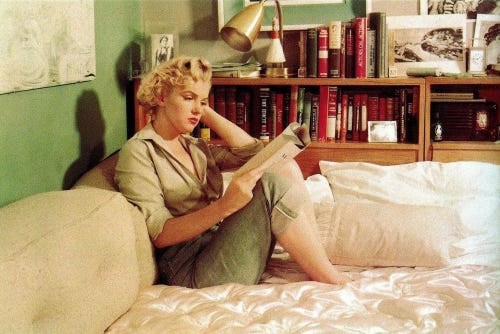
Norma Jeane, or Marilyn Monroe
Marilyn Monroe might well have been part of the targeted audience for Marie Bostwick’s novel. While it appeared outwardly that she had achieved her dream of being a glamorous superstar, she led a deeply unhappy life in which everything about her was strictly controlled and dictated. When she joined the film industry, her name was changed to something more marketable. Her image was altered—her hair dyed, even a nose operation performed.
Most frustratingly of all, Marilyn was shoehorned into the role of the ditzy-but-innocent blonde bombshell. After several films in which she was compelled to play the same trope, she understandably began to tire of the picture that had been painted of her. She longed for roles that were more serious, that carried more substance, and that allowed her to demonstrate that she was, in fact, an intelligent and well-read woman.
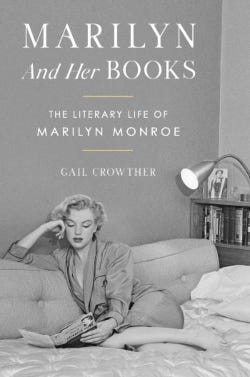
Marilyn and Her Books by Gail Crowther is a gift to lovers of Marilyn and the literary world alike. We have seen ‘Rory Gilmore’s Reading List’ challenges floating around the Internet for years; I hope that we soon see ‘Marilyn Monroe’s Reading List’ challenges as well. Not only does Crowther describe, with moving tenderness, Marilyn’s reading habits, her bookshelves, and her joy in visiting bookstores—but she also provides us, at the end of the book, with a long list of all the books known to have been part of Marilyn’s personal library.
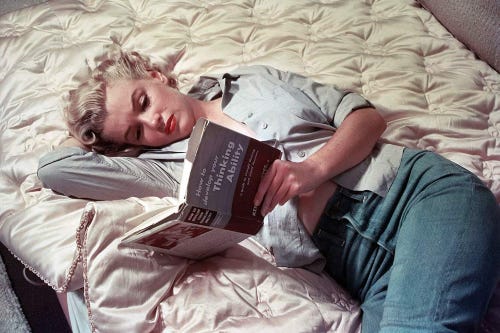
It’s as if Marilyn Monroe were speaking to us from beyond the grave. “This book was amazing,” she says, holding out A Lost Lady by Willa Cather. “I think you’ll really enjoy it.”
Books are Stronger than Death
Marilyn Monroe met a tragic end; we all know this. Conspiracy theories surrounding her demise have existed from the moment she was found lifeless in bed, a bottle of pills next to her hand. Is she dead, though? Reading Crowther’s book, it felt very much as though Gail were visiting the home of a woman who might walk in at any moment.
I was introduced to Marilyn Monroe as a child, when my mother played her movies and we enjoyed them together. Images of Marilyn can be found everywhere, from wall décor to designer clothing. Thanks to Gail Crowther, we now have access to something more intimate: Marilyn’s personal library. Through her personal library, we as readers—because we remain readers, even after death—meet in a time-between-times, a place-between-places, enjoying the same ideas and rooting for the same characters.
After reaching out to Gail Crowther, I was kindly sent a copy of Marilyn and Her Books to read and review. I completed it in a weekend; my full review will go live on Saturday as this week’s featured Tearoom Library book. Marilyn Monroe will have visited the Tearoom. Indeed, in this place, nothing is impossible. First, though, her biographer visited.
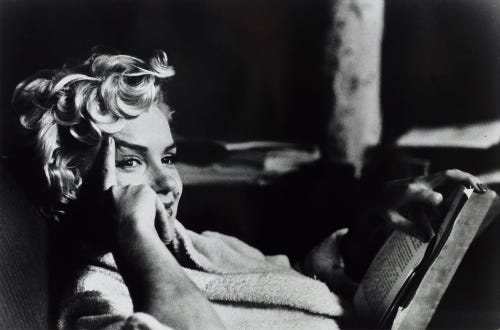
Gail Crowther agreed to an interview, and she answered some questions about the book, as well as the world’s lasting love for Marilyn Monroe. I hope you enjoy it like I did. Be sure to purchase a copy of her book on May 26 by visiting this link.
Q: Even though Marilyn Monroe is the central subject of the biography, the book also feels like a love letter to personal libraries and the people who build them. Did you feel that while writing it?
A: I definitely felt that – it was a love letter to reading and readers, to books, to writers, to librarians, to bookshops, and to the power of the written word to enrich, change, transform, and sometimes even, save, lives. So in that sense it was a love letter to writers too. I take the business of reading very seriously!
Q: Why do you think Marilyn Monroe’s literary life still matters today? What do you think ordinary readers recognize in her relationship with books?
A: I think the Marilyn Monroe we love today is a product of her reading life. She used books to hone her craft, her acting, and her mind and in that sense her literary life is a crucial part of her legacy. I think people reading about Marilyn’s relationship to her books will most likely see some similarities to their own, if not in reading material, certainly in the importance of books. I started to think about how I shelve my books (hopelessly haphazard with some attempt to at least have genres together) but I hope my book makes people think about their own literary lives and the role that books play.
Q: Marilyn Monroe seemed deeply serious about learning and intellectual growth. Do you think she might have written books of her own had she lived longer?
A: It’s a good question and my honest answer is I’m not sure. We have existing fragments of things that she wrote so we know that she did enjoy doing this. Whether that would have developed into something more structured is hard to say. I for one would have loved to read Marilyn’s memoir after she had lived a long and fruitful life.
Q: The Tearoom often focuses on women and literary life, which made this book feel especially fitting for our readers. What are your thoughts on the history of women reading — and on how women’s relationship with books has changed over time?
A: I think books have saved women’s lives, I really do. They have offered escape, alternatives, comfort, energy, and inspiration. Books also save people from loneliness and help in moments of physical and mental isolation. I don’t really know if these universal things have changed over time, but possibly the biggest change has been increased literacy rates making books and reading possible for more people, and public lending libraries which mean books are accessible for all — as they should be. I guess the biggest change though, that is not particularly related to gender, is how people read books – with the arrival of audio books and Kindle which opens up whole new formats which means that some people don’t necessarily own physical books, as such.
Q: Do you think Marilyn Monroe read partly as a way of becoming someone she was not yet allowed to be publicly?
A: I think Marilyn read always, even from childhood. And I think she read because she genuinely had an inquisitive mind and a real desire for self-betterment. It is true that as she became a star, this readerly Marilyn was not the image the studio wanted to project, and I think it must have been frustrating for her, eventually even suffocating, to not be seen as an informed woman and a powerful reader.
Q: While writing this book, did Marilyn Monroe begin to feel less like an icon and more like a fellow reader?
A: Yes, she absolutely did. I felt like I discovered a whole new side to her. Probably the biggest discovery for me was the role that reading played in her acting career. I had no idea that she studied so many books about acting, the physical body, how to move and breathe, how to use your voice, endless plays to perfect the art of dialogue, and autobiographies to see how other stars coped with fame. I also loved that we shared a liking for certain books and I loved that she kept books near her bed, something I also do.
Q: Many well-known women — from Jacqueline Kennedy to Susan Sontag — left behind traces of themselves through the books they loved. Why do you think readers are so drawn to the private literary lives of famous women?
A: I think if you look at someone’s personal library, you gain a unique understanding of them. It is like catching a glimpse inside their head, a place that is often hard to reach. This is especially so with well-known women who have a tightly-crafted public persona. It’s almost like being able to remove that mask just for a moment and see what lies beneath.
Q: What do you hope modern readers — especially women readers — take away from seeing Marilyn Monroe through the lens of literature rather than celebrity?
A: I hope her lively literary life, her informed mind, and her fierce intelligence become a firm part of her legacy and how we understand her. I also hope readers consider the ways in which misogyny is still alive and well and applied to women who try to challenge the dominant discourse in society. Can women be beautiful, sexual, and an avid reader. Of course they can!
Find Gail Crowther Online:
Web: www.gailcrowther.com
Instagram: crowther_gail
Substack: Gail Crowther | Substack

How interesting! I had never really thought about what old film stars were reading before.
This was such an interesting read. I love anything that reminds us there’s always more to people than the image the world creates for them. I never knew this side of Marilyn, and now I’m genuinely curious to learn more.