


A Lifelong Search for History
It was my intention, in the year of 2025, to carry out a special reading challenge. I wanted to read about all of the U.S. Presidents, in order. This would allow me to learn our history in a unique manner. I could appreciate the changes that took place, since 1776 (and even before it!), with more context to serve as an aid.
I quickly discovered that such a project was…complicated. When I began, I thought I would only be finding books and reading them. To deep-read a history book requires more energy than that. What’s more, there’s so much to cover.
For example, I began this journey (obviously) with Washington. As I read about the first presidents in order, I noticed details overlapping. Nuance emerged that I don’t think I would have paid attention to during a casual read. On occasion (such as with Washington and Jefferson), I read more than one book on the figure. While worthwhile, that practice cost me more time.
The truth is, I can’t rush through fifty biographies in two years or even three if I want to learn from them. It doesn’t help that I became more ambitious, choosing to read about First Ladies as well. It’s going to be a lifelong journey, though I’m sure that I will be grateful for the effort. I also decided not to force my reads to be in chronological order.
The good news is, I did learn a great deal about the first five U.S. Presidents. From Washington to Monroe, eight books (and a couple of Kindle books) offered me insight into our country’s tumultuous beginning.
First Ladies: Exhibits of Courage
This post, however, is about the wives of the U.S. Presidents. While less is written about these women, I sought information about them. Their stories allowed me to look at the Founding Fathers in a different light.
In Washington, D.C., the Smithsonian Museum boasts of a great treasure. The First Ladies exhibit displays a collection of gowns belonging to some of the First Ladies. Not all of the First Ladies are represented, as clothing can be difficult to maintain in good condition. Still, those that are on display are dazzling.
Fashion can change. Trends become fleeting as time itself. This exhibit whispers a timeless truth: a woman can seem unbeatable when wearing a dress that makes her feel most herself. It also tells of a different truth: behind every strong man is a strong woman.
I wanted to make a post about the First Ladies to show my appreciation. I’ll link back to my previous posts, in case you would like to know more. Our early history might seem masculine, but history is never quite that simple.
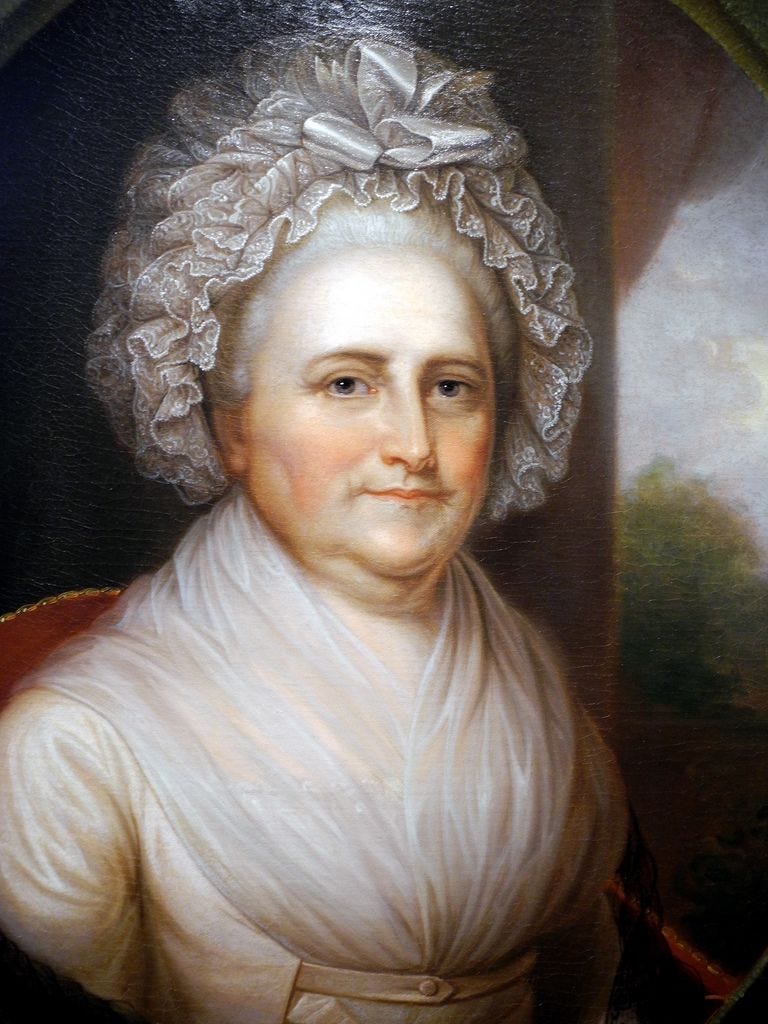
Martha Washington
The wife of the first U.S. President has always been mysterious, a soft figure in the background of his life. I’ve found different sources of material about her. I’ve also written two blog posts about her.
Martha was a widow when she married the man who would one day be president. Her first husband was the wealthy Daniel Parke Custis. Their match seemed unconventional, as she did not come from a wealthy family, herself. The fact that it still took place makes me think it was also a love match.
She and Daniel had four children, but that marriage was doomed to tragedy. Illness would take the lives of two of their children, as well as Daniel himself. Grieving but unbroken, she immediately set about managing the affairs of Daniel’s property. She dedicated herself to caring for their two surviving children. Eventually, she married again.
Her second husband, George Washington, was a promising man with an impressive military history. It started out as a marriage for money—Martha was wealthy, and George needed finances in order to fix and manage his house, Mount Vernon. Fondness grew, over time.
During the war, Martha proved herself to be an invaluable source of comfort for George. After it ended, the Washingtons hoped to settle in Mount Vernon at last. However, these plans were forced to the backburner. George Washington was unanimously elected the first President of the United States, forcing him to change plans.
Eventually, he did retire—for good. They could at last enjoy their golden years at Mount Vernon.
Martha Washington died on May 22, 1802, only three years after George’s death. To learn more about this formidable woman, check out my two posts:
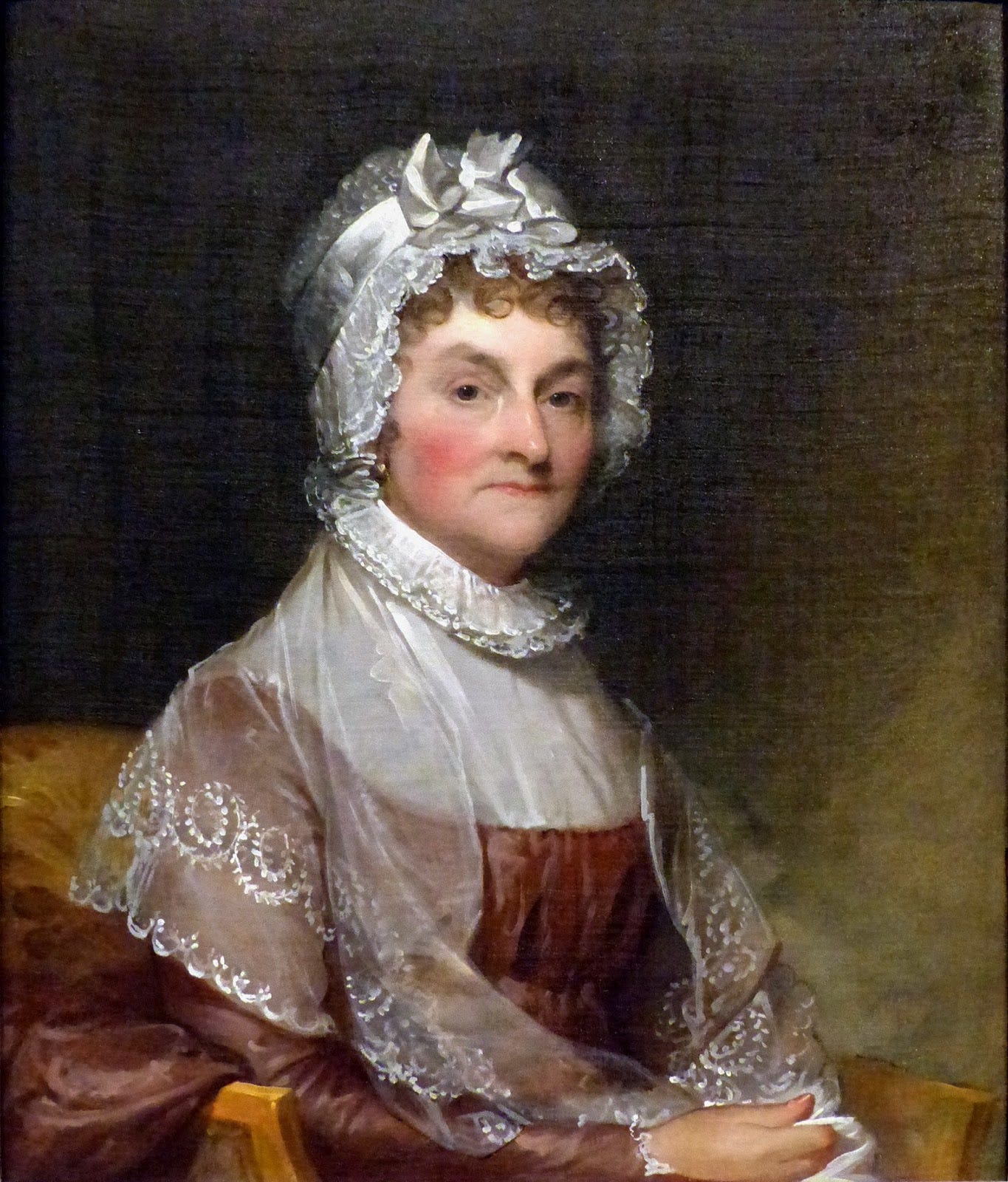
Abigail Adams
Abigail Adams was a treat to read about. It certainly helped that most of her letters to her husband, John, survived. This is a great contrast to Martha Washington, who burned personal correspondence between herself and George.
From a young age, Abigail Adams was described as a frail and sickly. Whatever the cause of her illness, her parents saw fit not to send her to school. Instead, they allowed her to educate herself, using her father’s extensive library. She and her sisters, Elizabeth and Mary, would remain close throughout their lives. They also had a brother named William, but it appears that he struggled with alcoholism. He is barely mentioned in their letters; even the cause of his death is unclear today.
When Abigail met her future husband, John, they did not take an immediate liking to one another. Her forthrightness was perhaps unusual to him. However, he quickly adapted, and feelings developed. Their match would be fortuitous, as his career took him to places perilous and crucial. When taking on such daunting tasks, it’s helpful to have someone capable of standing firm with you.
When John Adams was called France as the American minister, Abigail went with him. She was astounded by the size of the home the ambassador was given. While delighted that she had her own sitting room, her practical side cut in. Wasn’t it wasteful that there were so many spaces that would never be used? Over time, she adjusted; it was a shock when they returned to Virginia and their ‘normal-sized’ house.
Abigail Adams had the steely personality needed to live in a foreign country during times of war. Later, this personality aided her in becoming First Lady. She was astute at investment, secretly building a respectable nest egg. Whispers of early feminism surround her final actions: In her will, she bequeathed most of her things to her nieces and granddaughters.
She died on October 24, 1818. Her husband would follow on July 4, 1826—famously, on the same day as fellow Founding Father, Thomas Jefferson.
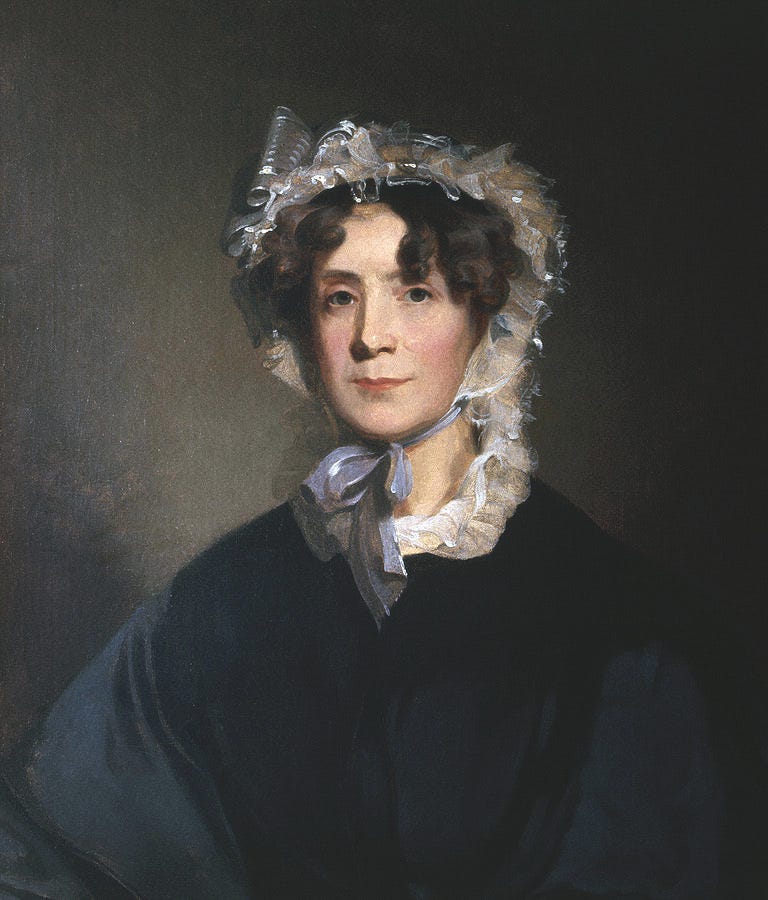
Martha “Patsy” Jefferson Randolph
The wife of Thomas Jefferson, Martha Skelton Randolph, did not live to see him become president. However, she did serve as first lady of Virginia from 1779 to 1782, when her husband was governor there.
Thomas and Martha Jefferson had a loving marriage that came to a painful halt. In 1782, after the birth of their youngest daughter, Lucy, Martha died of childbirth complications. So great was Jefferson’s grief that his friends feared he’d lost the will to live. He became a hermit, prone to deep spells of melancholy.
When he became president, it was his eldest daughter, Martha “Patsy” Jefferson, who often assumed the duties of First Lady. Her early years had equipped her for such important work. She had gone with her father to France when he was sent as minister. During that time, she was educated at a high-end French boarding school. Though this school was tended by nuns, it accepted Protestant children, as well as children of important figures.
At this school, surrounded by people of good title, she learned how to host get-togethers with grace. These, however, were not the only things she learned.
When Martha Jefferson returned to Virginia with her father, she had acquired an extensive education. It made her stand out among her peers at home. In Virginia, there was little use for a woman with such a sharp mind. It must have made for lonely company, when the girls couldn’t follow her in conversation, and the gentlemen didn’t expect her to have knowledge at all.
Unfazed, Martha educated her own children in the same way—sons and daughters. At Monticello, we can see some of the books she utilized for this purpose. Her father watched with a chagrin. Indeed, he seemed to regret having allowed her to become educated (Thomas Jefferson was a product of his times). He did not attempt to stop her, either, choosing instead to enjoy the presence of his family.
Martha lived a fulfilling life. She died on October 10, 1836, aged sixty-four. Her children, especially her daughters, remained grateful for the care she put into their educations.
Theirs was not a welcoming world for strong, intelligent women. However, Martha “Patsy” Jefferson caught on early to an idea that is, thankfully, prevalent today: equality.
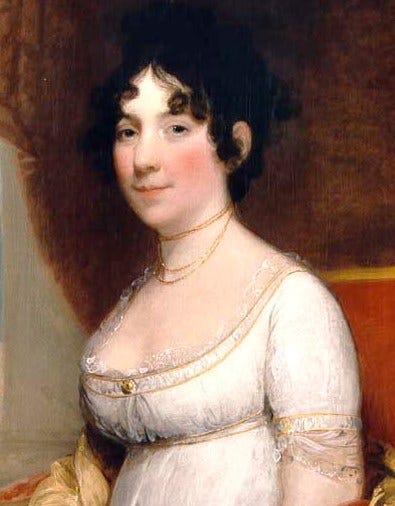
Dolley Madison
The wife of James Madison, our fourth president, is one of the most famous figures in our early history. Dolley Madison is best known for saving the portrait of George Washington during the War of 1812, when the British set fire to the White House. Though the story as we know it might have been embellished, it is a fact that she was an impressive woman.
She was born Dolley Payne on May 20, 1786. Similarly to Martha Washington, she was married to another man, then became a widow. Her second spouse would go on to be known as a Founding Father.
Dolley’s first husband, John Todd, was a wealthy Quaker with whom she had two children, John and William. Tragedy brought a swift end to this marriage, when a yellow fever epidemic caused the deaths of John and their son, William. The epidemic also took the lives of her mother-in-law and father-in-law. Unsurprisingly, Dolley would carry grief for the rest of her life.
She and James Madison met in 1794. They were married in September of that year. Madison, a long-standing bachelor, was seventeen years older than her, yet they proved to care for one another deeply. Their marriage produced no children—another interesting parallel to Martha and George Washington, whose marriage was childless. James Madison cared well for his stepson, though there were many times when young John’s raucous personality might have been difficult.
Madison was elected president in 1809, and he would serve until 1817. A shy introvert, he was greatly blessed to have a wife who enjoyed arranging social events. Dolley connected with guests, making those around her feel as though they belonged. Such was her personality that she would be known as the Queen of Washington.
Dolley Madison lived to the age of eighty-one. She died on July 12, 1849, but had built a legacy so bright that we still talk about her today.
Conclusion
I am, as I type this, reading a book about James Monroe. I’m paying attention, hoping for details about his wife, Elizabeth, so that I can write an updated list with her story, as well. There does not seem to be quite as much information about her; I would be happy if I can write one good article about her.
The fact that I can write this post means I’ve learned a lot about the Founding Fathers and their wives, even if I haven’t made as much progress as I wished. These are things I hadn’t known before, or that I knew on a surface level. We are never too old to learn.
Who was your favorite First Lady, and why?

What a terrific summary. Thanks, Mariella, for highlighting these fascinating women. My favorite first lady is Eleanor Roosevelt, an entirely different era than the women you've written about here, but my fav, nonetheless. My second would be Abigail Adams. Stephanie Dray has a new biographical novel about her coming out in 2026 that I'm looking forward to reading.
Well done! I’m hoping to do a serious read and perhaps, if you’d like, interview you concerning your history work in the new year, if you’d like, maybe do an article on your work for President’s Day?