


Two Ways of Escaping
Some people live for traveling and exploring the world through external experience—physically entering old buildings to learn their history.
Others, like me, may not move through the world that way. Not because one way is superior or inferior, but because life unfolds differently.
I do not consider that unfortunate.
We might not be able to step onto a plane whenever we want, but we have books.
A plane takes you physically into another place. A book is a universe you can carry quietly in your hands.
And when you spend enough time traveling through books, something strange begins to happen.
You start to feel nostalgia for places you have never actually lived in. For rooms you have only ever imagined. For lives you have only ever borrowed for a few hundred pages.
You begin to miss them.
Wi-Fi Can’t Replace These Things
In contrast, modern life offers its own kind of escape—one that is faster, flatter, and constantly available. The smartphone has made so many things easier, more efficient, and in many cases safer than they once were.
It is convenient to have nearly everything gathered into one small device. It is reassuring that apps handle authentication and protect sensitive information.
And yet, in doing so, we lose something quietly essential: touch.
Human beings still crave the tangible

.There is a reason we turn the pages of books instead of swiping through them. A reason we keep drawers of mementos from certain years of our lives. A reason we linger on objects that outlast their usefulness.
Wi-Fi, apps, and AI can replicate access, but they cannot replicate presence.
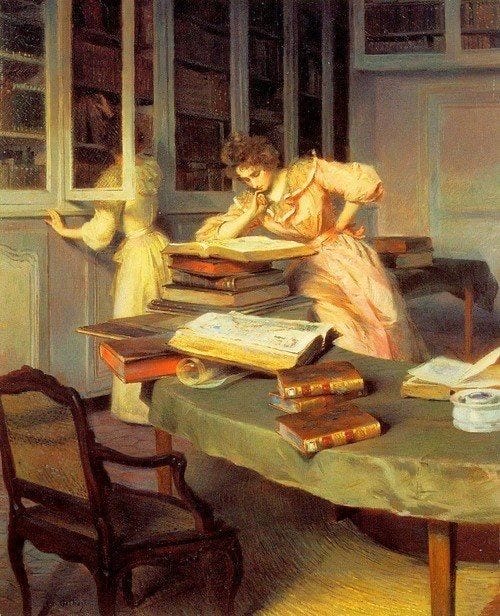
And so we find ourselves learning about objects and rituals that no longer exist in our daily lives—and, if we are anything like me, feeling a quiet kind of longing for them.
No more walking to the mailbox hoping for a letter. No more garments that feel like they belong to another kind of attention span, another pace of life.
These things are not entirely gone. But they are out of reach in the way the past always is.
And still—we can read about them.
We can carry them, briefly, inside us.
What Books Make Us Long For
Some of the things I most long for were introduced to me in books. They were unremarkable in their heyday—simply aspects of everyday life.
The people who used them probably never imagined they would become objects of longing. Quill pens were ordinary. Letter openers lived quietly in desk drawers.
And yet, in reading, they begin to feel luminous.
There are certain things I find myself nostalgic for, even though I have only ever known them secondhand:
Handwritten letters, the kind folded into envelopes with real weight
Old-fashioned trunks, worn at the corners, carrying entire lives from one place to another
Handmade clothing, stitched slowly enough to hold the shape of attention
They are not remarkable because they were rare.
They are remarkable because they were once normal.
And somewhere in reading, in imagining, in borrowing the past through pages, I began to miss them as if I had lost them myself.
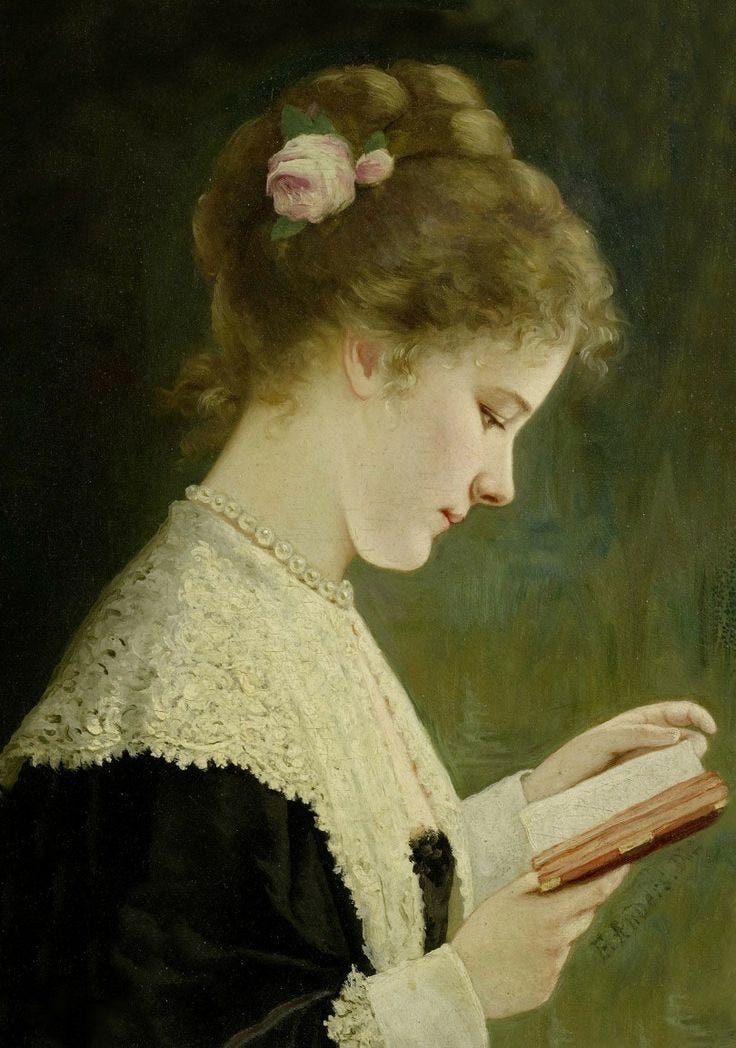
We Are Not That Different
If we really think about it, our ancestors would be just as fascinated by us as we are by them.
Imagine going back three generations and showing your great-great-great grandfather Wikipedia. Imagine trying to explain that nearly all recorded human knowledge can now be summoned in seconds from a small glowing rectangle.
Imagine young women with heavy workloads discovering that, in the twenty-first century, new dresses can be acquired with a two-hour visit to a mall rather than weeks of measuring, sewing, and squinting by candlelight.

There is something almost disorienting in that comparison. Not because one world is better than the other, but because both would feel equally miraculous to the other.
Imagine authors centuries ago learning about blogs. What kind of blog would Aristotle have kept? Augustine? Would they have written in careful, polished essays—or in fragments, updated daily, thoughts posted before they were fully formed?
And imagine their astonishment at the idea that a single thought, once written, could travel instantly across the world.
It is easy to think of history as something static, something finished behind us. But in reality, it is only perspective that changes.
We are not so different from those who came before us.
We are simply standing in a different kind of miracle.
And perhaps this is what books quietly teach us: that longing does not only move backward. It moves in every direction.
We look at the past and feel a kind of homesickness for it. But if we could see ourselves from a distance—through the eyes of those who came before—we might realize that we, too, are already becoming someone else’s version of the past worth studying. Someone else’s curiosity. Someone else’s imagined simplicity.
Conclusion
Maybe this is why books feel so intimate.
They remind us that no moment is ever truly finished—not the past we miss, and not the present we are living now.
Everything is still being read.
We are writing the stories that our great-grandmothers once wished they could read.
And perhaps what would have astonished them most is not only what we have made—but the strange abundance of time in which to make it. Technology has reshaped our lives in ways they could not have imagined, leaving us with new kinds of distance, and new kinds of attention.
The story has not stopped moving.
As we read the words of those who lived before us, perhaps we can also imagine them reading us in return.
And smiling quietly at what we have become.
Editor’s Note: I am now on Booktok, where I’ll be talking about literature, about the Tearoom, and why nostalgia is such an essential part of me. I would love it if you would follow me by clicking here. Be sure to introduce yourself!
Also, The Tearoom on Ensorcell Avenue releases for Kindle and as a teeny paperback on May 30. I won’t ask you to ‘buy me a coffee.’ But if you’d like to buy yourself a trip to a magical cafe…preorders for the eBook are only $2.99. Grab a copy here.
Thank you for supporting indie authors.

I love 'A plane takes you physically into another place. A book is a universe you can carry quietly in your hands.' It resonated deeply. That is my life now as I travel less but I know I can still reach out through books.
I also like to think about what some authors would've been like on social media. For instance, I think G.K. Chesterton would spend a ton of time writing quips on X, and Tolkien would have a blog he would keep forgetting to update.