


The Tearoom Library, No. 002 — The Black Tulip
Author: Alexandre Dumas
Genre: Historical Fiction · Adventure · Romance
Rating: ★★★★★
Follow-Up Reading:
A Tale of Two Cities by Charles Dickens
Tulipomania: The Story of the World’s Most Coveted Flower & the Extraordinary Passions It Aroused by Mike Dash
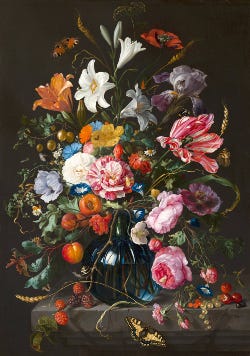
Featured Image: The Tulip Folly (1882) by Jean-Léon Gérôme
A Study in Obsession and Care
Human beings are, by nature, creators. Each individual is so full of beautiful or frightening emotion that it cannot help but take form. If this emotion is not expressed in some way, if it is allowed to collect in one’s heart and fester, there follows a listlessness that I consider worse than death.
In my previous Tearoom Library post, I wrote about Girl with a Pearl Earring by Tracy Chevalier. It is a fantastic work of historical fiction inspired by the famous painting by Dutch artist Johannes Vermeer. The visual arts, and painting, represent one way of releasing those emotions and harnessing human talent.

There are other ways of creating, though—ways that require us to go outside and stand in the sun, get soil caught under our fingernails, and breathe in fresh air. Gardening is another art form, one that requires a certain type of patience and connection with one’s plants.
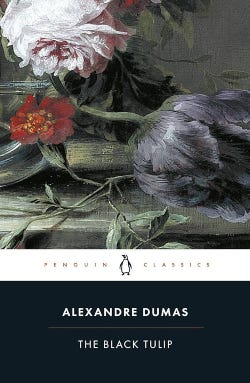
This week’s featured book, The Black Tulip by Alexandre Dumas, does not have a painter as a protagonist. Rather, the main character, Cornelius van Baerle, is a florist, a “tulip-fancier.” Like Vermeer, he lives in 17th-century Holland. Like Vermeer, van Baerle is a solitary man who devotes himself to his trade.
This story takes place during the great tulip craze of that century, and van Baerle, an expert gardener and florist, is obsessed with creating a type of flower that has not been known to exist before.
Van Baerle wants to cultivate a tulip black as ink, profound as night. He would present it at a competition and win a fortune, as well as national acclaim. However, van Baerle is not the only tulip-fancier obsessed with this competition—and other, less honest men are willing to do whatever it might take to steal the flower and the grand prize.
Envy, Plagiarism, & Love
Next door to van Baerle lives an envious rival, Isaac Boxtel, who also wants to present the black tulip. He does not take interest for the sake of love; he cares little for the flower. He wants only the money, acclaim, and royal connections. Boxtel is not van Baerle’s only rival—he has been accused of treason by people in high circles.
This notoriety encourages Boxtel to destroy his neighbor’s life. He conspires against van Baerle, his conscience numbed by lust for glory, and sets a trap that ends with van Baerle being sent to prison. It will not be so easy for Boxtel to claim the fruits of van Baerle’s labor, however. Before his arrest, van Baerle takes his three bulbs for the black tulip, hiding them in his clothes.
His true love is the flower. He might lose his freedom unjustly, but he will not abandon the flower to the uncaring hands of a bitter neighbor. And in prison, those tulip bulbs are his only company; he speaks to them, cares for them, finds comfort in their existence, for even behind bars, not yet planted, they are full of life.
But he still yearns to grow a black tulip and present it to the society competition. He enlists the help of Rosa, the prison guard’s daughter. Illiterate but deeply sensitive, with a gentle heart, Rosa agrees to help van Baerle plant his bulbs, seeking adequate soil. He gives her one bulb to grow in her home, a bulb that she cares for as if it were a child.
As they secretly nurture the bulbs, hope is cultivated in the midst of his confinement. Rosa’s flower begins to grow; so does their bond. Cornelius, in their stolen moments alone, gives her what I consider to be one of the greatest gifts: he teaches her to read and write, so that she is no longer powerless.
As Cornelius falls for Rosa, it is evident that he is still obsessed with the tulip bulbs, caring for them in a way that she cannot compete with. Rosa learns to read, and her personal confidence grows in the process. When it becomes clear that he cares for the tulips as if they were ladies, she becomes jealous. Can their romance blossom like the tulip that they are nurturing?
When Tulips Were Gold
To understand the rich backdrop of this classic novel, one must know the historical circumstances in which it occurred. Only then can we understand why Cornelius is so fixated on a flower—and why Boxtel would betray his neighbor for that same glory.
The Dutch tulip craze—often called Tulip Mania—took place in the early 17th century during the Dutch Golden Age, when the Netherlands was a center of global trade and growing wealth. Tulips, originally imported from the Ottoman Empire, became a luxury status symbol among the Dutch elite, prized especially for rare varieties with striking color patterns caused by a mosaic virus.
As demand surged, bulbs began to be traded not just as flowers but as speculative assets. Contracts were bought and sold for future delivery of bulbs, sometimes changing hands many times before the flowers were even planted. Prices escalated dramatically, with some rare bulbs reportedly valued higher than houses or large estates.
By the winter of 1636–1637, the market had become highly unstable. Prices were driven less by the intrinsic value of tulips and more by speculation and the expectation that they could be resold at higher prices. In February 1637, confidence suddenly collapsed when buyers failed to show up at routine auctions, triggering a rapid drop in prices. Many investors were left holding contracts that were now nearly worthless.
Although the economic damage was more limited than later financial crashes, the episode has endured as one of the earliest recorded examples of a speculative bubble—illustrating how quickly markets can be swept up by hype, scarcity, and the human tendency to believe that rising prices will continue indefinitely.
A Note from the Margin
In the Tearoom, we often speak about what we are reading.
Part of our mission is to dig into beautiful books for gems: ideas that reside within us for the rest of our lives, quotes that offer comfort in the darkest moments. I’ve chosen to share some of the quotes I jotted in my journal with members of the Tearoom Circle.
