


To visit the Tearoom Library and peruse the other available titles, click here.
The Tearoom Library, No. 041 — The Blue Flower
Author: Penelope Fitzgerald
Genre: Historical Fiction / Literary Fiction / Philosophical Romance
Rating: ★★★★
Follow-Up Reading:
Death Comes for the Archbishop by Willa Cather
(for quiet spiritual beauty, restrained prose, and a sense of history felt through atmosphere rather than plot)The Man Who Was Thursday by G.K. Chesterton
(for philosophical tension, symbolism, and the strange collision between idealism and reality)Kristin Lavransdatter by Sigrid Undset
(for emotionally intelligent historical fiction shaped by faith, love, and moral seriousness)
In the Mind of Novalis
In order to understand this novel and its complexities, I had to do some reading about the poet on whom it was based.
Fritz, the protagonist, had a short but impactful life in the world of literature and philosophy—but I had not heard of him until I picked up The Blue Flower and my instinct told me to know him better.
Born Friedrich von Hardenberg in 1772, he would later take the name Novalis. He was a German Romantic poet, philosopher, and early figure in the intellectual movement of Romanticism. He came from a noble Saxon family and was trained in law, but his life was marked more by intellectual inquiry and poetic imagination than by public career.
He is best known for his fragmentary philosophical writings and lyrical poetry, especially Hymns to the Night, which reflects on love, death, and transcendence following the early death of his fiancée, Sophie von Kühn. His brief romance with Sophie is the most obvious plot arc in The Blue Flower, but as you will see in this post, I found other aspects of the book to be far more interesting.
Novalis’ unfinished novel Heinrich von Ofterdingen introduced the famous Romantic symbol of the “blue flower,” representing longing, artistic desire, and the pursuit of the infinite.
We catch glimpses of these ideas in Fitzgerald’s novel—seeds planted early in the mind of a young man destined to work in the salt mine industry.

By the time Novalis died of tuberculosis at 28, most of his family had already died before him.
He left behind a small but highly influential body of work that shaped German Romantic thought and its emphasis on inner life, spirituality, and the merging of poetry with philosophy.
The Poet on Washing Day
The Blue Flower had been sitting on my shelf for quite a while.
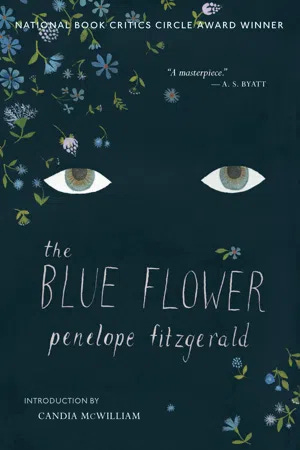
I knew that Penelope Fitzgerald had been considered one of the greatest female writers in recent times, but the book cover, for one, did not give me much of a hint about what her novel was about. A pair of eyes, staring out at me from a solid blue background—such a cover could be the face of a book about anything.
I soon realized that The Blue Flower was a puzzle because it follows the life of a man who lived his life pondering puzzles. In the era of Johann Wolfgang von Goethe, protagonist Fritz von Hardenberg offers a glimpse into the intellectual movements of his time.
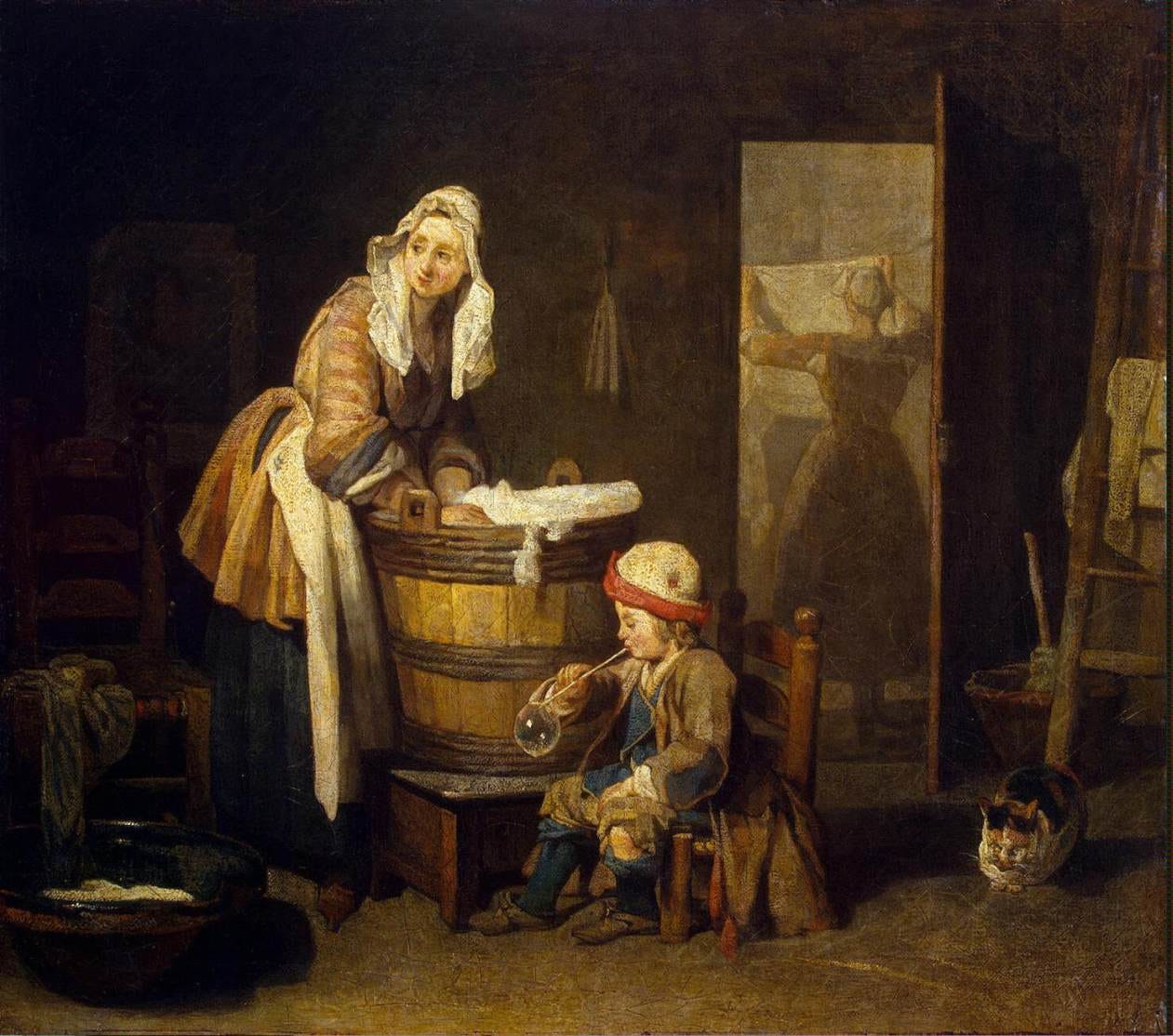
Fritz was not an immediately likeable character because he seemed to be everywhere and nowhere at once. For example, in the first chapter, we see his family hard at work on washing day. Laundry was not a minor household chore in the eighteenth and nineteenth centuries; it was an exhausting domestic ritual that often consumed an entire day, sometimes longer. Clothes and linens had to be hauled by hand, boiled in great vats of water, scrubbed with lye soap, wrung out, dried, ironed, and folded without the help of modern machines.
For many families, washing day structured the rhythm of the household itself. It was labor-intensive, communal, and overwhelmingly performed by women, whose work kept the family functioning and respectable.
In The Blue Flower, beginning the novel on washing day quietly grounds Fritz’s philosophical wandering in the physical reality maintained by the women around him. There is no evidence that he was not helping them (though there are plenty of passages that make clear how washing was primarily the responsibility of the women—his mother, Auguste, and his sister Sidonie, whom I will return to later in this post).
Fritz comes off as absent-minded and detached from reality. When I realized that I was judging him for that reason, I forced my train of thought to change. I, myself, am more often than not disconnected from reality. I will be doing my chores dutifully while pondering the life of an albatross or replaying in my memory a conversation that I believe could have ended better. Fritz, in this sense, is not so different from me; if I dislike Fritz, it means that I dislike this part of myself.
See what I did there? This is a novel full of philosophical puzzles, circles that never quite end, contradictions that—in their own strange way—make sense after the fact.
The Book Drew Me Back
Because Fitzgerald utilized the philosophical arcs so masterfully, once I had finished reading this novel the first time, I could not resist the impulse to return to the first chapter—to absent-minded Fritz on washing day—in order to piece together the hints she had dropped, the riddles I missed, and decide how I felt about each individual character.
Characters are most often the driving force of a good book for me. I can tolerate a subpar plot if the character is memorable, if they make mistakes I can sympathize with, if they mess up and try to rebuild their life (or even if they take more sinister paths in search of fulfillment, such as in the case of Sydney Carton in A Tale of Two Cities).
Fritz might have been the focus in The Blue Flower, but I did not find him to be the most interesting character at all. More memorable than Fritz is his six-year-old brother, the Berthold, who speaks without filter and spares no one’s feelings when he thinks it is time to be blunt. Of him, one of the characters later in the novel says: “Not all children behave childlike.”
When I read that line, I was reminded of my fascination this year with children in literature. Peter Pevensie defeating Maugrim is not a child behaving childlike in the “acceptable” sense. Mary Lennox, with her broken spirit tending the secret garden, takes more responsibility for her own self-improvement than most adults I know. And Hamnet in Hamnet makes a sacrifice that bewilders even death.
Not all children behave childlike. There is no fixed age for wisdom, or for being right. We do children a disservice when we convince ourselves they cannot understand the more complicated matters of life.

And this brings me to the idea that there is really no fixed age for love—all modern nuances aside—as The Blue Flower demonstrates when Fritz becomes an apprentice and falls for his master’s twelve-year-old daughter, Sophie.
As a love interest, aside from the fact that she is not even developed into a woman yet, I found Sophie to be a disappointment. I had the sense that Fritz was so caught in what Fitzgerald describes as “the kingdom of the mind” that he gave little thought to love and what it meant. He fell—or thought he fell—for Sophie, with her crude jokes and uncomplicated view of the world, and her ability to simplify what he constantly complicated.
By the end of the novel, I was unconvinced that he was ever in love with her in the sense that we understand love. She was there at a time when he was maturing into the age of love; in his intelligence, he was also too innocent to fully register her age. She paid attention to him, listened to his dense speeches, and perhaps gave him opportunities to laugh that he did not find with his family.

I sincerely do not believe he was in love with her.
However, he did care for her.
A Note from the Margins
I keep returning to the women in this book, even after I’ve finished it, as if the story is still quietly unfolding around them.
What follows is less summary and more of a personal reading of what stayed with me after the final page.
