


Visit The Library Index for more reviews!
The Tearoom Library, No. 044 — The Book Club for Troublesome Women
Author: Marie Bostwick
Genre: Historical Fiction / Women’s Fiction / Book Club Fiction
Rating: ★★★★★
Follow-Up Reading:
The Jane Austen Society by Natalie Jenner
(for literary friendship, healing through books, and quiet community)The Guernsey Literary and Potato Peel Pie Society by Mary Ann Shaffer
(for wit, warmth, and women finding courage through correspondence and reading)The Enchanted April by Elizabeth von Arnim
(for women quietly stepping outside their mundane lives in search of personal meaning)
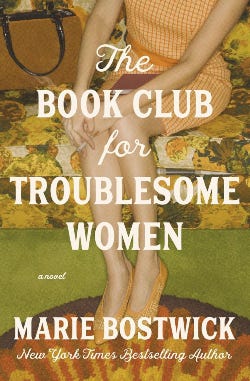
A Party of Four
History has seen many excellent novels which featured four female protagonists. Little Women is, doubtlessly, the first that comes to mind. Others include The Group, The Joy Luck Club, and The Enchanted April — stories in which friendship becomes its own kind of ecosystem, capable of sustaining, wounding, reshaping, and revealing the women within it.
To this list of stories with four corners—compasses of literature—I now add The Book Club for Troublesome Women. Marie Bostwick’s excellent novel follows four women in different phases of life, marriage, and happiness. Margaret, Charlotte, Bitsy, and Viv could hardly be more different, yet they begin to form a lifelong bond after creating a book club for women dissatisfied with the world as it was, beginning with The Feminine Mystique.
What follows is not merely a story about feminism or suburban frustration, though those elements are certainly present. It is, more deeply, a novel about the startling intimacy that occurs when women begin speaking honestly to one another.
The book club becomes less a literary gathering than a sanctuary: a place where disappointments can finally be named aloud, where private resentments stop masquerading as gratitude, and where each woman slowly discovers that her unhappiness is not an isolated personal failing, but part of something larger and deeply shared.
A Book that Sparked Controversy
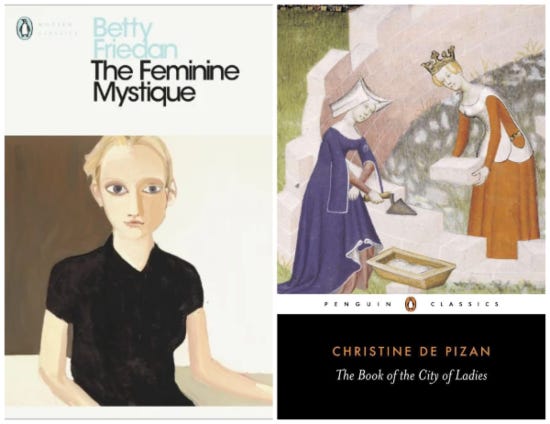
To understand why this book club’s bond matters, I found myself looking more closely at the first book they read: The Feminine Mystique. The women are so transformed by it that they begin calling themselves, as a group, “the Bettys.” I wanted to understand what this book was—and why it caused such a stir.
The Feminine Mystique, published in 1963, examined the quiet dissatisfaction experienced by many American women in the postwar suburban era. Betty Friedan described what she famously called “the problem that has no name”: the persistent sense of emptiness felt by women who had been taught that marriage, motherhood, and domestic perfection should be enough to complete a life.

Drawing from interviews, psychological studies, advertisements, women’s magazines, and her own observations, Friedan argued that society had narrowed women into domestic roles while discouraging intellectual ambition, meaningful work, and independent identity.
Rather than rejecting marriage or family life, the book questioned why women were expected to surrender all other aspirations to them. Friedan traced the cultural forces—education, media, consumerism, and psychology—that shaped this reduction of identity.
The book became foundational to second-wave feminism because it gave language to what many women had felt but not yet been able to name, opening wider conversations about education, work, autonomy, and expectation in twentieth-century America.
Literature Changing Society
The Feminine Mystique made me think instantly of another feminist-themed book that I have seen mentioned quite often this year—Christine de Pizan’s The Book of the City of Ladies.
I summarized the Book of Ladies in my review for Allegra Goodman’s novel, Isola, which you may read here. It makes me wonder how many such texts were written and forgotten over the centuries.
Will they come to light? I hope so; it will prove that there have always been women who longed to fulfill their potential, to achieve more. But what does it mean to want more?
In The Book Club for Troublesome Women, Margaret ponders this very question. After her husband, Walt, dismisses her work as a paid columnist as ‘a jobette,’ she is forced to face the fact that expectations in the sixties for women and their lives had not changed that much from the time of Christine de Pizan.
Women in the sixties were discouraged from working, attending university, or having any sort of responsibility that did not involve staying at home. Already in the forties women were beginning to notice the disparity in expectations.

In a flashback to her adolescence, Margaret remembers a heated exchange between her mother and father, who believed firmly in gender roles:
“Oh, for Pete’s sake. Are we back to this again? You take care of the house, the kids, and me. Don’t we matter? Maybe you’d like to go back to working ten-hour shifts with grease on your hands, me getting shot at, and leaving our kids to fend for themselves because you’re working late at the factory. Is that what you want? For the war to keep going just so you could feel like you do something?”
“Stop it. That’s not fair. Of course I don’t wish the war was still on. I just want—”
“What?” he shouted. “What can you possibly want that we don’t already have? What?”
There was a pause, then the sound of a sob, choked with confusion and shame.
“I don’t know. I don’t know. Just ... more.”
Margaret’s mother eventually ended her own life, as she was unable to find the more that she needed in order to find fulfillment. But by the sixties, women were becoming more aggressive.
The Bettys spend the entirety of this novel trying to name what exactly this elusive more is.
When More is Found
Earlier this year, I posted a review for the Tearoom Library on the book Camera Girl by Carl Sferrazza Anthony. It is a compelling portrait of the early life of Jacqueline Kennedy Onassis before she became First Lady. Like Margaret, Jackie Bouvier possessed a passion for writing and storytelling. She became renowned in Washington because she would stop ordinary people on the street, ask them questions, and feature their answers in her column.
Read my post about Camera Girl here:

I was delighted when Marie Bostwick made references to Jackie’s career as a writer. One of the most powerful moments in The Book Club for Troublesome Women occurs when Margaret is invited by a reporter to a gathering of accomplished women. Some are diplomats, others reporters, but Margaret is the only guest in the room who feels she is merely a housewife, distinctly out of place in such a prestigious crowd.
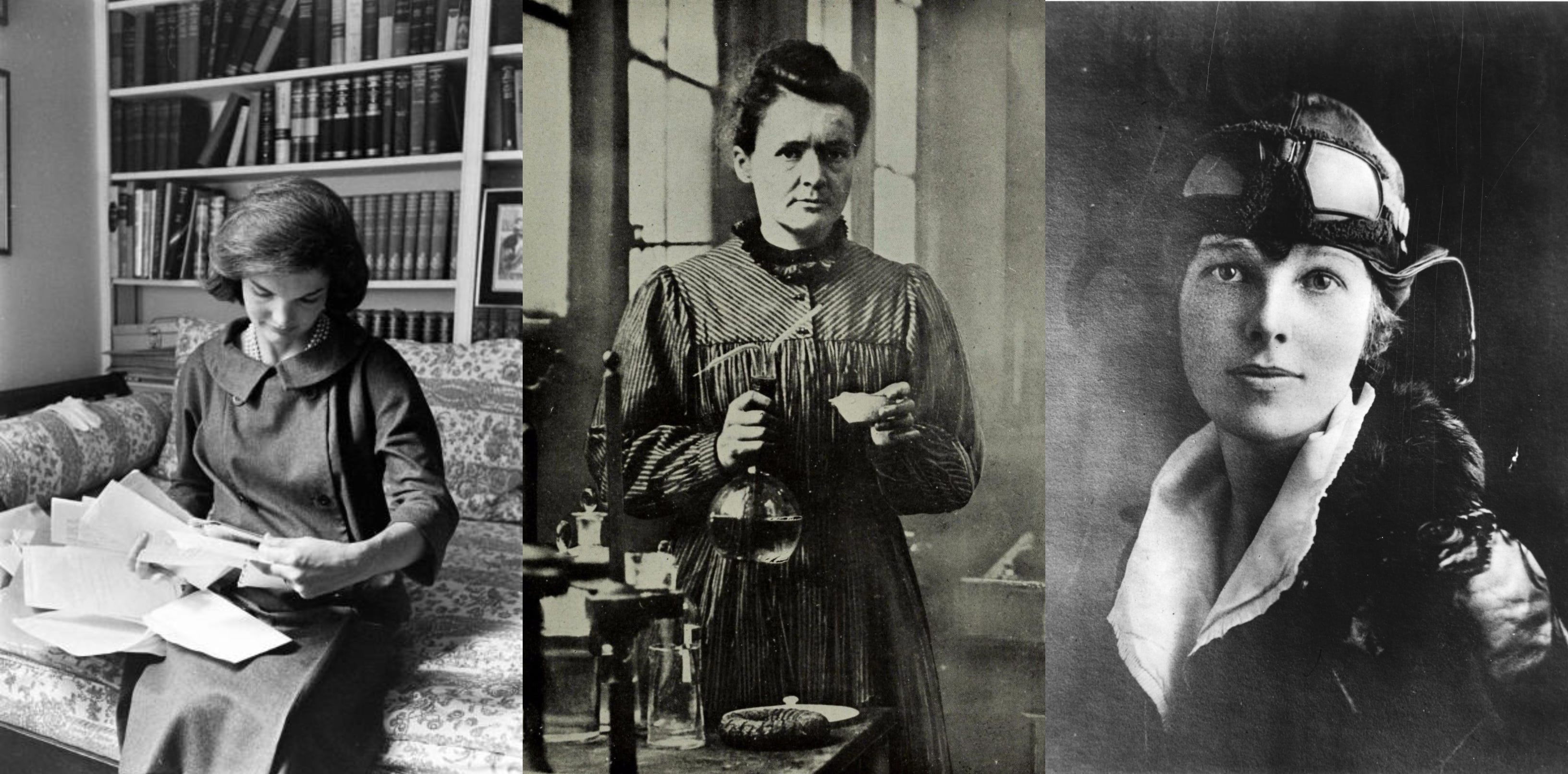
They are all waiting for the guest of honor to arrive and are dumbfounded when she does, accompanied by the Secret Service to keep her safe: the First Lady herself. Jackie Kennedy strolls into their meeting, lights a cigarette, and speaks cheerfully about her beginnings as a columnist.
I recalled from Camera Girl the behind-the-scenes details of Jackie’s work as a columnist: she very nearly was not hired because women at the time were considered unreliable choices.
What if she leaves to get married? was the common question in an interviewer’s mind whenever a young woman applied for work. Back then, it seemed inconceivable that a woman could sustain both a career and a family at the same time.
Margaret reflects upon her mother’s longing for more and settles, at last, upon a definition:
More meant alive, knowing that her existence made ripples felt by others, that she was doing something more than just sucking oxygen and taking up space, that she had something unique to offer.
Jackie Bouvier spent her adolescence and early adulthood searching for the same more for which Margaret’s mother pined. We know, now, that she eventually found it when she became First Lady and made ripples across the world.
What will it take for us to realize today that women may still aspire toward more—and that we are permitted to make ripples of our own?
A Note from the Margins
After finishing the novel, I spent some time reflecting in the margins about ambition, fulfillment, and the quiet fear of wanting too much.
