


The Tearoom Library, No. 053 — Whistler
Author: Ann Patchett
Genre: Literary Fiction
Rating: ★★★★
Follow-Up Reading:
Gilead — Marilynne Robinson
(for a similarly quiet and compassionate novel that finds profound meaning in ordinary lives)The Storied Life of A.J. Fikry — Gabrielle Zevin
(for readers who enjoy stories about the power of books, community, and human connection)The Dutch House — Ann Patchett
(for another beautifully observed family story shaped by memory, longing, and the lasting influence of a particular place)
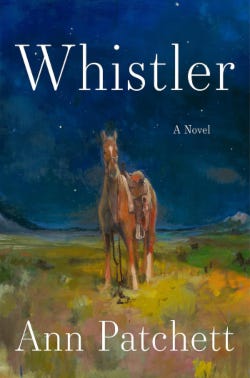
A Horse Beckons
Sometimes a book does not enter your reading life so much as it quietly insists on it. Whistler was one of those books.
I do not make a habit of reading what is new or following literary trends. A glance through my reading journal reveals an eclectic taste that wanders across centuries, genres, and occasionally languages. In the coming months, I even hope to read several novels in Spanish as a way of deepening my understanding of a second language.
Yet when Ann Patchett’s new novel Whistler began appearing on the Substacks of readers I trust, I found myself intrigued.
The cover alone captured my attention: a horse poised against a striking landscape, mysterious and strangely serene. Then I learned that the story begins in a museum. As someone who loves art as much as literature, I felt the familiar pull of curiosity.
Normally, I wait. I listen to other readers. I let the excitement surrounding a new release settle before deciding whether to enter the conversation myself.
This time was different.
I purchased a copy of Whistler on publication day, something I rarely do. For two days it sat untouched beside my chair while I admired the crisp jacket, preserved its fingerprint-free sheen, and enjoyed the faint scent of a newly printed book.
On the third day, I opened it.
The horse on the cover seemed to be beckoning me forward. I wanted to know where it was leading. What followed was a deeply emotional journey—a novel that explores the unpredictability of love, the complexity of human relationships, and the preciousness of time.
Whistler is, in many ways, a reminder that our lives are shaped not only by the choices we make but also by the people who unexpectedly enter our paths.
Here is my review.

The Man at the Museum
Daphne is the protagonist of Whistler, and the novel tells her story in two different phases of her life.
The first takes place in the present day, introducing her as a married woman in her fifties. She is visiting the Met with her husband, Jonathan. As they admire the museum’s medieval collection, Jonathan notices an older man nearby. He appears to be following them—but more specifically, watching Daphne.
The second phase takes us back to an incident that occurred when Daphne was nine years old, an event that left both emotional and physical scars. One winter evening, she and her stepfather, Eddie Triplett, drove up a hill near a raspberry farm to look at the stars. While they stood beneath the Milky Way, the car began rolling downhill. Suddenly stranded in the cold, they found themselves caught in an accident whose consequences would echo for decades.
The years between that accident and the scene at the Met are marked by both joys and sorrows. Shortly afterward, Daphne’s mother, Abigail, and Eddie divorced. As children often do when families fracture, Daphne convinced herself that she was somehow responsible for the separation. The trauma of her childhood eventually influenced her decision not to have children of her own.
By the time we meet her at the museum, she has not seen Eddie in decades. But the man following her through the galleries is Eddie.
Now elderly, hesitant, and burdened by memories of the past, he recognizes Daphne because she resembles her mother. The accident scarred him as deeply as it scarred her. Between them lies a conversation that has remained unfinished for decades. Standing in the shadow of the museum’s treasures, both realize that the time has finally come to have it.

“This is My Daughter”
Relationships can fail for many reasons. Whistler presents one of the situations in which a marriage falls apart. I will not spoil it here; what matters, in my mind, is the bond forged between Daphne and Eddie during the brief time they spent as a family—Eddie, Abigail, Daphne, and her sister Leda.
We are often presented with a picture-perfect image of what a family should look like, but books like this coax us to reconsider. Human beings are messy, and relationships are messy as well. Divorce, under any circumstances, can be devastating for the children involved, but love, if genuine, can outlive it. When a family is suddenly fractured—as suddenly as a car accident—wounds may emerge that, if left unaddressed, make it difficult to build a new life.
Eddie and Daphne shared enough experiences that they truly came to know one another as father and daughter. Trapped together in the car after it crashed down the hillside, they placed complete trust in each other. Eddie told stories to distract Daphne from the seriousness of their situation, including the story of a horse named Whistler, for whom the novel is named.
With no other resources available—this was before iPhones—they were forced to share a blanket to keep from freezing and even a “pee cup.” In truth, Daphne confided more in Eddie than she did in her biological father. This was why she struggled to assemble her own sense of family when Eddie vanished from the portrait.
It’s also why, when they were reunited decades later, Eddie introduced her to friends and acquaintances by saying, “This is my daughter.” Daphne is initially surprised. She spent most of her life without a father figure willing to claim her. Yet she soon realizes that Eddie is telling the truth.
In all the ways that matter, Eddie became Daphne’s father, and Daphne is his daughter. Their family is atypical and fragmented, but its roots are deep. Their bond overcame prejudice and survived years stolen from them.
Indeed, their bond is so strong that there’s no one else Eddie would rather die beside.

A Note from the Margins
The story ends here, but the conversation continues. Paid subscribers can join me in the margins for a more personal reflection on Whistler, reading, and the lives we hope our stories might outlast.
