


The Tearoom Library, No. 056 — Mona Lisa: A Life Discovered
Author: Dianne Hales
Genre: Biography / Art History / Cultural Nonfiction
Rating: ★★★★★
Follow-Up Reading:
Leonardo by Serge Bramly (for a more complete portrait of the Mona Lisa’s creator, where art, anatomy, and ambition blur into one restless intelligence) Read my review here!
The Private Life of the Mona Lisa by Roger Highfield (for a quieter, investigative lens into the painting’s material life and cultural afterlives)
Vanished Smile: The Mysterious Theft of the Mona Lisa by R.A. Scotti (for the theft that briefly turned a painting into a global absence, and made its image more famous in its missing than its presence)
The Loveliest Woman Never Known
We have all seen the Mona Lisa. Even if a person has never set foot in an art gallery, let alone Paris—even if they know very little of Leonardo da Vinci—his enigmatic La Gioconda is one of those images so deeply embedded in our visual culture that it no longer belongs to a single museum, or even a single nation. It belongs, in some diffuse and unclaimed way, to all of us.
La Gioconda has had an adventurous existence, even without her consent. She has traveled from Florence to Paris with her revered creator, and once hung—so legend tells—on the bathroom wall of a French king. She was stolen from the Louvre in a notorious heist that transformed her absence into global spectacle.
She was eventually returned to the museum, but her journeys did not end there. La Gioconda might well have had a passport of her own: she has crossed oceans, first to America at the request of First Lady Jackie Kennedy—who else could have written an invitation to such an improbable guest? She has also visited Russia and Japan, carried not as a painting but as an event.
The Mona Lisa does not travel overseas anymore, but that does not mean she has ceased to move through the world. Every day at the Louvre, she remains the most visited painting in existence, receiving thousands who stand in claustrophobic lines for a few suspended seconds in the light of her unreadable smile.
While we have all seen the beaming face of da Vinci’s painting, Mona Lisa’s identity has remained a mystery ever since she was completed. Who was the woman who sat, eyes sparkling, while the master mixed those colors like an alchemist?
Some might scoff and say that the model doesn’t matter, as the painting itself is an object apart. In a sense, this might be true. But I’m stubborn—if there was a woman da Vinci esteemed enough to render immortal, I would like to know who she is.
I’m not alone in this; journalist Dianne Hales had the same curiosity, and she used her investigative skills to traipse across Florence, visiting places that this woman might have known, trying to piece together a profile.

The Many Theories
Because so little is definitively known about the sitter, the Mona Lisa has accumulated theories the way still water gathers reflections.
Over the centuries, scholars and enthusiasts have proposed a long list of possible identities: a Florentine merchant’s wife, a noblewoman from the Medici orbit, even a self-portrait in disguise. Each theory is presented with varying degrees of confidence, yet none quite settles the question.
Part of what makes the painting so enduring is this refusal to resolve itself into certainty. The more we try to anchor her to a single biography, the more she seems to slip sideways into possibility, as though she were less a fixed identity than a space where interpretation keeps happening.
Most experts, however, now agree that the sitter was likely a woman named Lisa Gherardini. She lived in Florence, close enough to Leonardo da Vinci’s own life that their paths may well have crossed. Her husband, a wealthy silk merchant, is believed to have commissioned the portrait.
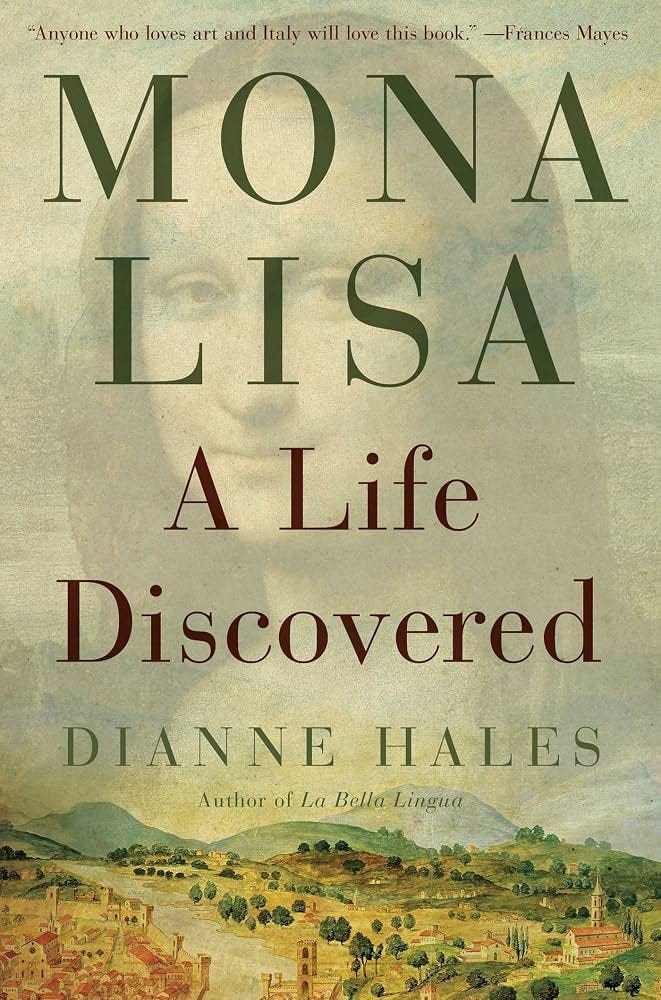
On the surface, the outline is simple. But in Mona Lisa: A Life Discovered, Dianne Hales resists leaving it there. She turns instead toward reconstruction—toward fragments, context, and inheritance.
Hales traces Lisa Gherardini’s family backward through Florence, assembling what can be recovered of their world: a lineage marked by resilience, political entanglement, and women who were not merely background figures but active participants in the life of their time.
What emerges is not a single definitive biography, but a kind of pressure building behind the portrait—a sense that the woman Leonardo painted was not isolated, but formed from a dense fabric of history, conflict, and continuity.
Seen this way, the Mona Lisa is not emptied of mystery. If anything, the mystery deepens. The smile no longer feels like an enigma without context, but like something held in reserve—an expression shaped by a life we can only partially recover, yet still somehow feel pressing against the surface of the paint.

Art Lives in Books
Hales’ quest to know why this woman was painted, and what about the work makes it so special, stirs up the spirit of the painter himself — Leonardo da Vinci, who today is known for his paintings, but had a brilliant mind that turned other ways, such as physics and the design of weapons.
Today, the Mona Lisa lives in Paris, rather than Lisa’s native Florence. She is an icon of the world, not just one nation, and is still honored—and parodied—in different works of art and different media. She has become a brilliant idea that all can contemplate, many replicate, but no one can claim to own. Her radiant smile is, to me, the face of art: universal, piercing, all-knowing, and impossible to trap in a frame.
This year, I have written about powerful icons such as Jacqueline Bouvier and Marilyn Monroe. Both possess images and identities that have outlived them and remain culturally resonant today. To this list, I feel comfortable adding Lisa Gherardini—La Gioconda—the woman immortalized by a man of genius. Even if parts of her story remain blurred by time, the fact remains that we have all seen her. We all know her face. Her image is as recognizable as that of the First Lady or Marilyn Monroe herself.
Literature and art are connected in that they both tell stories. Mysteries in paintings have long attracted writers, who are often tempted to step into the silences history leaves behind. Susan Vreeland and Tracy Chevalier both explored the world of Vermeer in their novels, using his paintings as a doorway into imagined lives. In Girl with a Pearl Earring, Chevalier gives a name and a voice to the model’s serene face: Griet. Yet even when a name survives, a life remains elusive. The distance between a portrait and a person is often where both history and fiction begin.
The same tension exists in the story of the Mona Lisa. Knowing that the sitter was likely Lisa Gherardini answers one question, but it raises another: what did Leonardo da Vinci see when he looked at her?
To understand the Mona Lisa only through the question of her identity is to miss the other half of the equation: the mind that made her.

The Artist
Leonardo da Vinci was not only a painter but a restless observer of everything he could see—an artist, engineer, anatomist, and inventor whose curiosity rarely stayed within a single discipline for long. Born in 1452 in the Tuscan town of Vinci, he came to Florence as a young apprentice and eventually moved through the courts of Italy, working for patrons who often valued his imagination as much as his skill.
Unlike many of his contemporaries, Leonardo treated painting less as decoration and more as inquiry. He dissected bodies to understand musculature, studied water in motion, observed light as if it were a language he was trying to learn. This way of seeing—analytical, patient, almost scientific—shaped everything he created, including the Mona Lisa.
When he began the portrait of Lisa Gherardini, he was already deep into this habit of looking beyond surfaces. The painting reflects that approach: not a fixed expression or a clear psychological declaration, but something softened, layered, and deliberately unresolved.
In Leonardo’s hands, a portrait becomes less about capturing a person as they are and more about studying what a person can be when held in sustained attention.

A Note from the Margins
For all of Leonardo’s curiosity about how a face holds meaning, there is still a difference between reading about an image and standing in front of it.
What follows is not an explanation of the Mona Lisa, but a memory of encountering her—one that belongs less to art history than to a specific room in Paris, to a crowd held in quiet compression, and to the strange feeling of distance collapsing into something immediate.
This section is for paid subscribers.
