


The Tearoom Library, No. 067 — A Founding Mother
By: Stephanie Dray & Laura Kamoie
Genre: Literary Fiction, Historical Fiction
Rating: ★★★★★
Recommended Reading:
Dear George, Dear Mary by Mary Calvi (for a richly imagined novel portraying George Washington’s first romance and the woman who almost became the nation’s First Lady). Read my review!
My Dear Hamilton by Stephanie Dray & Laura Kamoie (for the unforgettable story of Eliza Schuyler Hamilton through revolution, heartbreak, and the lifelong work of preserving Alexander Hamilton’s legacy).
Ladies of Liberty by Cokie Roberts (for a fascinating nonfiction exploration of the extraordinary women who helped shape the early American republic alongside the Founding Fathers).
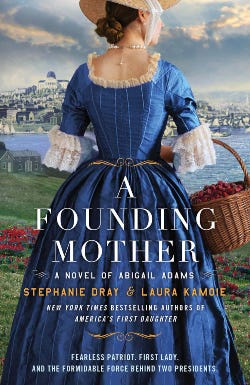
A Founding Family
America recently celebrated the 250th anniversary of the Declaration of Independence. It is a remarkable milestone for a nation that has already made history in so many ways. The anniversary has no doubt inspired many people to look back at the Revolution, searching for the little-known stories and remarkable individuals who helped shape the nation.
I had already begun that journey last year by starting a lifelong project: reading biographies of every U.S. president and first lady in chronological order. I’m currently making my way through a book about Andrew Jackson, but much of last summer was devoted to John Adams and the extraordinary family that surrounded him.
John Adams’s intelligence, integrity, and unwavering commitment to independence helped shape the early republic. Yet his legacy is inseparable from that of his wife, Abigail, whose intellect, political insight, and remarkable correspondence have ensured that she is remembered as far more than simply the wife of a president.
One of my favorite biographies from last year was Abigail Adams by Woody Holton. It painted the portrait of a woman with a fierce sense of purpose and an unshakable belief in the ideals of the Revolution. As the wife of the nation’s second president and the mother of its sixth, Abigail stood at the center of America’s founding story. It felt only fitting that Stephanie Dray and Laura Kamoie would bring her life to readers through a sweeping work of literary historical fiction.

The Beauty of Historical Fiction
By its very nature, historical fiction blends documented history with imaginative storytelling. Conversations are reconstructed, quiet moments are imagined, and emotional truths are explored where the historical record falls silent. A Founding Mother embraces this balance beautifully, and Stephanie Dray and Laura Kamoie are refreshingly transparent about the creative liberties they took, explaining their choices in a thoughtful Author’s Note.
Although the novel includes fictionalized scenes, it never feels careless with history. Dray and Kamoie immersed themselves in letters, diaries, biographies, and other primary sources, creating a world that feels deeply authentic. Even the imagined moments seem entirely plausible because they are built upon a solid historical foundation. Mary Calvi achieved something similar in Dear George, Dear Mary—a novel I also highly recommend. While it dramatizes George Washington’s first romance, its meticulous research allows the fictional elements to fit naturally within the known historical record.
That, to me, is the greatest strength of historical fiction. Rather than rewriting history, it respectfully fills the spaces between established facts, giving readers an emotional connection to people who might otherwise remain distant names in textbooks. When done well, it deepens our appreciation of the past without compromising its integrity. A Founding Mother accomplishes exactly that, making it an especially fitting novel to read during the celebration of America’s 250th anniversary.

Mothers and Fathers Alike
Founding is such a powerful word. It evokes beginnings, courage, and the uncertain work of building something that has never existed before. The generation that declared independence had no guarantee that the United States would survive beyond a few decades. Even the new capital was little more than a muddy experiment. In A Founding Mother, Abigail describes Washington as an “embryo” of a city when compared to established places like Philadelphia and Baltimore. Yet despite the uncertainty, the founders never abandoned their vision of an independent republic.
The Founding Fathers are rightly remembered for that achievement. Fortunately, recent years have also seen a growing appreciation for the Founding Mothers—women whose intelligence, resilience, and political insight helped sustain the Revolution and the fragile nation that followed. Abigail Adams stands among the foremost of them. She famously urged her husband to “remember the ladies” when creating the new government, a sentence that has echoed through American history ever since.
John Adams famously dismissed the suggestion with humor, much to Abigail’s frustration. For him, it may not have seemed an urgent matter, but Abigail never stopped remembering the ladies. Largely self-educated through her father’s library, she developed an intellect and confidence that set her apart from many women of her era. She regularly read and critiqued John’s letters and political writings, evidence of the deep respect he held for her judgment even when they disagreed.
Equally remarkable was Abigail’s financial independence. While devoted to her family, she refused to be merely dependent upon her husband’s income. Through careful management, prudent investments, and wise stewardship of the family’s resources, she accumulated a substantial estate of her own. Rather than leaving it solely to the next generation, she directed much of her wealth toward the women in her family, quietly advancing the independence she believed they deserved.

Pin Money
One of the novel’s most memorable threads is Abigail’s talent for business. While John serves abroad in France, she looks for opportunities wherever she can find them. The authors portray her gathering scarce pins—small necessities that had become valuable during wartime—and selling them for a profit. She also asks John to send fashionable French goods such as lace, shoes, gloves, and fine handkerchiefs, knowing they would command high prices back home. Not every shipment survived the hazards of wartime travel, but enough did to demonstrate Abigail’s remarkable commercial instincts.
The novel never presents these efforts as greed. Instead, they reflect Abigail’s determination to provide stability for her family in an unpredictable world. She understood that financial security offered a measure of freedom, particularly for women whose futures often depended entirely upon the fortunes of their husbands.
Despite her political interests, Abigail never viewed public life as separate from domestic life. She devoted herself to the education, health, and happiness of her children, believing that raising thoughtful citizens was itself a patriotic act. She took particular pride in educating her daughter Nabby, ensuring she could engage in conversations that many believed belonged only to men. Abigail recognized the inequalities surrounding her, yet she refused to let them dictate the ambitions she held for her children or for women more broadly.
She would not live to see the opportunities that later generations of women would claim, but she helped prepare the ground for them. In that sense, Abigail Adams was not simply a witness to America’s founding—she was one of its architects, planting seeds whose harvest would come long after her lifetime. That quiet confidence in the future may be one of the most enduring forms of hope on which the republic was built.

A Note from the Margins
It was fascinating to read A Founding Mother so soon after Dear George, Dear Mary, watching two different authors breathe life into many of the same historical figures. George Washington and Thomas Jefferson appear here in ways that feel faithful to their familiar historical portraits, yet each novel emphasizes different aspects of their personalities. I especially appreciated the treatment of Martha Washington in A Founding Mother. While Mary Calvi keeps her somewhat in the background, Stephanie Dray and Laura Kamoie allow Martha greater depth, portraying her as a woman who may not have loved war but who understood—and firmly supported—her husband’s cause. Her conversations with Abigail Adams are among the novel’s quiet pleasures.
What lingered with me most, however, was Abigail herself. The nation John Adams helped build had laws and institutions, but Abigail helped shape something less tangible: its moral imagination. Her famous plea to “remember the ladies” was not fully answered in her own lifetime, yet neither was it forgotten. More than two centuries later, those words continue to spark conversations about equality, education, and citizenship. Even her practical “pin money” becomes symbolic of something larger—a woman creating security, independence, and opportunity in a world that offered her very little of any of those things.
The American Revolution was never won by soldiers alone. It also depended upon women and men who endured years of uncertainty, managed households, raised families, wrote letters, preserved hope, and quietly invested themselves in a future they might never live to enjoy. That slower form of sacrifice rarely occupies the center of history books, yet it is no less heroic. A Founding Mother is a beautiful reminder that nations are sustained not only by those who fight for them, but also by those who patiently build them.

A House Without Its Husband
When John Adams was sent to France as a diplomat during the Revolutionary War, Abigail Adams found herself carrying a burden that was both ordinary and extraordinary. He would cross the Atlantic twice—in 1778 and again in 1779. The second journey was especially significant, as he brought their eldest son, John Quincy Adams, believing that exposure to diplomacy and public life would help shape the boy’s future.
For Abigail, however, these journeys meant separation.
She was left not only to manage the household but also the affairs of their farm, a responsibility that stretched beyond her usual knowledge and experience. She hired assistance where she needed it, learning to navigate unfamiliar challenges while ensuring that everything continued to function in her husband’s absence.
The home itself she could manage. Abigail had always possessed a practical intelligence and a remarkable ability to organize, make decisions, and take responsibility when circumstances demanded it. Yet there was a difference between running a household and carrying the emotional weight of doing so alone.
The distance between Massachusetts and France felt endless.
Abigail depended upon her husband’s letters for reassurance, but they did not arrive as often as she hoped. The delays were partly a matter of caution, as letters traveling across the ocean during wartime risked being intercepted. Still, knowing the reason did little to quiet her worries.
When John Quincy accompanied his father abroad on his second journey, Abigail experienced another painful separation—the absence of her eldest child. She understood the opportunities such an experience could provide and wanted the best for her son, but that did not make the distance easier to bear.
Her letters reveal the private side of the Revolution: not only the political decisions and military struggles, but the lives of the families left behind. While history often remembers John Adams as a diplomat and founding father, Abigail’s letters remind us that his work required sacrifices from those closest to him as well.
Eventually, the separation would come to an end. Abigail crossed the Atlantic herself and joined John in France, beginning a new chapter of their marriage abroad. The journey brought its own challenges, but it also allowed the couple to share in the experiences that had previously existed only through letters—life in a foreign country, diplomatic circles, and the uncertain future of the new American nation.
The Revolution was being fought across oceans and battlefields, but it was also being lived quietly in homes like the Adams household—through unanswered letters, long periods of waiting, and the daily courage required to carry on.
Conclusion
A Founding Mother is historical fiction at its finest: meticulously researched, emotionally resonant, and deeply respectful of the people whose lives inspired it. Stephanie Dray and Laura Kamoie transform Abigail Adams from a familiar historical name into a vivid, complex woman whose intelligence, wit, and perseverance leave a lasting impression.
For readers who enjoy literary historical fiction—or who simply want to know the people behind America’s founding rather than the monuments they became—this novel is an easy five-star recommendation. It celebrates not only one remarkable woman, but also the countless quiet acts of courage that helped shape a nation. In this anniversary year, there could hardly be a more fitting story to read.
Martha Washington, the First Founding Mother

We observe history from valuable angles by focusing on ladies who lived through it. Where did they stand during crucial events? How did changes affect them?
I really enjoyed this post. Have you seen the TV series, John Adams? It is very good. Laura Linney plays Abigail Adams in it and is excellent.