


The Tearoom Library, No. 069 — Taipei Story
Author: R.F. Kuang
Release Date: September 8, 2026
Recommended Reading:
Babel by R.F. Kuang — A powerful novel about language, translation, and cultural identity, Babel explores how words can both connect and divide people while asking who has the right to tell another culture's story.
Whale Fall by Elizabeth O’Connor — Like Taipei Story, this novel examines the importance of preserving local stories and traditions, showing how outsiders can misunderstand—or deliberately reshape—the histories of the communities they study. Read my review here.
Reading Lolita in Tehran by Azar Nafisi — This memoir celebrates the transformative power of literature while demonstrating how books can help us preserve identity, culture, and personal freedom in the face of political and social upheaval.
The Stories We Inherit
Each human being is a world of their own. We are shaped by the memories we share, the places we visit, and the novels we love most. We are also marked by our ancestry, the origins from which we came, and the history that makes each country unique. I am one such person: my mother is from Peru, and she taught me to speak Spanish when I was very young. I have been to Peru many times to visit family and experience some of the country’s most important landmarks.
I enjoy learning not only about American history, but also about the stories from Peru that my mother has shared with me. I have tried celebrated Peruvian dishes, visited Machu Picchu, and seen the Nazca Lines from above in a plane. We learn so much about ourselves when we pursue knowledge of our second countries. It is an incredibly fulfilling journey to embark on.
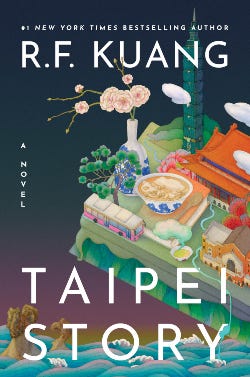
It is so important to be curious about our origins, even if we never learn everything there is to know. The quest for self-knowledge can lead us to other countries and continents. This is the premise of Taipei Story: college student Lily Chen travels to Taiwan to improve her Chinese. During this trip, she learns far more than a different language; immersion in a new culture reveals things she never knew about herself.

Lily Chen’s Quest to Learn Chinese
Learning a language is rarely as simple as studying grammar books. To truly understand a different tongue, it helps to be immersed in it.
Lily quickly discovers that such immersion is not easy. In fact, it is deeply uncomfortable, as she develops headaches trying to do something as basic as reading street signs. Soon, the strain of the challenge begins fraying Lily’s nerves—and those of her roommate, Anna, who is also trying to learn the language.
A misunderstanding involving JC, Lily and Anna’s mutual crush, causes their friendship to unravel. For weeks, Anna cannot bear to be in the same room as Lily. Then Lily’s grandfather dies suddenly, sending her spiraling into the confusing terrain of grief.
Alone in a foreign country, she struggles to make sense of a life that suddenly has a gaping hole. Although she was never especially close to her grandfather because he lived in China, she is left with a painful sense of lost opportunity. She had been learning Chinese partly to communicate with him better, subconsciously using the language as an excuse to postpone difficult conversations. Once he dies, it is too late, regardless of how well she can speak the language.
There are questions she will never be able to ask him—in any language.

Accepting That We Can’t Know It All
We are all racing against time. Each of us has something we are postponing: confessions, questions, dreams worth pursuing. We tell ourselves to wait—until a certain birthday, until we receive a sign, until circumstances beyond our control improve.
Some things cannot be delayed forever. Yet we wait all the same, paralyzed by fear of taking the next step. Lily is not in control of Anna’s anger toward her, nor is she in control of life and death. What she can control is how she responds to those challenges.
She cannot control what the signs on the street look like, but she can commit herself to studying the language so that one day she can read them with greater ease. She cannot control the tensions at home, where her family has long lived in conflict, but she can choose to make different decisions for herself.
When traveling to learn about a culture—even one that is supposedly “our own”—it is important to accept that we will never know it completely. College courses can teach us language, history, and politics, but some knowledge can only be gained through experience. Textbooks cannot replace what we learn by walking unfamiliar streets, tasting local food, and experiencing the climate, customs, and rhythms of a place.
Lily is constantly discouraged because she does not understand Chinese with the same ease as someone who grew up surrounded by it. She fears that she has failed to honor her roots, disappointed her grandparents, and wasted her trip to Taiwan because she has fallen short of the standards she set for herself.
Yet in the final chapters, we learn that many schools in Taiwan exist for people hoping to learn English. A Chinese student attending one of those schools would face many of the same challenges—only from the opposite perspective. The realization is quietly reassuring: no one begins as an expert, and every language learner must first endure the discomfort of not knowing.

On Cultures & Preserving Local Stories
Different countries may speak different tongues, but certain experiences and emotions are universal to humanity. We all experience stress, growing pains, heartbreak, and the pain of fractured friendships. While customs surrounding death may differ across cultures, the reality of grief is universal.
Whale Fall also explored the concept of language barriers. Manod is the only English speaker on her island who can translate for the researchers, but they do not have honest intentions. Instead, they distort her stories to fit their own narrative. Lily, by contrast, immerses herself in Taiwan’s language and customs, only to discover that complete mastery is impossible. The researchers in Whale Fall fill in the blanks with “facts” that suit them. Lily is so determined to get everything exactly right that she loses sight of why she began this journey in the first place. She is not failing at being Chinese; her expectations for how much she could learn in a matter of weeks are simply unrealistic.
Though culture and language can seem impenetrable, we are not as different as we sometimes believe. We all feel love, fear, and grief. We are all searching for meaning and, perhaps, for a happy ending. None of us can skip the awkward process of learning. We must study words and dates until we memorize them, but memorization alone is never enough. We must strive to understand, and that takes much longer.
Taipei Story is a novel about understanding both the world and oneself. It is about patience as we navigate places that are both familiar and unfamiliar. It is about the messy process of grief, the limits of what we can know, and the courage to keep learning anyway. Above all, it reminds us to extend kindness to ourselves in the face of imperfection.

A Note from the Margins
Taipei Story and Whale Fall ask similar questions about backstory and how it should be protected. There is great joy in sharing our lives, our worlds, and our customs with other people. We should be proud of where we came from, of the traditions that shaped our families, and of the stories that make us unique.
Learning about one’s heritage is more accessible than ever. We do not need to take on language courses as demanding as Lily’s; today, we can begin with a simple online search. Countless books also exist for those who wish to dive deeper. It is a personal project that can bring a profound sense of fulfillment.
We must know our own stories because there are people who will take them and twist them to serve their own purposes. They will misrepresent our cultures, and when that happens, it is important to be able to push back against them. Stories are, and have always been, sacred. Few are more important than the stories written into our very being.
If you’ve never stopped to think about your ancestry or your parents’ cultures, there is still time. Perhaps you are not racing against the clock to communicate with an elderly grandparent; even so, you can begin learning for your own sake. You have so much of your own story waiting to be discovered. What a marvelous journey that will be.

Conclusion
The greatest journeys are not always measured in miles, but in understanding. Taipei Story reminds us that learning a language is also an invitation to learn ourselves—to embrace the uncertainty of grief, the imperfections of growth, and the quiet beauty of discovering where we come from. We may never know everything about our heritage, our families, or even ourselves, but the willingness to keep asking questions is what matters most. Every story has a beginning, and perhaps the journey of understanding our own is one that never truly ends.

Thank you for this review, Mariella. Not only does it make me want to read TaiPei Story, but I am itching to scribble in margins and visit faraway places to find connections with ancestors.