

The Tearoom Library, No. 061 — Siren Says
On healing, grief, and how fantasy sometimes tells truth more clearly than reality

Tearoom Library No. 061 — Siren Says
Author: Jennifer Michelle Herrera
Genre: Fantasy / Romance
Rating: ★★★★★
Follow-Up Reading:
The Witches of New York by Ami McKay (for a similarly magical family living in New York)
Uprooted by Naomi Novik (for a story about the healing, mystical power of nature)
Whale Fall by Elizabeth O’Connor (for another story that deals with mythology and healing)
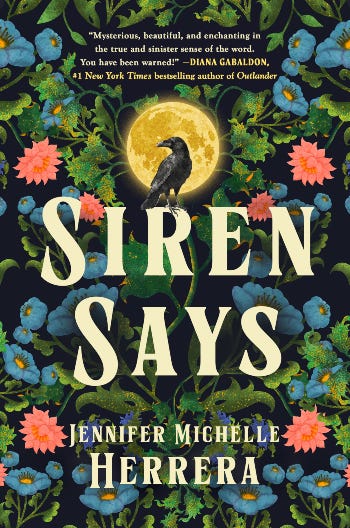
What the Book Appears to Be Versus What It Actually Is
When author Jennifer Herrera reached out and asked if I would review her novel, I suspected I would enjoy it. I have always been drawn to fantasy stories filled with witches, folklore, and hidden magic. Longtime subscribers to The Tearoom may remember my own fantasy serial, The Graveyard House, which featured a wizard and his family. (You can still read it here.)
It was a delight to read Siren Says. The novel publishes in August; I know that it is going to be met positively. On Monday, I will publish an exclusive Tearoom Table interview with author Jennifer Michelle Herrera. Meanwhile, here are my thoughts about the book.
Family—even for those of us without enchanted powers—remains one of life’s great refuges. It does not always arrive through blood. Often, the families we choose become the ones who sustain us most. Either way, there is comfort in having someone willing to carry part of our burdens when life grows difficult. Some of the most memorable books I have read this year have explored that truth.
On the surface, Siren Says appears to be a novel about magic. Raven possesses an unusual connection to plants, and a mysterious scar left behind by her mother’s magical death draws her toward a hidden world of folklore, secrets, and power. That premise alone would make for a compelling fantasy.
Yet as I read, it became clear that magic is not the novel’s true subject.
At its heart, Siren Says is a story about love.
Not only romantic love, though there is certainly romance here, but the enduring love between parents and children, sisters and friends, and the people who become family through loyalty rather than blood. The magic gives the story its shape, but these relationships give it its soul.

The Heart of the Story: Grief and Healing
Grief is a wound that all of us must face sooner or later. It is easy to say that time heals, but healing does not mean erasing. Those who have lost someone they love know that the scar remains, even after the sharpest pain has faded.
In Raven’s case, that truth becomes literal. After her mother dies a strange magical death, Raven is left with a scar that is not only painful but dangerous. While most of us carry our grief beneath the surface, hidden behind carefully practiced smiles, Raven’s wound is visible—a constant reminder of loss that refuses to disappear simply because time has passed.
The scar ties her to the moment she watched her mother die, making it difficult for her to move forward into adulthood. It becomes a physical manifestation of grief itself: a burden she cannot ignore and cannot escape.
Early in the novel, Raven visits a group of psychics and asks a question that stayed with me long after I closed the book: How do I heal the wound my mother gave me?
It is the sort of question many grieving people ask in one form or another. How do we continue after loss? How do we carry what has happened without allowing it to define us?
The psychics cannot offer Raven an easy answer. For years, she lives without the closure she seeks. Even when she finally learns the truth behind the scar, the knowledge brings little immediate comfort. The wound does not simply disappear.
Neither does grief.
What Siren Says understands so well is that healing is not the same thing as forgetting. Raven’s journey suggests that peace is found not through avoidance, but through acceptance, understanding, and growth. The scar remains, but it no longer has to control her life.

Romance That Supports Rather Than Dominates
Siren Says does not only explore grief. It is also a fantasy romance, but unlike many recent bestsellers in the genre, the romance serves a deeper purpose. It is not included merely to create tension or satisfy expectations. Instead, it becomes part of Raven’s journey toward healing.
For much of her life, Raven has refused to let herself fall in love because of the scar on her back. She fears revealing this mark to anyone else. She fears rejection. Most of all, she fears suffering another loss.
When Idris enters her life, their relationship begins with mistrust. Yet as Raven learns that they share more in common than she first realized, she finds her carefully guarded heart becoming increasingly difficult to control.
What makes this romance compelling is that Raven does not discover her worth through Idris. He does not save her, nor does he complete her. Instead, he offers something equally valuable: understanding. He sees her imperfections, her grief, and her unusual family history, and he does not turn away. Because he carries burdens of his own, he is able to meet her with empathy rather than judgment.
Together, they create a relationship built on mutual support. When life becomes difficult, they lean on one another without losing themselves in the process.
It is not romance that heals Raven. Rather, Idris helps create an environment in which she feels safe enough to be vulnerable. In that sense, the love story becomes more than a subplot—it becomes another step in her healing journey.
Many readers will recognize this experience. When we are grieving, it is easy to believe that no one wants to witness our pain. We learn to hide our wounds because we fear they will make others uncomfortable. There is something profoundly liberating, then, about finding a person—whether a friend or a romantic partner—who allows us to lower our guard without fear of rejection.
This is one of the reasons fantasy can be such a powerful genre. Siren Says takes an experience as universal as grief and transforms it into something visible, magical, and tangible. Raven’s struggles may be wrapped in enchantment, but the emotions beneath them are deeply real.
Fantasy gives shape to experiences that are often difficult to explain. Only in fantasy can grief become a scar, a curse, or even a monster that must be faced. By giving pain a form, stories like Siren Says help us better understand our own.
Just because something does not exist in ordinary life does not mean it isn’t true.
Siren Says succeeds because it understands that magic alone is never enough. The spells, folklore, and mysteries make the story enjoyable, but it is Raven’s emotional journey that gives the novel its lasting power.
Readers looking for a fantasy romance will find one here. Readers looking for a thoughtful exploration of grief, healing, and the courage required to love after loss may find something even more valuable.

A Note from the Margins
One of the things I have noticed this year is how often the books that stay with me are not the ones with the most dramatic plots. They are the ones that tell the truth.
Not factual truth, necessarily. Emotional truth.
I have never carried a magical scar across my back. I have never consulted psychics or discovered hidden powers. Yet Raven’s question—How do I heal the wound my mother gave me?—felt instantly recognizable.
What follows is for members of the Tearoom Circle.
